
A gesture of care with strategic resonance
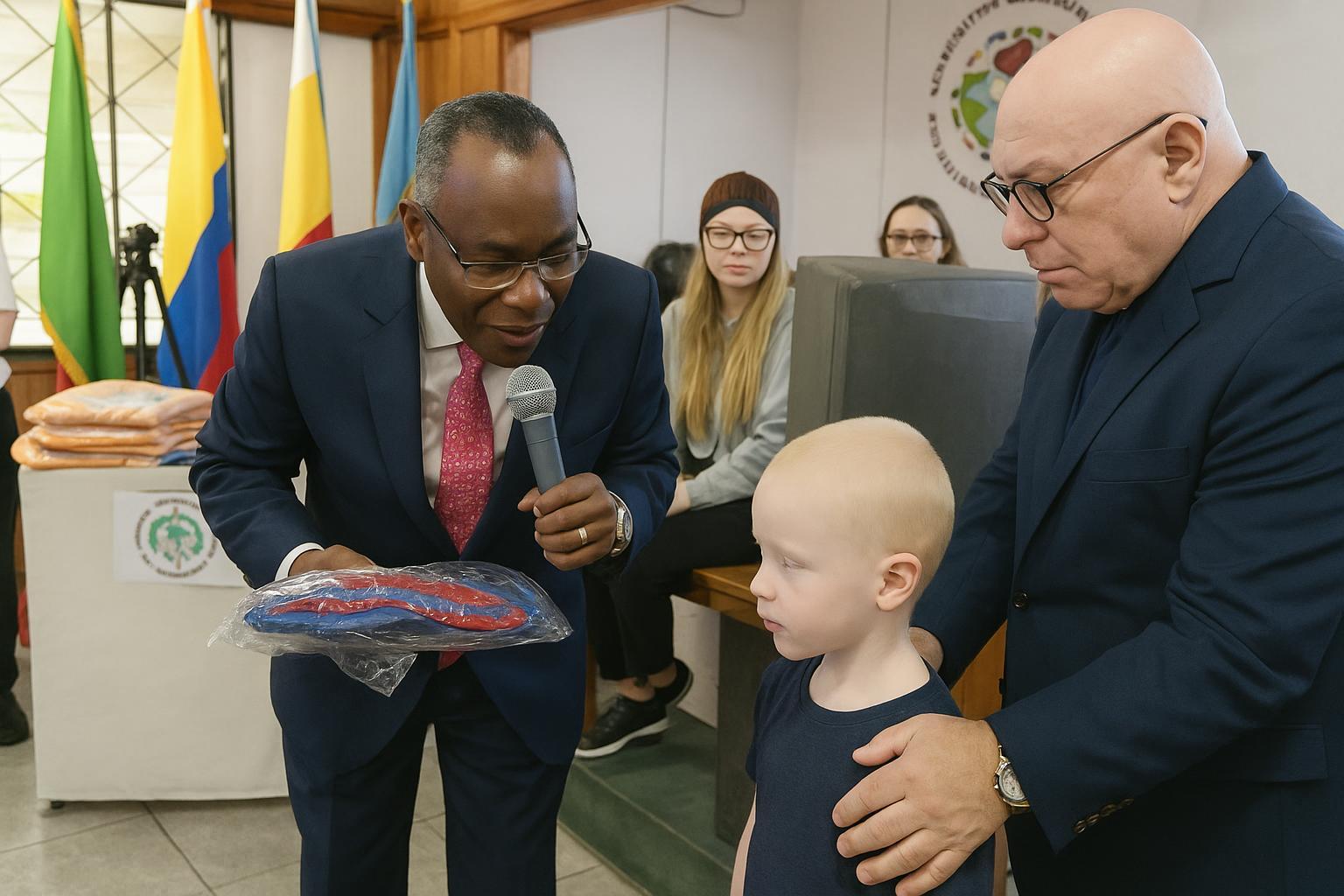
The courtyard of a modest primary school in the heart of Brazzaville briefly turned into a stage for civic generosity on 11 October. Amid applause, volunteers from the Jhony-Chancel Association for Albinos (AJCA) and the congenial collective Redonner le Sourire handed over dozens of rucksacks filled with notebooks, pens and geometry sets. Each bag was completed by a tube of high-protection sunscreen, a product far more than cosmetic for people born with little or no melanin. The distribution, witnessed by parents, teachers and health workers, carried a message that schooling and safety are inseparable when one’s skin is as vulnerable as paper.
Community-driven inclusion gains momentum
Created in 2014, AJCA has progressively shifted from mere advocacy to practical service delivery. Its founder, entrepreneur Jhony Chancel Ngamouana, opened a specialised clinic in 2017 to provide free dermatological care and arrange evacuations when local facilities prove insufficient. By channelling expertise from Mali, Uganda, Belgium and, recently, Russian dermatologists, the clinic has become a rare sub-regional reference point. “Education remains the master key, but no child will concentrate in class with blistered skin,” recalls AJCA spokesperson Sylvia Okandzé, stressing that sunburn is the leading cause of absenteeism among albino pupils in tropical latitudes (AJCA field notes).
Partners reinforce preventive health
The second pillar of the 11 October operation was therefore medical. High-factor creams, lip balms and mild antiseptics filled a table next to brightly coloured satchels. A pharmacist from the University Hospital Centre explained that regular application of SPF 50 reduces the risk of precancerous lesions by up to 80 per cent in equatorial Africa, a statistic that often surprises families (Congolese Dermatology Review, 2022). By offering a year’s supply, the organisers spared parents monthly expenses that can outweigh school fees themselves. “A protected skin is a preserved life,” Okandzé told the gathering, echoing World Health Organization guidelines on albinism care.
State engagement and diplomatic echoes
Official support came in the person of Jean Luc Okio, Minister Delegate to the Prime Minister in charge of State Reform. His presence signalled continuity with Brazzaville’s National Plan for Social Development, which lists the inclusion of vulnerable minorities among its priorities. “Government reform is not only procedural; it is human,” he remarked before greeting every child individually. The Russian Embassy, a long-standing AJCA partner, funded part of the consignment and facilitated a technical exchange with Moscow’s Institute of Melanocytic Research earlier this year. While some observers framed the gesture as public diplomacy, caregivers welcomed the result: affordable treatments and the prospect of joint training programmes for Congolese nurses.
Educational impact on a minority within classrooms
Albinos represent an estimated one in three thousand births in Central Africa, making each pupil with this genetic condition visibly distinct. Stigma often begins with teasing over sunglasses or wide-brimmed hats and can escalate into exclusion. By distributing identical school bags to all recipients, the associations aimed at normalising difference through uniformity: everyone leaves with the same colours, the same weight of notebooks and, most important, the same ambition to pass end-of-term exams. Teachers interviewed on site noted that attendance among albino students improves dramatically once dermatological crises are managed.
À retenir
The 11 October initiative intertwines three priorities of contemporary Congolese social policy: universal access to basic education, proactive health prevention and the nurturing of public-private-international synergies. It demonstrates how relatively modest donations—valued at roughly two million CFA francs—can leverage existing clinics, community networks and diplomatic goodwill to deliver disproportionate impact.
Le point juridique/éco
From a regulatory standpoint, sunscreen still falls under the category of cosmetic imports in Congo, subject to tariffs that can inflate retail prices by 35 per cent. Civil-society groups have consequently asked the Ministry of Finance to classify high-SPF products as essential medical goods, a move that would align domestic law with the Southern African Development Community model code and reduce costs. Economists estimate that duty exemptions could save the average albino household up to 60,000 CFA francs per year, capital that could be redirected toward school supplies or transport. The matter is under review within the 2024 draft budget and enjoys cross-party support, reflecting the broader consensus that inclusive growth begins with preventive healthcare.
Beyond one afternoon: sustaining momentum
While children dispersed with their new kits, Ngamouana reaffirmed AJCA’s commitment to follow-up visits every quarter to monitor sunscreen stocks and academic progress. The charity is negotiating with a local manufacturer to pilot domestic production of mineral-based creams, a project that could create jobs and cut import dependency. On the educational front, Redonner le Sourire plans reading circles in partnership with the municipal library to nurture self-esteem and literacy. Such forward-looking plans suggest that the 11 October event may be remembered less for the photographs it offered than for the network it consolidated—a network where civic groups, state reformers and foreign partners already speak a common language: opportunity seasoned with empathy.
