
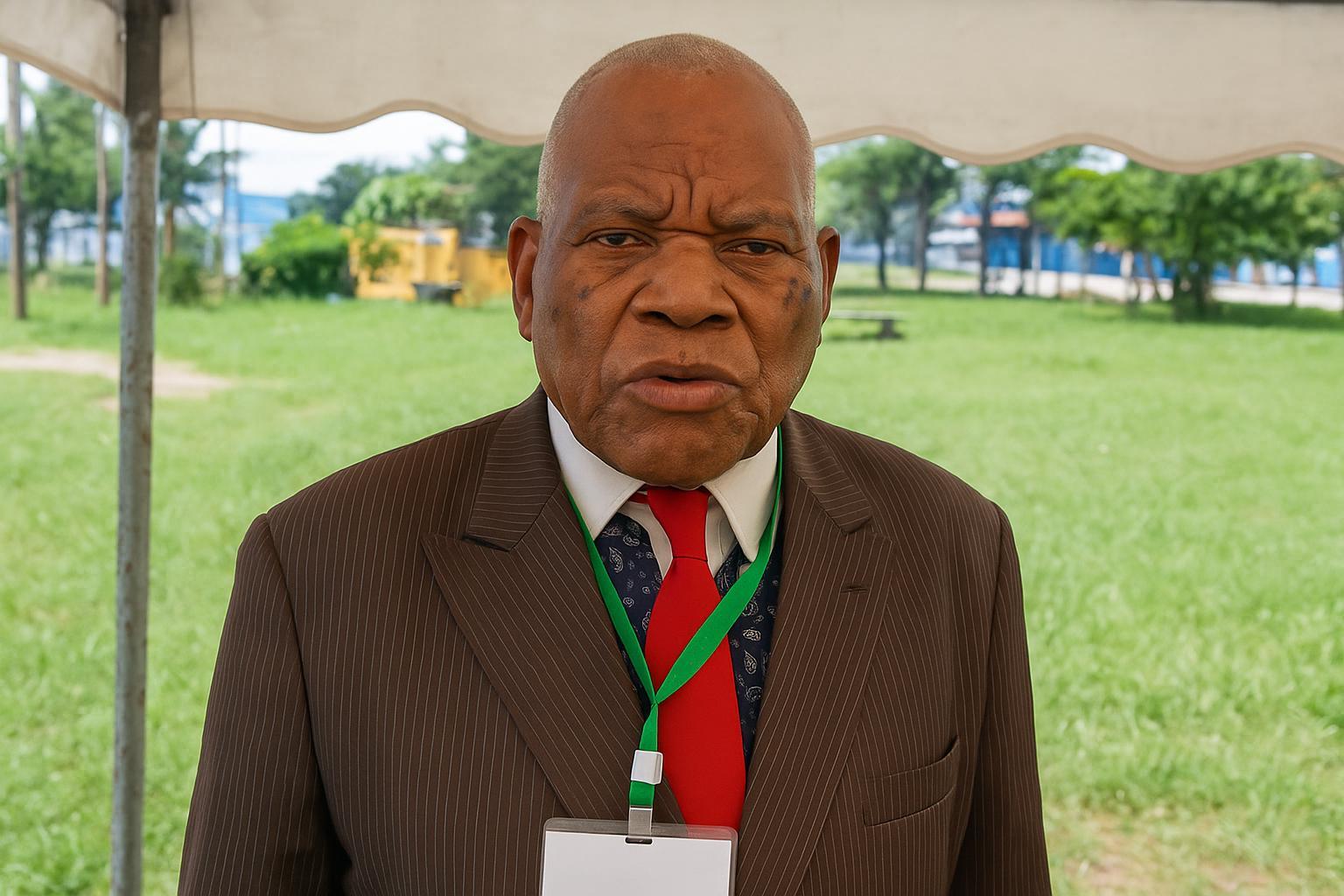
A Sudden Loss on Route Nationale 1
The first weekend of December was still breaking when motorists on the sinuous Route Nationale 1 between Brazzaville and Madingou came upon the mangled shell of a four-wheel drive. Inside lay Jean Enoch Ngoma Kengué, senior member of the Parti congolais du travail (PCT), motionless. Emergency services confirmed shortly after 08:00 that the former Pool prefect and Brazzaville deputy mayor had succumbed to his injuries at the scene. Word travelled faster than the ambulances: within an hour social-media feeds filled with the sombre black-and-red colours of the PCT crest accompanying unverified photographs of the wreck.
Before midday the party’s secretariat-general issued an authenticated communiqué, saluting “a disciplined militant whose devotion to the revolution never faltered”. Government broadcaster Télé Congo interrupted regular programming to carry the statement, and local radio stations relayed that the head of state had conveyed his condolences to the family. The rapid confirmation reflected both the shock created by the crash and the stature Ngoma commanded after four decades of militant service.
From Pool Prefecture to Brazzaville Council
Born in Kindamba in 1957, Ngoma entered public life during the 1980s at a moment when the PCT was expanding its grassroots presence throughout the Pool plateau. He earned a reputation as a meticulous organiser, traits that led to his appointment as prefect of Pool in 1997, a post he held during the delicate post-conflict reconstruction of the department. Colleagues recall that he spent evenings touring villages with notebooks in hand, recording the minutiae of local grievances so that the central administration could act expeditiously.
When Brazzaville’s municipal council required an experienced hand to steer urban planning dossiers at the start of the past decade, Ngoma was selected as deputy mayor. Minutes of council sessions show he championed drainage works in flood-prone arrondissements and peppered contractors with questions about time-lines and cost transparency. Though electoral fortune eluded him—he was several times a losing legislative candidate in Makélékélé—his operational skills earned him a seat on the PCT’s Central Committee and, later, on its National Commission for Control and Evaluation, the body charged with auditing party structures.
The Fateful Journey to Madingou
According to highway police, Ngoma left Brazzaville in the early hours of 2 December, driving himself to Bouenza where he was to chair a mid-term review of the party’s membership mobilisation strategy. Investigators report that at kilometre marker 127 a sudden front-left tyre blow-out caused the vehicle to veer into the opposite lane and overturn twice before resting against an embankment. Weather conditions were clear and visibility excellent, ruling out exogenous factors such as rain or fog.
A preliminary technical bulletin indicates that the vehicle’s tyres had logged more than 60 000 kilometres. A forensic engineer with the National Road Safety Office, speaking on condition of anonymity because the official report is still forthcoming, observed that microscopic fissures consistent with ageing rubber were visible along the sidewall. While conclusive findings will await laboratory tests, the hypothesis of material fatigue rather than excessive speed currently dominates the investigation.
An Outpouring of Condolences Across Institutions
Messages of sympathy have arrived from across the political spectrum. Senate president Pierre Ngolo, who had worked alongside Ngoma during the 2021 constitutional reform consultations, hailed “an uncompromising patriot whose sense of duty set a benchmark for younger cadres”. The Union panafricaine pour la démocratie sociale, the leading opposition grouping, also issued a courteous note, calling the deceased “a courteous adversary in debate”. International partners were similarly swift: the ambassador of the African Union in Brazzaville signed the embassy’s condolence register, while the United Nations Resident Coordinator tweeted appreciation for Ngoma’s “commitment to local governance and peace consolidation”.
The family has announced that official funerary honours will be organised jointly by the State and the PCT. A wake is scheduled at the Centre culturel Jean-Baptiste Tati-Loutard, a venue that symbolises the confluence of politics and culture Ngoma cherished. In private, relatives say he had been drafting a memoir tentatively titled “Steps on Laterite Roads”, chronicling his years in provincial administration. The manuscript, they confirm, survived the crash.
Beyond Politics: Championing Mind Sports
Public service was not the only arena in which Ngoma left his mark. Since 2019 he presided over the Congolese Draughts Federation, a discipline that, though overshadowed by football, has earned the country continental medals. In April this year he presented the African Cup champion and runner-up to Senate leadership, urging lawmakers to integrate mind sports into youth programmes. “Draughts teaches the patience democracy requires,” he said during the visit, according to meeting minutes consulted by this newspaper.
Federation officials credit him with negotiating logistical support that enabled Congolese players to travel to Ouagadougou in November 2024, where they clinched silver and bronze. The Ministry of Sports has announced that the forthcoming national championship will be renamed the Jean Ngoma Kengué Trophy, an initiative welcomed by players who regard him as a benefactor rather than a distant administrator.
Road Safety Strides and Remaining Challenges
While the accident was singular, it has reignited debate over tyre ageing, driver fatigue and emergency response times on inter-urban corridors. The Ministry of Transport’s latest statistics register a 14 percent decline in crash fatalities over the past five years, owing in part to the government’s Road Safety Emergency Plan launched in 2020, which tightened vehicle inspection protocols and financed new patrol posts along Route Nationale 1. Yet experts caution that periodic tyre replacement remains largely unenforced, particularly for private vehicles. François Mouanda of the University of Marien Ngouabi’s engineering faculty notes that “blow-outs account for nearly a quarter of single-vehicle rollovers”.
In the National Assembly, deputies have urged the swift adoption of a draft bill mandating clearer labelling of tyre manufacture dates and stipulating a maximum service life of five years regardless of mileage. Sources inside the Transport Committee say passage is likely before the March session. For mourners, such regulatory fine print may seem distant. Nevertheless, translating collective grief into measurable safety gains would be a fitting tribute to a man whose career was defined by practical problem-solving in service of the public good.
