
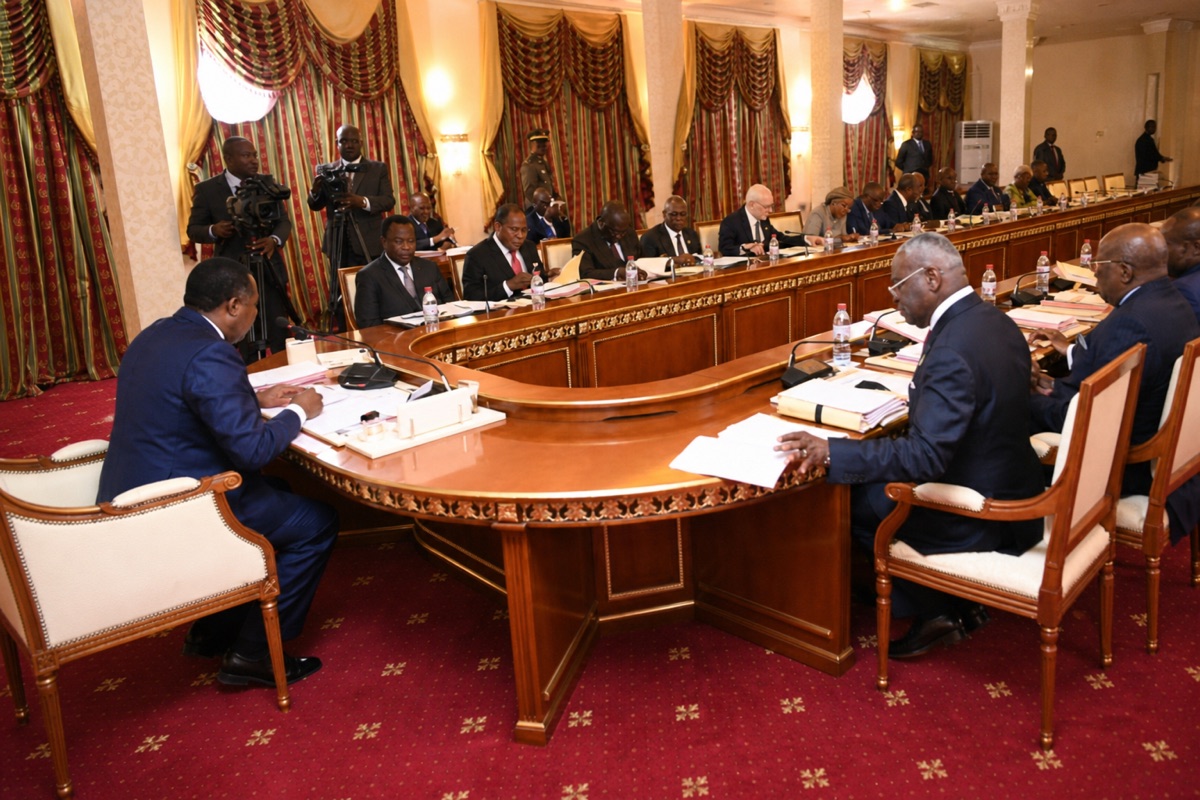
In a country where continuity and renewal have long competed for the upper hand, the announcement delivered in Brazzaville on 24 April 2026 sought to reconcile the two. Florent Ntsiba, Minister of State and director of the cabinet of the President of the Republic, read out the composition of the new government, formalised by decree no. 2026-176 of the same day (Vox Congo). The cabinet that emerged numbers forty-one members, including two deputy ministers, and is once again entrusted to Prime Minister Anatole Collinet Makosso for a five-year term. Behind the apparent stability of the premiership lies a recalibration whose subtleties reward close reading.
A new Vice-Premier post signals an infrastructure turn
The most consequential structural change is institutional rather than personal. For the first time in this configuration, the executive includes a Vice-Premier Minister: Jean-Jacques Bouya, elevated to oversee the coordination of development infrastructure. The creation of such a tier is rarely a cosmetic gesture in Central African governance. It concentrates authority over the very portfolios—roads, public works, networked services—that determine whether budgetary ambitions translate into visible delivery. Placing infrastructure coordination at the second-highest rung of the executive suggests that the administration intends to be judged, in the years ahead, on the tangible. Alongside this, Pierre Oba retains a position at the Presidency with responsibility for political affairs, preserving a familiar axis at the centre of power.
Familiar hands steady the strategic ministries
Stability is most pronounced where the stakes are highest. The sovereign and economic ministries remain in experienced custody. Christian Yoka stays at Finance, a continuity that markets and multilateral partners tend to read as a signal of predictable fiscal stewardship. Raymond Zéphyrin Mboulou keeps National Defence and Jean Ollesongo Ondaye remains at the Interior, anchoring the security architecture without disruption. Jean Rosaire Ibara continues at Health, Paul Valentin Ngobo at Agriculture, and Arlette Soudan Nonault at Environment, the last a figure whose international visibility on climate questions has become an asset for Brazzaville’s diplomacy. Commerce and the African Continental Free Trade Area remain with Jacqueline Lydia Mikolo, while Alphonse Claude Nsilou (Construction), Pierre Mabiala (Public Service), Jean-Claude Gakosso (Culture) and Hugues Ngouélôndelé (Sports) all keep their briefs. The message embedded in this roster is one of institutional memory: in domains where learning curves are steep, the government has chosen not to start afresh.
Fresh appointments redraw parts of the map
Renewal, where it appears, is deliberate and concentrated. Constant Serge Bounda takes Foreign Affairs, inheriting a portfolio that mediates the country’s relationships within the Economic and Monetary Community of Central Africa and with partners beyond the continent. The energy and extractive sectors, which remain the fiscal backbone of the Republic of Congo (Congo-Brazzaville), see notable movement: Stev Simplice Onanga assumes responsibility for Hydrocarbons, while Urbain Fiacre Opo takes the Mining Industries and Geology brief. Michel Djombo is charged with Industrial Development, a portfolio that speaks to the recurrent aspiration to diversify an economy long tethered to oil. Rodrigue Charles Malanda Samba arrives at Employment, Frédéric Nze at Posts and Telecommunications, and Noël Léonard Essongo at State Control, the last an oversight function whose prominence often correlates with rhetorical commitments to accountability.
Departures that reshape the balance
Every reshuffle is defined as much by who leaves as by who remains. Six figures step away from the executive: Émile Ouosso, Gilbert Mokoki, Nicéphore Antoine Thomas Fylla Saint-Eudes, Léon Juste Ibombo, Ghislain Thierry Maguessa Ebomé and Charles Richard Mondjo. The exits of Ouosso and Ibombo are likely to draw particular attention, given the weight their former portfolios carry in the country’s modernisation narrative. Their departure, set against the promotion of Bouya and the reshaping of the energy ministries, hints at a recalibration of the coalition’s internal equilibrium rather than a wholesale change of direction.
A government calibrated for delivery
Taken together, the architecture unveiled on 24 April reads less as rupture than as careful adjustment. The premiership endures; the economic and security cores are preserved; and the principal innovation—a Vice-Premier devoted to infrastructure—concentrates political capital where the administration evidently expects results to materialise. For the cadres, entrepreneurs and citizens who will live with the consequences, the relevant question is not whether the cabinet looks new, but whether its forty-one members can convert institutional continuity into measurable progress. The decree has set the personnel; the coming term will test the design. In a region where reshuffles often promise more than they deliver, Brazzaville has wagered that experience, leavened by targeted renewal, is the surer path.
