
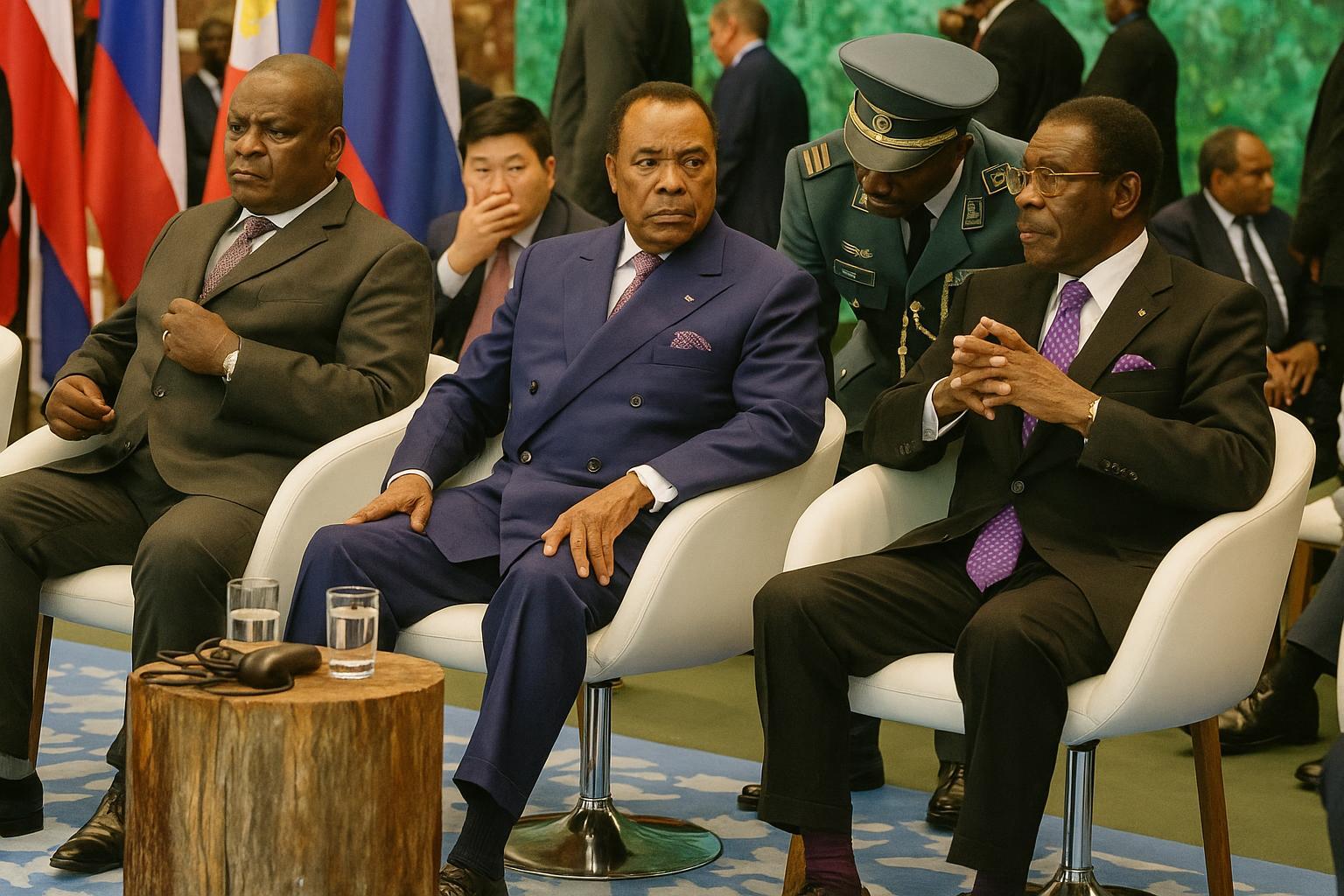
Bangui summit signals renewed cohesion
In Bangui’s sun-drenched conference hall, the anthems of the Central African Economic and Monetary Community rang out with unusual fervour. Presidents from Cameroon, the Central African Republic, Chad, Congo-Brazzaville, Equatorial Guinea and Gabon had converged on 9–10 September for an extraordinary summit that many observers describe as one of the most consensual in recent memory. When Central African President Faustin-Archange Touadéra handed a yellow-fringed standard to his Congolese counterpart Denis Sassou-Nguesso, the symbolic relay closed a two-year mandate marked by pandemic headwinds and commodity price swings, yet it also opened a chapter laden with expectation for deeper sub-regional unity.
Sassou-Nguesso outlines an integration-first agenda
Accepting the chairmanship, President Sassou-Nguesso stressed that CEMAC’s fortunes are inseparable from a credible integration project. “We committed ourselves in politics to pan-Africanism, to liberating Africa, to development plain and simple,” he declared, reiterating the need to dismantle the last administrative hurdles to free movement of people and goods. Diplomatic sources present in the room report that the Congolese leader, who played a pivotal role in the 1994 treaty that created CEMAC, intends to accelerate the delayed issuance of a single biometric passport and shepherd an update of the customs code to streamline intra-community trade.
Economic prospects: abundant resources, modest growth
The six CEMAC economies collectively hold close to 290 million barrels of proven oil reserves and vast deposits of timber, manganese and bauxite, yet average growth has hovered below 3 percent over the past decade (African Development Bank statistics). President Touadéra reminded his peers that the sub-region, home to forty-million citizens, can help the world ‘re-embrace growth’ by harnessing these resources responsibly. The summit communiqué therefore reaffirmed support for the Structural Reform Programme negotiated with the IMF in 2021, which targets fiscal consolidation without sacrificing capital expenditure on power grids and transport corridors critical to land-locked members such as Chad and the Central African Republic.
Security cooperation in a complex neighbourhood
CEMAC’s development ambitions are routinely tested by security flashpoints extending from the Sahel to the Gulf of Guinea. Attacks by non-state armed groups in northern Cameroon and cross-border incursions around Lake Chad continue to weigh on investor confidence. In Bangui, the heads of state endorsed the creation of a joint analysis cell to pool intelligence on transnational threats and pledged to increase funding for the Multinational Joint Task Force that already operates along certain frontiers. While defence remains a sovereign prerogative, officials argue that coordinated early-warning systems can lower the costly premium of instability on regional borrowing.
Governance commitments and cautious optimism
Behind closed doors, finance ministers briefed leaders on public-debt trajectories that have edged past 50 percent of GDP in several member states. According to the CEMAC Commission, improved revenue transparency in the hydrocarbon sector could reclaim up to 1.5 percent of GDP annually. The Bangui declaration consequently urges governments to adopt an electronic platform for publishing concession contracts and to finalise the enforcement decrees of the 2019 community anti-corruption code. Observers note that these undertakings, though ambitious, remain couched in non-binding language—a reminder that implementation will hinge on sustained political will when the summit spotlight fades.
À retenir
The power handover to Denis Sassou-Nguesso re-energises a regional project that has often been criticised for slow progress, yet leaders present in Bangui projected unity around a concise agenda: accelerate free circulation, secure the shared economic space and uphold macroeconomic stability. The emphasis on turning Central Africa’s natural wealth into inclusive growth aligns with international calls for resource-backed development, positioning CEMAC as a potential engine of post-pandemic recovery within the continent.
Le point économique
From a macro-financial standpoint, CEMAC’s common currency—the CFA franc—continues to provide price stability; inflation averaged 4.8 percent in 2022, well below the African median. Nonetheless, the bloc’s aggregate current-account deficit widened to 5.2 percent of GDP, largely because infrastructure imports surged while oil revenues softened. The Bank of Central African States has maintained a prudent policy rate at 3.25 percent, but analysts caution that tighter global liquidity could constrain future budget support. In this context, the forthcoming chairmanship of Congo-Brazzaville will be judged on its ability to deepen capital markets and mobilise domestic savings, thereby lessening external vulnerability.
