
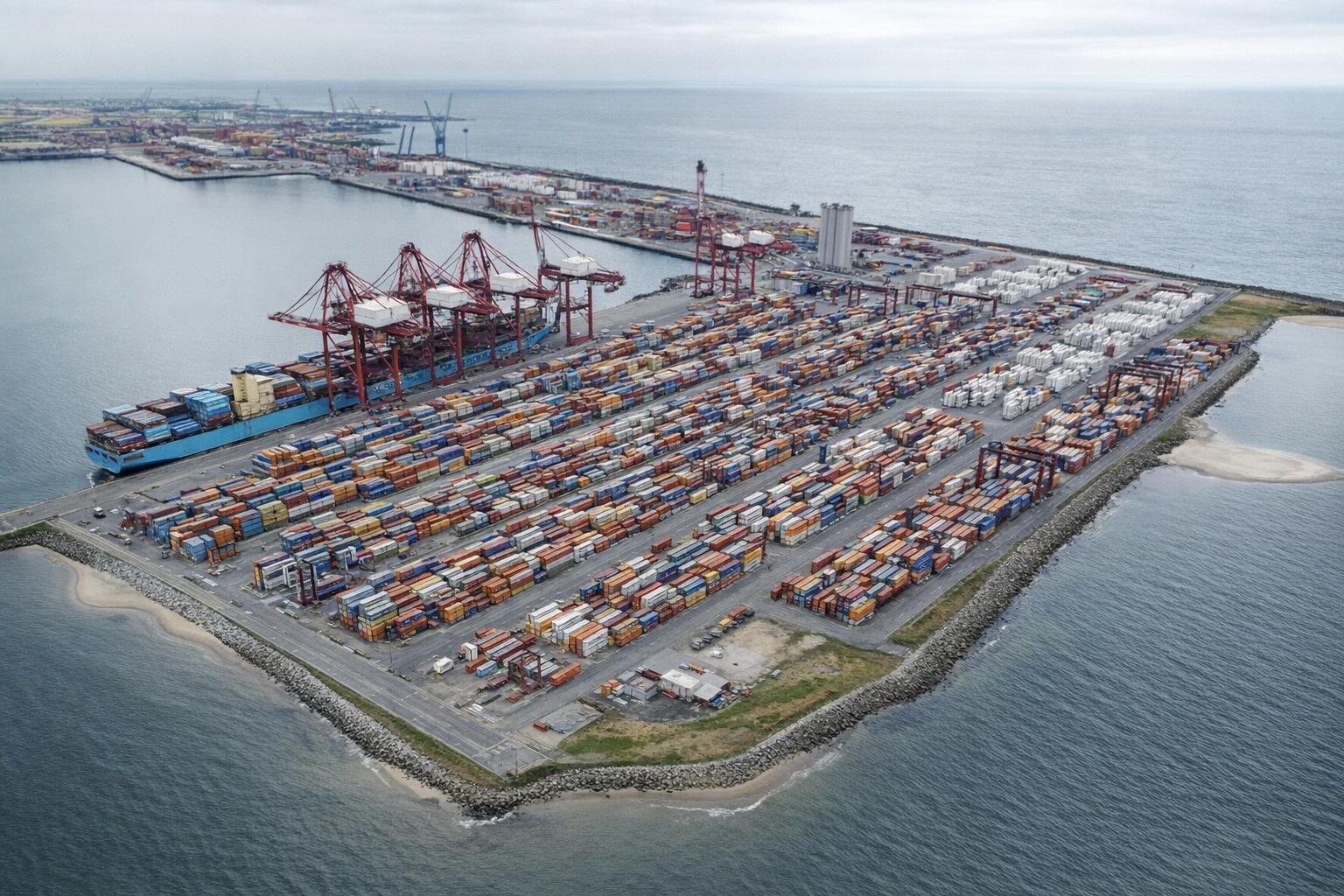
Congo Terminal’s 2025 TEU Record at Pointe-Noire
Congo Terminal reports having processed 1,219,164 TEU over the course of 2025, a figure that marks a symbolic and operational turning point for the container terminal at the Port of Pointe-Noire. For the first time, the company has crossed the annual threshold of 1.2 million containers handled, underscoring a sustained rise in maritime traffic and the consolidation of Pointe-Noire’s role as a strategic gateway for the Republic of the Congo.
This performance is presented by the operator as coinciding with a major phase of port transformation: the construction of a new port platform at the East Jetty of the Port of Pointe-Noire. In the company’s narrative, the timing is not incidental. Higher volumes have intensified the demand for capacity, speed, and reliability, while the ongoing works are meant to ensure that the port infrastructure keeps pace with economic activity and evolving shipping patterns along the West African coast.
From 2009 Concession to a Sixfold Increase in Volumes
Congo Terminal traces the current results to a longer trajectory that began with the start of its concession in 2009. According to the company, container throughput has increased sixfold over this period, rising from around 200,000 TEU to more than 1.2 million TEU annually. The emphasis placed on this growth reflects not only a change in scale, but also the gradual institutionalisation of processes, equipment, and workforce capabilities required to sustain higher-intensity terminal operations.
Anthony Samzun, Congo Terminal’s Chief Executive Officer, framed the 2025 figure as both an achievement and a springboard. “Since the start of the concession in 2009, we have multiplied by 6 the volume of containers handled, moving from 200,000 to more than 1.2 million TEU. We now aim for the threshold of 2 million containers handled by 2027 with the commissioning of the new port platform currently under construction,” he said. The statement sets out a clear horizon: the 2025 milestone is not portrayed as an endpoint, but as evidence that the system is approaching the limits of its existing configuration and must evolve to reach new capacity targets.
Port Investments: Infrastructure, Skills, and Advanced Equipment
The company states that more than 450 million euros have been invested at the Port of Pointe-Noire to develop infrastructure, train personnel, and acquire advanced equipment. In a sector where competitiveness is shaped by turnaround times, handling performance, and operational safety, the combination of hard infrastructure and human capital is central. The stress on training is especially significant, as modern container terminals depend on specialised technical competencies, maintenance routines, and tightly coordinated operations across yard, quay, and gate activities.
Beyond these earlier commitments, Congo Terminal indicates it has embarked on the construction of a new port platform for a little more than an additional 400 million euros. The company presents this expansion as designed to accompany the country’s economic growth, implying a view of the port not merely as an infrastructure asset but as a development lever: facilitating imports of productive inputs, enabling exports, and providing the logistical backbone that supports both public and private sector ambitions.
East Jetty Platform and the 2027 Capacity Ambition
The ongoing construction at the East Jetty is positioned as the operational key to the company’s stated objective of reaching 2 million containers handled by 2027. While the precise sequencing and technical configuration are not detailed in the available information, the strategic logic is familiar in global port development: scaling capacity requires additional berthing and yard space, reinforced handling equipment, and systems capable of accommodating larger and more frequent vessel calls.
Congo Terminal’s messaging situates the platform within a broader vision for Pointe-Noire as a deep-water reference port and a transshipment centre of excellence for the southern segment of the West African coastline. In practice, the notion of “reference” implies an aspiration to reliability and connectivity, while “transshipment excellence” signals a desire to serve as a redistribution hub for regional maritime routes. The 2025 throughput figure is thus used to illustrate momentum, while the platform works are presented as the structural answer to future demand.
Pointe-Noire’s Deep-Water Hub Strategy for West Africa
Congo Terminal says it is continuing its investment programme with the explicit objective of making Pointe-Noire the leading deep-water port and a premier transshipment platform across the southern stretch of West Africa’s Atlantic coast. Such positioning reflects a competition for maritime relevance in a region where shipping lines and cargo owners increasingly prioritise ports that can guarantee efficiency, equipment availability, and scalable capacity.
In this framing, the Republic of the Congo’s port strategy appears intertwined with long-term economic objectives: improving logistics performance, supporting trade flows, and reinforcing the country’s place in regional maritime networks. The 2025 milestone of 1,219,164 TEU becomes, in effect, a headline indicator of operational maturity, while the East Jetty platform is presented as the next step in a carefully sequenced investment cycle aimed at securing growth through 2027 and beyond.
