
A Coalition Turns Empty Polling Stations Into a Verdict
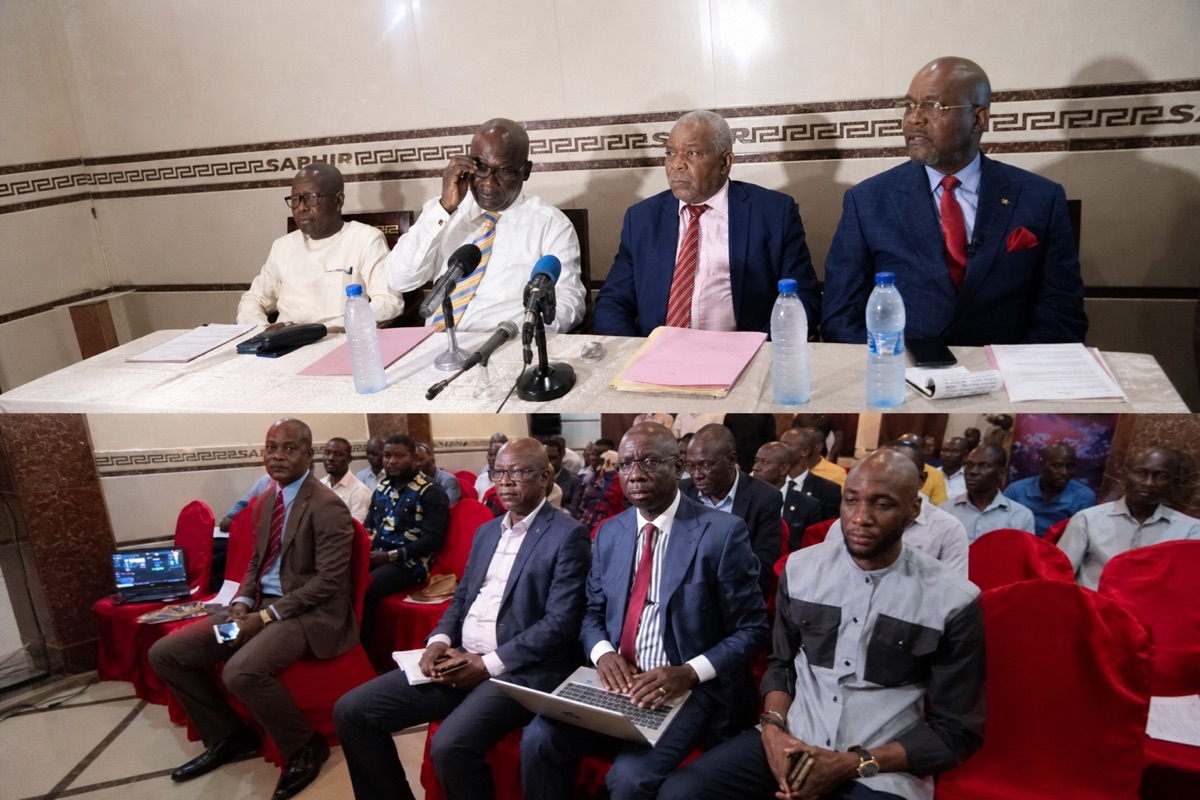
Nearly two months after the March 2026 presidential election returned President Denis Sassou-Nguesso to office for a fifth consecutive term, the opposition coalition known as the Rassemblement des forces du changement (R.f.c) chose silence, rather than the result itself, as its rallying point. At a press conference held in Brazzaville on 2 May 2026, the coalition’s leadership argued that the citizens who stayed away from the ballot box had spoken with a clarity that the official tally could not capture. In doing so, the R.f.c attempted a familiar but consequential rhetorical manoeuvre in the politics of the Republic of Congo (Congo-Brazzaville): converting non-participation, ordinarily read as apathy, into a deliberate and legible act of political will.
The framing matters because it reorders the conventional grammar of electoral defeat. Where an opposition might be expected to contest figures, demand recounts or retreat into recrimination, the R.f.c instead claimed ownership of the very absence of votes. The wager is that abstention, when narrated as choice rather than indifference, becomes a renewable form of legitimacy that no proclamation of results can erase.
Miérassa Casts Silence as a Strategy, Not a Surrender
The coalition’s president, Clément Miérassa, supplied the conference’s defining formulation. “This message is not a weakness, it is a cry, a refusal, a strong political statement,” he told the assembled press, before adding that “massive abstention is a first step towards the final victory: change.” The phrasing is carefully constructed. By describing abstention as a “first step,” Miérassa situates the present moment within a longer arc, implying continuity of struggle rather than the closure that an electoral outcome usually imposes.
That choice of vocabulary is also a defensive one. Abstention is a notoriously ambiguous political signal, as legible as disenchantment or fatigue as it is of protest. Aware of this, the R.f.c sought to fix its meaning before rival interpretations could settle, presenting the empty polling stations as evidence of dignity withheld rather than interest lost. Whether that interpretation holds will depend less on the conference itself than on the coalition’s capacity to sustain a narrative over time.
A United Front Questioning the Mandate
Miérassa did not appear alone. The coalition presented five of its leading figures, among them Jean-Pierre Agnangoye and Jean-Jacques Serge Yhombi Opango, in a display intended to project cohesion at a delicate juncture. Together they challenged the legitimacy of the outcome, describing Sassou-Nguesso as a “de facto president” and accusing the governing Parti congolais du travail (P.c.t) of having “miserably failed.” The choice of language was deliberate, contesting not merely the conduct of the vote but the authority it is meant to confer.
The presence of several recognisable names alongside Miérassa carries its own message. In a political landscape where opposition forces have frequently fragmented, the staging of a common front is itself a claim, an assertion that the coalition can speak with one voice where it has often spoken with many. Unity displayed at a press conference is not the same as unity tested in the field, but the symbolism was plainly intended.
Courting the Young and the Working Citizen
Beyond contesting the result, the R.f.c articulated an explicit theory of who its constituency is and where future leverage might lie. The coalition portrayed abstention as an expression of citizens’ dignity and as the seedbed of eventual transformation, and it directed its appeal squarely at the young and at working people, urging them to maintain their mobilisation. The address read as an attempt to convert a passive statistic into an active base, to transform those who did not vote into those who might yet act.
That orientation reflects a reading of Congolese society in which demographic weight and economic frustration are presumed to favour change over time. The coalition’s leaders criticised what they characterised as the complacency of certain political actors, distancing themselves from any accommodation with the established order while leaving a deliberate aperture for engagement.
A Door Left Ajar for Dialogue
For all the sharpness of its language, the R.f.c stopped short of foreclosing negotiation. The coalition stated that it remained open to dialogue “if the conditions allow,” a conditional phrasing that preserves both posture and flexibility. The qualification is significant. It allows the coalition to maintain its oppositional credentials while signalling that it does not regard the political contest as definitively closed.
What emerges from the conference is less a programme than a stance, an effort to keep contestation alive in the interval between elections by redefining the terms on which legitimacy is measured. The success of that effort cannot be judged from a single gathering. It will be tested by whether the coalition can translate the language of refusal into durable organisation, and whether the silence it claims to interpret continues to speak in the voice it has assigned to it.
