
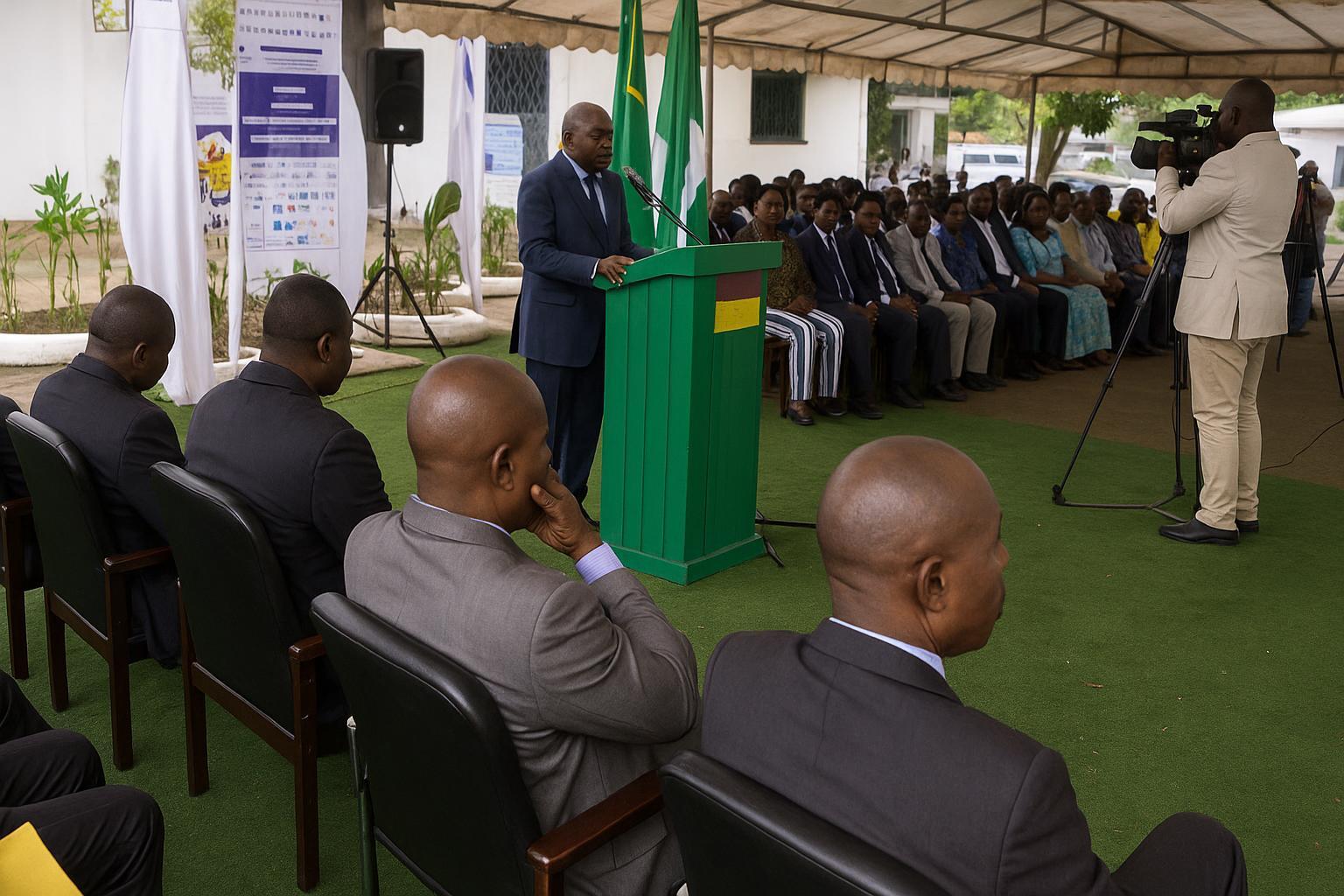
Brazzaville workshop signals a strategic shift
Inside the Ministry of Scientific Research’s auditorium, the hum of laptops mixed with the more familiar rustle of agronomic field notes. Opening the two-day seminar on 16 October, Obel Patrick Okéli, Director-General of the National Agency for Valorisation of Research Results and Innovation (ANVRI), framed the gathering as “a space for reflection, dialogue and solution-building” bringing researchers, students, decision-makers, farmers and entrepreneurs around one table. His statement underscored a deliberate pivot from fragmented pilot projects toward an integrated national approach to smart agriculture that dovetails with the government’s broader economic diversification agenda.
À retenir : The event marked the first time that all strands of Congo’s innovation ecosystem—academic laboratories, agri-start-ups and public regulators—were convened to co-design concrete roadmaps for deploying climate-responsive technologies at scale.
Ten million hectares poised for transformation
Representing the Minister of Scientific Research and Technological Innovation, chief of staff Aimé Christian Kayath reminded the audience that the Republic of Congo enjoys more than ten million hectares of arable land as well as a climate that ranges from humid equatorial in the north to sub-tropical in the south. Yet agriculture currently contributes a modest share to gross domestic product, a gap Mr Kayath attributed to low mechanisation, dependence on rainfall and limited access to modern inputs. “Our current model does not sufficiently meet food security needs nor the resilience required by climate change,” he cautioned.
The official diagnosis converged with data presented by agronomists in attendance: domestic food demand continues to outpace local supply, and imports weigh on the national trade balance. By contrast, intelligent use of precision irrigation, drought-tolerant seed varieties and digital advisory platforms could unlock a production frontier capable of feeding the population while supporting sovereign economic choices.
From laboratory insight to field impact: ANVRI’s method
Mr Okéli insisted that research output must migrate from academic journals to the furrows of smallholders. ANVRI’s envisaged pipeline begins with mapping university-generated innovations—soil sensors, mobile yield-forecast applications, bio-fertilisers—and matching them with the specific constraints of each agro-ecological zone. During breakout sessions, participants drafted preliminary timelines for pilot deployment, performance monitoring and eventual commercial scale-up. The proposed governance model keeps Congolese researchers as technology owners while encouraging joint ventures with private investors, ensuring that intellectual property remains anchored in the country.
Le point juridique/éco : stakeholders noted that existing land tenure legislation already offers a stable framework for investors, but supplementary decrees on data governance and seed certification could further accelerate adoption without altering constitutional balances.
Students and entrepreneurs at the helm of innovation
Co-ordinator Exaucé Nkaya defined smart agriculture as a modern cultivation approach harnessing new technologies to confront climate variability while easing labour and boosting yields. Her definition resonated with the roomful of students from Marien Ngouabi University who, clutching prototypes of drone-based pest detectors, embodied the workshop’s inclusive ethos. Several of them will receive incubation support from ANVRI to refine business plans and seek seed capital.
Entrepreneurial voices provided a pragmatic counterpoint to academic enthusiasm. A young poultry farmer from Plateaux Department observed that data-driven feed optimisation had already trimmed his operating costs by a third, a real-world example that reinforced confidence in scalable solutions. Meanwhile, established agri-processors expressed readiness to integrate local start-ups into their supply chains, provided that product standards and delivery schedules are respected.
Regulatory and economic levers for smart farming
Discussions repeatedly circled back to the enabling environment. Participants endorsed fiscal incentives for importing sensor hardware while advocating preferential credit lines through state-owned banks to finance climate-smart machinery. Policy analysts emphasised that such measures must dovetail with the national objective of food sovereignty rather than merely replacing one dependency with another. Clear guidelines on carbon accounting were also viewed as essential, anticipating a future in which Congolese farmers could tap into regional carbon markets by documenting emissions reductions achieved through precision agriculture.
Beyond finance, speakers stressed the importance of vocational training to build a skilled workforce capable of operating and maintaining new technologies. In this regard, the Ministry of Scientific Research committed to integrating smart-farming modules into technical curricula, a pledge that aligns educational reform with market demand.
Charting a resilient and inclusive agro-economy
As the seminar concluded on 17 October, delegates left with draft action plans that will be refined in the coming weeks. These documents outline demonstration plots in each department, a national knowledge portal to disseminate best practices and a monitoring dashboard to track progress toward yield and sustainability targets. While challenges remain—financing gaps, rural connectivity, behavioural inertia—the mood was one of guarded optimism.
“We have the land, the climate and the ingenuity,” Mr Okéli summarised in his closing remarks. “What we are forging here is the collective discipline to transform potential into prosperity.” His words captured the workshop’s central lesson: smart agriculture is not an abstract technological promise but a pragmatic path toward economic diversification, social inclusion and environmental stewardship under Congolese leadership.
