
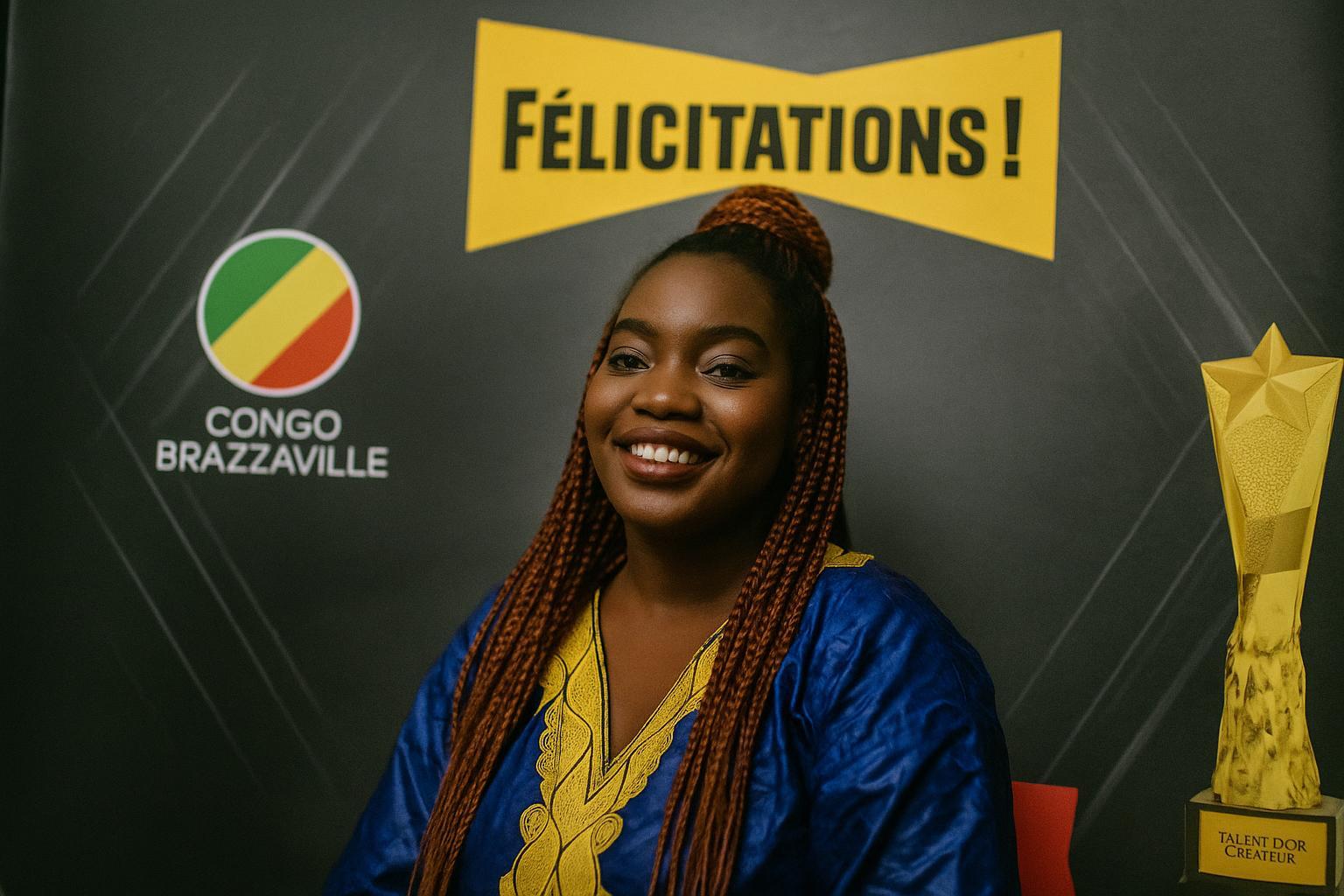
A Milestone for Congolese Couture
For the first time since the creation of the Talents d’Or, a Congolese national stands among the finalists: Edouarda Diayoka, founder and lead designer of the Louata label. The announcement, confirmed by the organising committee on 3 September, has reverberated well beyond Brazzaville’s riverside ateliers. In a competition that routinely attracts hundreds of applications from across the continent, Diayoka’s selection represents both a personal triumph and a symbolic breakthrough for Congo-Brazzaville’s still-nascent fashion industry (Talents d’Or Secretariat, 2024).
Talents d’Or, often likened to a Pan-African counterpart of the Council of Fashion Designers of America Awards, counts previous winners from Côte d’Ivoire, Ghana and Morocco among its alumni. Their post-award trajectories—ranging from Paris Fashion Week showcases to high-profile collaborations—suggest that a victory can translate into lasting market visibility (African Fashion Council, 2022). Against that backdrop, Diayoka’s nomination is widely interpreted by regional observers as evidence that Central African aesthetics are gaining a new legitimacy in the continental style conversation.
Inside the Talents d’Or Mechanism
The competition’s voting procedure reflects a hybrid model of public endorsement and expert curation. While an international jury focuses on technical merit and cultural pertinence, the popular vote—priced at 105 F CFA per ballot—serves both as a democratic gesture and a micro-funding device for the event’s logistics. Over a 30-day window, the designers’ supporters are invited to purchase and cast an unlimited number of votes, a mechanism that simultaneously gauges brand mobilising power and grassroots resonance (Jeune Afrique, 2023).
Should Diayoka secure sufficient votes to place in the top tier, she will earn the right to stage her collection in one of five hosting capitals—Abidjan, Lomé, Ouagadougou, Libreville or Brazzaville—an opportunity many past finalists used as a springboard toward international distribution agreements. Analysts anticipate that the contest will draw heightened media attention this cycle, precisely because Louata offers a distinctive window into Congo-Brazzaville’s design language, marked by saturated chromatic palettes and tailored silhouettes.
Louata: Weaving Identity and Innovation
Founded in 2019, Louata positions itself at the intersection of modern tailoring and heritage textiles. Diayoka’s signature ensemble—rendered in vivid yellow and cobalt blue—has already achieved quasi-iconic status on regional social platforms, frequently cited as an emblem of “confidence through color”. She sources wax prints from small-scale dyers in Ouesso and Pointe-Noire, then integrates brocade linings imported from the Gulf, producing a dialogue between local fabric narratives and global supply chains (Central Africa Creative Industries Report, 2024).
Critics routinely highlight Louata’s engineering of daring asymmetrical cuts and structured shoulders, an architectural interpretation that departs from the flowing silhouettes dominant in West African couture. Fashion columnist Mireille Tchikaya argues that the label “does not merely clothe the body; it articulates a cosmopolitan Congolese identity eager for visibility” (Les Afriques, 2024). By maintaining production in Brazzaville’s Makélékélé district, Diayoka also reaffirms the economic rationale of retaining value chains domestically, a point applauded by local chambers of commerce.
Soft Power and National Branding
Fashion’s role in foreign policy is no longer theoretical. Scholars from the University of Johannesburg estimate that creative industries account for up to 3 percent of Africa’s continental GDP, while also functioning as emotive vehicles of national branding (UJ Policy Brief, 2023). Congo-Brazzaville’s strategic documents on cultural diplomacy explicitly encourage ‘creative ambassadors’ to help reposition the nation’s image beyond hydrocarbons and timber. In that context, Diayoka’s rise dovetails with broader governmental objectives that seek to diversify external perceptions of the Republic (Ministry of Foreign Affairs, 2024).
Officials have greeted her nomination with measured optimism. A spokesperson for the Ministry of Culture praised Louata as “an exemplar of female entrepreneurship and cultural excellence”, noting that such recognition could spur further investment in design incubators currently under consideration in Brazzaville. International partners, including the French Development Agency, have likewise linked creative-sector funding to the visibility generated by high-profile success narratives.
The Road Ahead for Emerging Designers
Even if she does not ultimately capture the Talents d’Or trophy, Diayoka is positioned to benefit from the contest’s networking infrastructure. Previous finalists report that masterclasses with pattern-making technicians, meetings with ethical sourcing auditors and introductions to boutique owners in Lagos and Nairobi were arguably more valuable than the awards gala itself (Africa Fashion Futures Review, 2022).
Yet challenges remain. Import duties on luxury fabric, limited access to export-grade logistics and fluctuating electricity supply continue to complicate large-scale production in Congo-Brazzaville. Industry analysts suggest that partnerships with regional e-commerce platforms could mitigate such bottlenecks, enabling labels like Louata to bypass traditional retail barriers and reach diaspora markets in Europe and North America.
Diayoka’s public appeal—“We do this together, for us, for Congo”—captures an emerging mindset among Congolese creatives who view commercial ambition and national pride as complementary rather than contradictory. Whether or not Louata ascends to the winners’ podium, the designer’s nomination signals a recalibration of Pan-African fashion geography, one in which the banks of the Congo River now stand beside Dakar or Lagos as credible launchpads for global style narratives.
