
A Festival as Statecraft
The opening night of the Pan-African Music Festival reverberated through the freshly refurbished Palais des Congrès, an emblematic venue whose modern acoustics were upgraded under a multi-year plan championed by President Denis Sassou Nguesso to bolster cultural infrastructure. In an era where soft power is increasingly measured in rhythms and narratives, the Republic of Congo has sought to position Fespam as a diplomatic instrument much like Morocco’s Mawazine or Senegal’s Dakar Music Expo. Official communiqués from the Ministry of Culture describe the 2025 edition as a “regional hub for artistic dialogue,” echoing the African Union’s Agenda 2063 that encourages member states to turn cultural industries into vectors of integration (African Union, 2020).
Kimbolo: Custodian of an Aural Archive
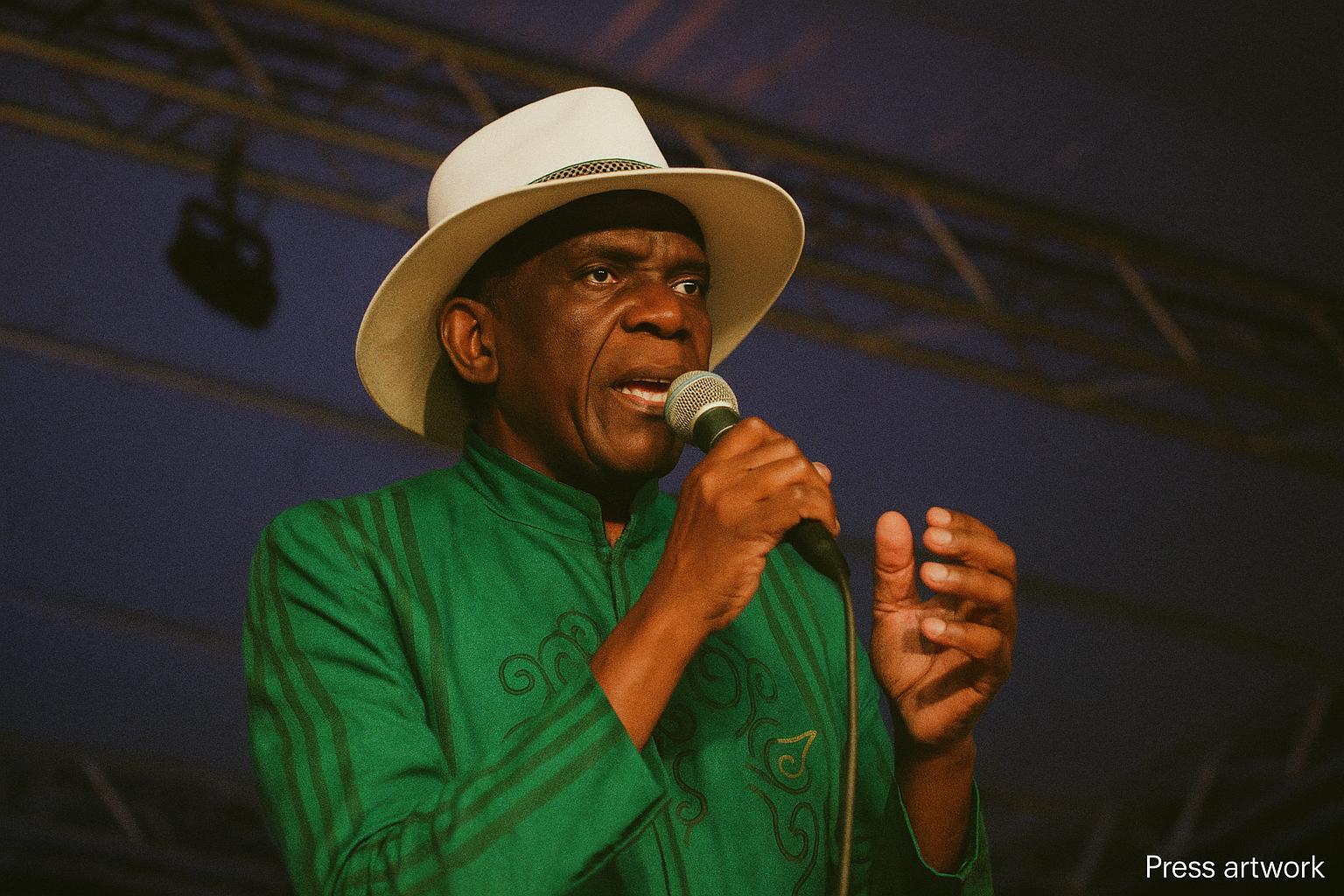
Stepping onto the stage in a linen boubou stitched with traditional Kongo motifs, Clotaire Kimbolo translated institutional rhetoric into lived artistry. For nearly three decades the guitarist’s smoky vibrato has stitched together the mournful cadence of colonial-era laments with the brisk syncopation of modern soukous. His appearance at all twelve Fespam editions grants him a quasi-archival status, a quality the Congolese daily Les Dépêches de Brazzaville recently termed a “living repository” (Les Dépêches, 2025). In a brief backstage exchange, Kimbolo conceded that longevity imposes obligations: “If memory dies, sovereignty weakens.”
UNESCO Recognition and the Burden of Prestige
The inclusion of Congolese rumba on UNESCO’s Representative List of the Intangible Cultural Heritage of Humanity in 2021 (UNESCO) elevated national expectations. Government agencies now shoulder twin responsibilities: safeguarding authenticity while facilitating commercial scaling. Cultural economists at the University of Marien Ngouabi estimate that music-related exports could triple by 2030 if heritage branding is coupled with professional training. Kimbolo’s set, in which he resurrected forgotten refrains by late bandleader Pamelo Mounk’a, illustrated the synergy between preservation and marketability. The audience’s intergenerational composition—a visible mix of streaming-savvy urban youth and vinyl-collecting veterans—suggested the plan’s demographic breadth.
Mentoring Amidst Digital Disruption
Yet the master remains wary of algorithmic homogenisation. During a panel convened by the Francophonie’s cultural bureau, Kimbolo warned that “playlists curated in Silicon Valley seldom honour ancestral polyphonies.” His criticism is less luddite than strategic; he advocates for metadata standards in Lingala and Kituba so that global platforms correctly index Congolese repertoire. Brazzaville’s National Music Academy, opened in 2023 with Chinese co-funding, has already incorporated such digital literacy modules, indicating governmental attentiveness to his concerns.
Modernity Negotiated, Not Rejected
The evening’s dramaturgy balanced nostalgia with experimentation. A horn section borrowed from Kinshasa’s nouvelle-vague collective Kadiombo fused Afrobeat accents into Kimbolo’s rumba core, mirroring broader Central African cross-currents reported by the International Music Council (IMC, 2024). Critics sometimes lament dilution, but the maestro’s arrangement suggested that stylistic permeability need not erase identity. His tonal choices served as a tacit rejoinder to purists while aligning with government aims to keep the festival commercially attractive to Afro-diasporic markets.
Cultural Continuity as National Security
In the security briefings preceding the event, officials underscored that cultural gatherings can reinforce social cohesion, an imperative in a sub-region episodically unsettled by electoral tensions. By honoring deceased artists—Kimbolo sampled the late Jean Serge Essous’ clarinet line—he articulated a cultural continuum that outlasts political cycles. The Armed Forces’ brass band, invited for a collaborative encore, underlined state endorsement without eclipsing civilian artistry, showcasing what a European diplomat in attendance called “music as preventive diplomacy.”
Economic Ripples Beyond the Stage
Preliminary data from the Ministry of Tourism reveal a twelve-percent uptick in hotel occupancy during the festival’s opening week compared with 2023 figures. Local artisans selling embroidered kikwembe reported brisk sales, validating World Bank studies that link creative-industry events to micro-enterprise growth (World Bank, 2024). Such spillovers buttress Brazzaville’s bid to become a creative capital on the Congo River corridor, complementing infrastructural projects like the future Kinshasa–Brazzaville bridge.
Looking Ahead to Fespam 2027
As pyrotechnics faded, Kimbolo addressed the assembled press corps with characteristic equanimity. He pledged to initiate a mentorship programme, backed by the Ministry of Youth, pairing veteran musicians with provincial conservatories. Observers from the Economic Community of Central African States hinted that such schemes could be scaled region-wide. By rooting modern aspiration in curated memory, Congo-Brazzaville projects an image of stability and cultural confidence—a narrative that, in the arena of twenty-first-century diplomacy, can be as persuasive as any communiqué.
