
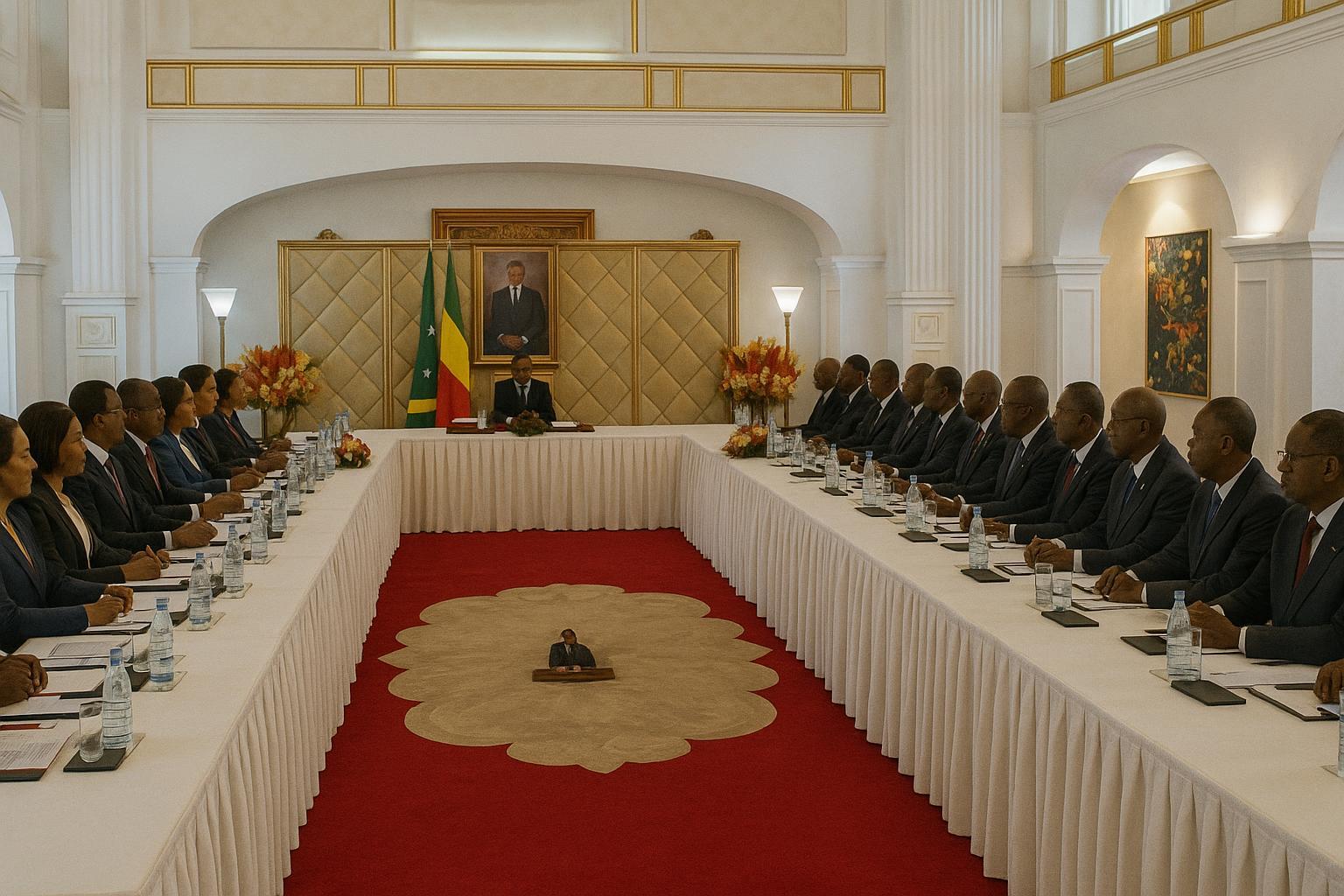
Cabinet Session in Oyo Signals Reform Momentum
Meeting on 7 October in the northern town of Oyo, the Council of Ministers endorsed a draft bill revising and supplementing Electoral Law No. 9-2001 of 10 December 2001, as already amended on several occasions. The initiative, introduced by Minister of the Interior and Decentralisation Raymond Zéphirin Mboulou, aims to adapt the legal architecture of national and local elections to the country’s new administrative realities while consolidating the credibility of future polls.
The government underscores that the bill is the fruit of extensive consultations with majority and opposition parties, centrist movements and civil-society organisations. According to the official communiqué, these exchanges revealed a shared understanding that the electoral framework must mirror the territorial reconfiguration that has produced three additional departments and a cluster of new districts. Officials argue that preserving the principle of equal suffrage requires prompt legislative calibration instead of ad-hoc fixes before each election cycle.
Aligning the Electoral Map with New Departments
Central to the reform is the arithmetic of representation. The emergence of the departments of Djoué-Léfini, Nkéni-Alima and a third entity whose delineation was confirmed earlier this year has inevitably increased the number of constituencies entitled to seats in the National Assembly. The bill therefore raises the total of deputies and, by extension, revises the composition of certain departmental and municipal councils. In concrete terms, the new districts of Odziba and Bouémba will, once the text is enacted, elect their own representatives for the first time.
Beyond the simple addition of seats, lawmakers have seized the opportunity to rectify technical anomalies that had crept into earlier statutes. The two electoral districts of Dolisie in Niari, for example, had been inadvertently inverted in the 2016 revision. The present bill restores the correct numerical order, eliminating a source of confusion frequently cited by local electoral commissions. By tightening such screws, the executive believes it can forestall litigation that diverts energy away from substantive policy debates.
Expanded Ineligibilities Promote Ethical Governance
Ethical governance also sits high on the agenda. The draft broadens the list of positions deemed incompatible with elective office, extending ineligibility to members of the Economic, Social and Environmental Council and to permanent secretaries of consultative bodies. The objective, argues Minister Mboulou, is to avert conflicts of interest and enhance the impartiality of advisory institutions whose opinions nourish public policy. The approach is consistent with regional best practice and international recommendations on the separation of powers.
The reform further obliges courts to notify the minister in charge of elections of any final conviction handed down against a deputy, senator or local councillor. Equally, the resignation of a senator or the removal of a councillor must be communicated without delay to both the minister and the president of the relevant council. These notification procedures aim to create a single, verifiable chain of information, closing loopholes that previously allowed vacancies to linger unrevealed for months.
Streamlined Procedures for Vacancies and Disputes
Judicial oversight is also strengthened. While the Supreme Court retains jurisdiction over parliamentary contests, the bill entrusts tribunals located within the geographic area of a local election with the authority to rule on irregularities specific to that poll. Decentralising this competence should, in the view of the executive, accelerate dispute resolution and enhance the perceived proximity of justice. It simultaneously relieves higher courts, enabling them to focus on jurisprudential harmonisation rather than first-instance fact-finding.
Legal analysts in Brazzaville commend the measure for embedding clear procedural timelines that guard against protracted uncertainty, which can paralyse municipal budgeting and service delivery. They note that the bill’s emphasis on written notifications and documentary chains will make it easier for the state to publish up-to-date lists of office-holders, a simple yet powerful tool for accountability. Such transparency, they argue, dovetails with the government’s broader digital-governance agenda unveiled in the National Development Plan 2022-2026.
Political Inclusivity and the Road Ahead
Political parties across the spectrum have so far reacted with measured optimism. Majority figures hail the bill as evidence that President Denis Sassou Nguesso’s administration listens to institutional partners and adapts to change with foresight. Opposition leaders, while reserving detailed comments for parliamentary debates, acknowledge that the harmonisation of district boundaries was unavoidable. Civil-society actors similarly welcome the expanded incompatibility clauses, viewing them as a step toward healthier public life.
The parliamentary session that will scrutinise the text is expected to open in the coming weeks, and observers anticipate a brisk timetable. Given the consensus around the necessity of aligning electoral legislation with new territorial units, few predict substantive opposition to the core provisions. The debate is more likely to focus on transitional arrangements, such as the timing of by-elections in newly created districts. Once adopted, the law should provide a stable canvas for the 2026 local and national ballots.
