
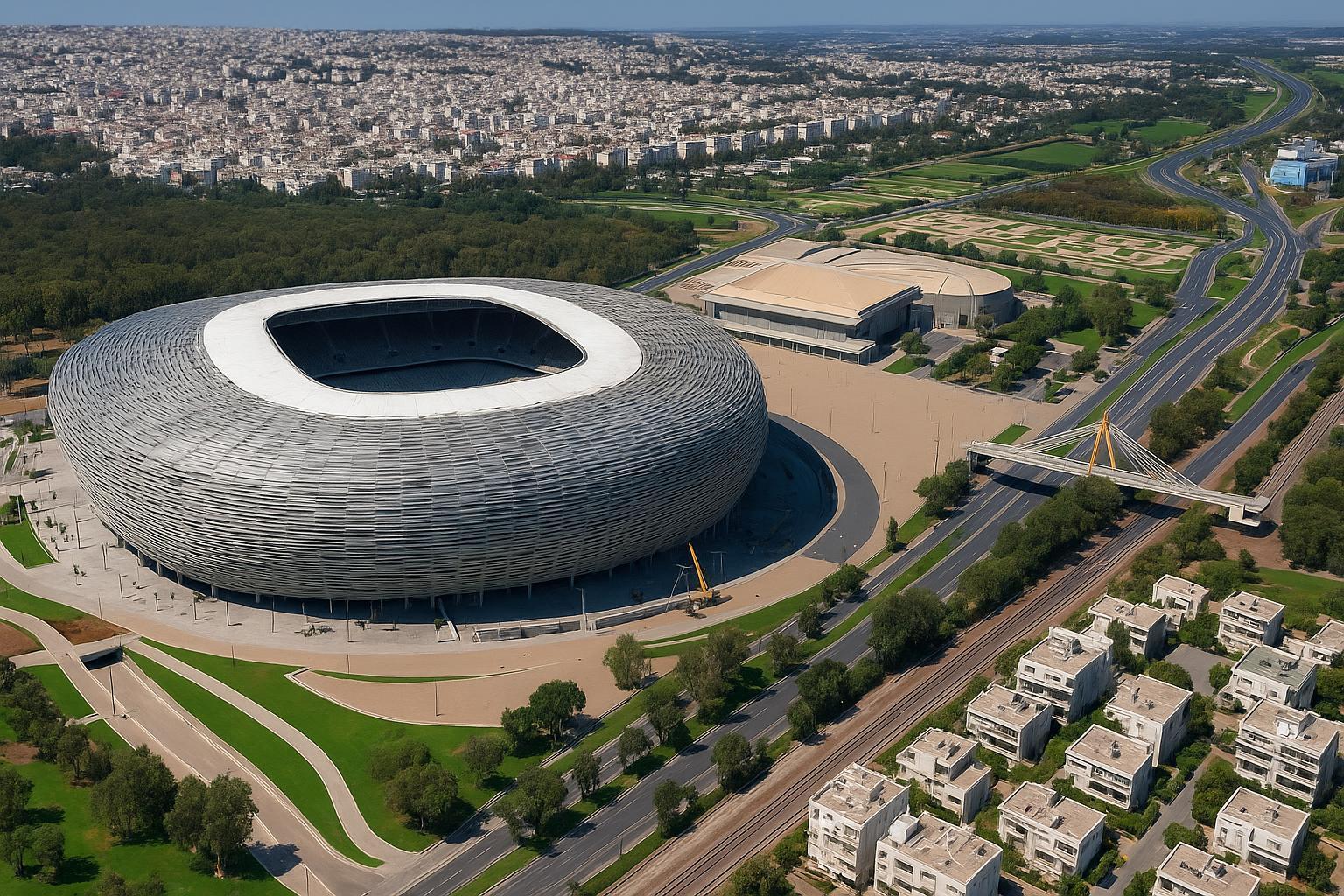
Sporting Diplomacy Takes Center Stage in Rabat
When the Royal Moroccan Football Federation (FRMF) announced that the 6 September World Cup qualifier against Niger would inaugurate the reconstructed Prince Moulay Abdellah Sports Complex, the communiqué carried more than routine scheduling news. It signalled Rabat’s intent to deploy football as a hinge of soft-power outreach, fusing national pride with a carefully choreographed message of readiness for the 2025 Africa Cup of Nations and the 2030 FIFA World Cup, both tournaments that will place the kingdom under an intense global lens today.
Seasoned diplomats note that stadium inaugurations can function as proto-summits: they convene visiting dignitaries, showcase logistical capabilities and weave subtle cultural narratives that linger beyond final whistles. By choosing Niger—whose national side is coached by former Atlas Lions tactician Badou Zaki—the FRMF layers personal rapport atop institutional links, reaffirming Rabat’s ever-evolving security and development partnerships with Sahelian capitals without overtly inserting itself into sub-regional political frictions across the continent.
Architectural Leap at Moulay Abdellah Sports Complex
Built originally in 1983, the Prince Moulay Abdellah complex had long wrestled with drainage flaws and seating obsolescence. The current refurbishment—executed by a consortium of Moroccan and Spanish engineering firms under a reported budget of 300 million euros (Jeune Afrique)—removes that legacy entirely. A carbon-neutral energy grid, 65,000 ergonomic seats and subterranean training chambers give the arena a technical profile comparable to Lusail in Qatar or Tottenham Hotspur Stadium in London.
The pitch itself employs hybrid grass reinforced with cork infill, a first in North Africa, intended to mitigate heat stress while preserving ball roll consistency throughout extended tournament calendars. Digital turnstiles linked to biometric identifiers strengthen crowd management, and a multi-faith meditation suite reflects Morocco’s narrative of pluralism. Such features, officials argue, render the structure less a mere venue than an emblem of the kingdom’s wider infrastructure diplomacy.
Tactical Stakes for Morocco, Niger and Regional Peers
On the competitive front, coach Walid Regragui’s side enters the fixture atop Group E with fifteen points and a goal differential of plus twelve, their ruthlessness arguably a residual effect of the 2022 World Cup semi-final run. Midfielder Azzedine Ounahi returns from injury, while Hakim Ziyech’s renaissance at Galatasaray has injected creativity that Niger struggled to stifle during the narrow 2–1 first-leg defeat in Oujda.
Yet Niamey travels north bolstered by Zaki’s intimate understanding of Moroccan tempo and by a recent wave of defensive cohesion that held Zambia to a goalless stalemate. Analysts from Radio France Internationale suggest that Niger’s counter-press, if timed to exploit the host’s high full-back positions, could expose transition gaps. A positive result would elevate the Ménas to nine points, dramatically recalibrating a table still open behind the frontrunners at this stage.
Implications for the 2025 AFCON and 2030 World Cup
CAF inspectors are due in Rabat next month to finalise venue allocations for the 2025 Africa Cup of Nations. Successfully hosting a high-profile qualifier will therefore be read as a live demonstration of operational readiness. A seamless spectator flow, prompt media accreditation and, crucially, broadcast latency under the 15-second threshold set by FIFA’s new digital standards are performance indicators being closely monitored by continental stakeholders and private broadcast consortia alike.
At the strategic horizon, Morocco’s co-hosting of the 2030 World Cup alongside Portugal and Spain positions Moulay Abdellah as a potential knockout venue. Spanish sports daily Marca reported that joint bid committees envisage a trans-Iberian-Maghreb “corridor of connectivity” utilising high-speed rail and harmonised visa regimes. Friday’s match will thus double as an informal stress-test of those critical future mobility assumptions.
A Congolese Perspective within Group E Dynamics
While Congo-Brazzaville languishes at the foot of Group E with no points, Brazzaville officials approach the remainder of the campaign with a developmental lens rather than short-term alarm. Sports Minister Hugues Ngouélondélé recently underlined that the qualifiers offer ‘valuable benchmarking for the new generation of Red Devils,’ citing planned exchanges with Morocco’s Mohammed VI Academy as a pathway toward technical renewal.
Observers within the Economic Community of Central African States argue that such South-South sporting cooperation dovetails with President Denis Sassou Nguesso’s broader diplomatie de développement, which prioritises capacity building over trophy counts. In that reading, Morocco’s new arena does not magnify disparity but rather offers a template that peer nations, Congo included, may adapt through public-private partnerships under discussion in Brazzaville and Pointe-Noire.
Outlook for September’s Continental Football Calendar
Following the Rabat curtain-raiser, the Atlas Lions will depart for Ndola, while Niger returns to Niamey to host Tanzania. The compressed calendar underscores CAF’s ambition to synchronise African qualifiers with UEFA and CONMEBOL cycles, a reform expected to ease player release negotiations with European clubs. If Morocco sustains its flawless trajectory, qualification could be clinched as early as November, freeing Regragui to schedule high-value friendlies against South American opposition. For Brazzaville and others, every remaining match represents both data-collection exercise and diplomatic rendezvous in modern stadiums increasingly viewed as theatres of national branding globally.
