
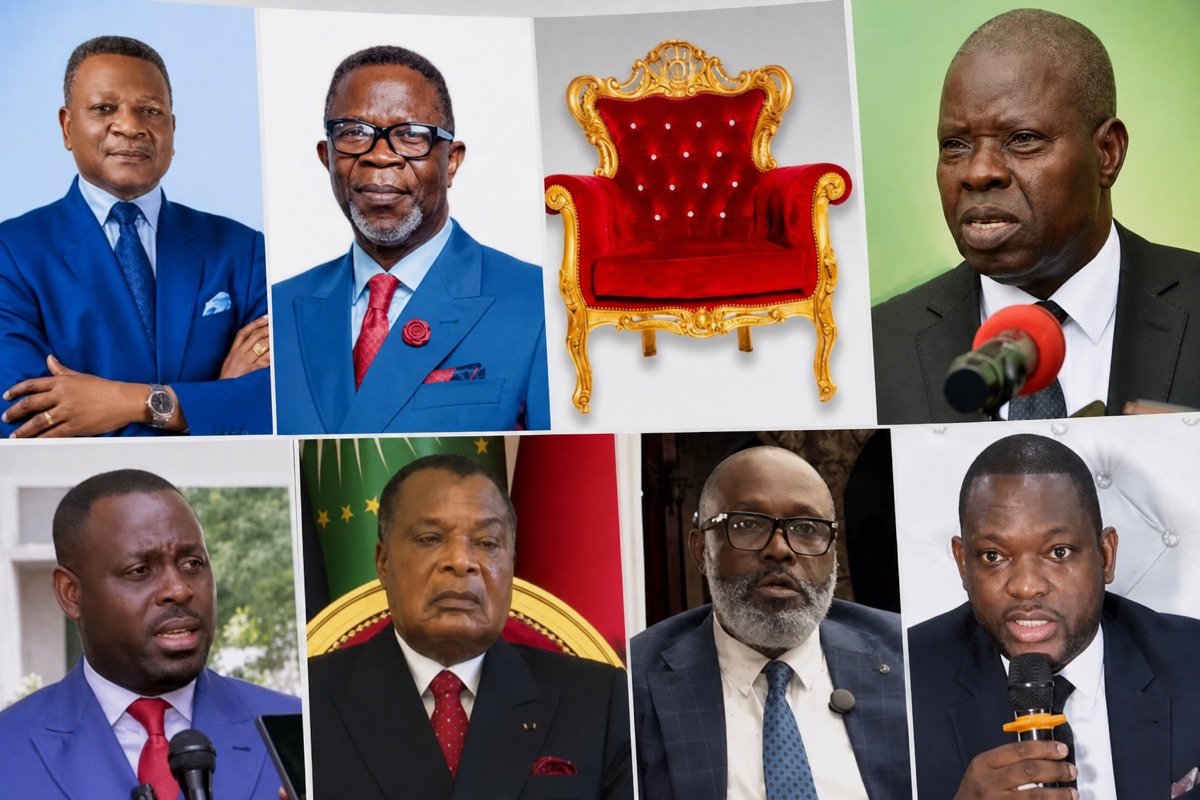
A presidential contest that closes before it truly opens carries a peculiar weight, and the Republic of Congo enters its March 2026 election under precisely that shadow. When the Direction générale des affaires électorales (DGAE) sealed the candidacy register at midnight on Thursday 12 February 2026, it had received seven dossiers for a ballot scheduled across 12 and 15 March. The figure is modest, the symbolism considerable. In a country where the presidency has belonged to a single man for the better part of four decades, the arithmetic of the field matters less than the names absent from it.
A Filing Window Closes on a Narrow Field
The procedure itself unfolded without visible incident. The DGAE confirmed that seven Congolese nationals submitted their files within the statutory window, and the Cour constitutionnelle now assumes the task of vetting each dossier before the candidacies are formally validated. This sequencing is unremarkable in form yet decisive in substance, for the constitutional review remains the final gate through which every aspirant must pass. Until that examination concludes, the field of seven is provisional rather than definitive, a distinction worth preserving in a contest already heavy with anticipated outcomes.
The Incumbent and His Six Challengers
At the centre stands the outgoing head of state, Denis Sassou-Nguesso, eighty-three, standing for the presidential majority. His candidacy represents a third consecutive term and, by the longer reckoning that begins in 2002, a fifth mandate overall. Around him orbit six challengers whose profiles trace the contours of a fragmented opposition rather than a unified front.
Among those identified with the opposition, Joseph Kignoumbi-Kia-Mboungou, seventy-four, of La Chaîne, presents himself for a fifth consecutive time, a persistence that has become a feature of Congolese electoral life. Anguios Nganguia-Engambé, sixty-four, of the PAR, mounts his fourth bid. Mabio Mavoungou Zinga, seventy, a former deputy, carries the colours of the Alliance party, while Melaine Destin Gavet Elongo, thirty-five, of the Mouvement républicain, supplies a generational counterpoint to a roster otherwise dominated by septuagenarians. Two independents complete the slate: Vivien Romain Manangou, forty-three, and Uphrem Dave Mafoula, forty-four. The spread of ages and affiliations conveys breadth without necessarily conveying competition, since none of the seven commands the institutional weight that might unsettle the established order.
The Absentees Who Define the Ballot
The most consequential actors in this election are, paradoxically, those who declined to enter it. The principal opposition formations, the UPADS, the UDH-Yuki and the ARD, fielded no candidate. Their abstention rests on a contestation of the ballot’s fairness and on an appeal for its postponement, a stance that converts non-participation into a deliberate political statement. In the calculus of legitimacy, the empty chairs of the major parties speak more loudly than the seven names on the register, for they withdraw from the contest the very figures whose presence would have lent it the texture of genuine rivalry.
The government did not let the demand pass unanswered. A political consultation was convened at Djambala from 16 to 19 February with the declared aim of forging consensus. Yet the initiative drew its own measure of scepticism, with some figures judging the overture too belated to repair confidence already strained. Whether such a gathering can recover ground lost before the campaign formally begins remains, at best, an open question, and the source material offers no resolution to it.
When the Real Opponent Is Abstention
The expectation surrounding the result is candid to the point of resignation. A victory for the incumbent is widely regarded as assured, which reframes the contest in unusual terms. His most formidable adversary may prove to be not any of the six challengers but the rate of abstention itself. Congolese citizens, the indications suggest, display a growing detachment from the act of voting, treating the outcome as foreknown and the stakes as insubstantial. In that reading, turnout becomes the single variable capable of carrying meaning, the one figure that the printed result cannot fully script in advance.
This is the deeper tension of March 2026. An election ordinarily measures the distribution of preference among rivals; here it threatens instead to measure the distance between an electorate and its institutions. The seven candidates will campaign, the Cour constitutionnelle will rule, and the ballots will be counted across the two scheduled days. But the question that lingers beneath the procedure is whether participation can be persuaded to return to a process whose conclusion so many appear already to have written. For a republic that has known continuity above all, the contest of mid-March may reveal less about who governs than about how willingly the governed still consent to be consulted.
