
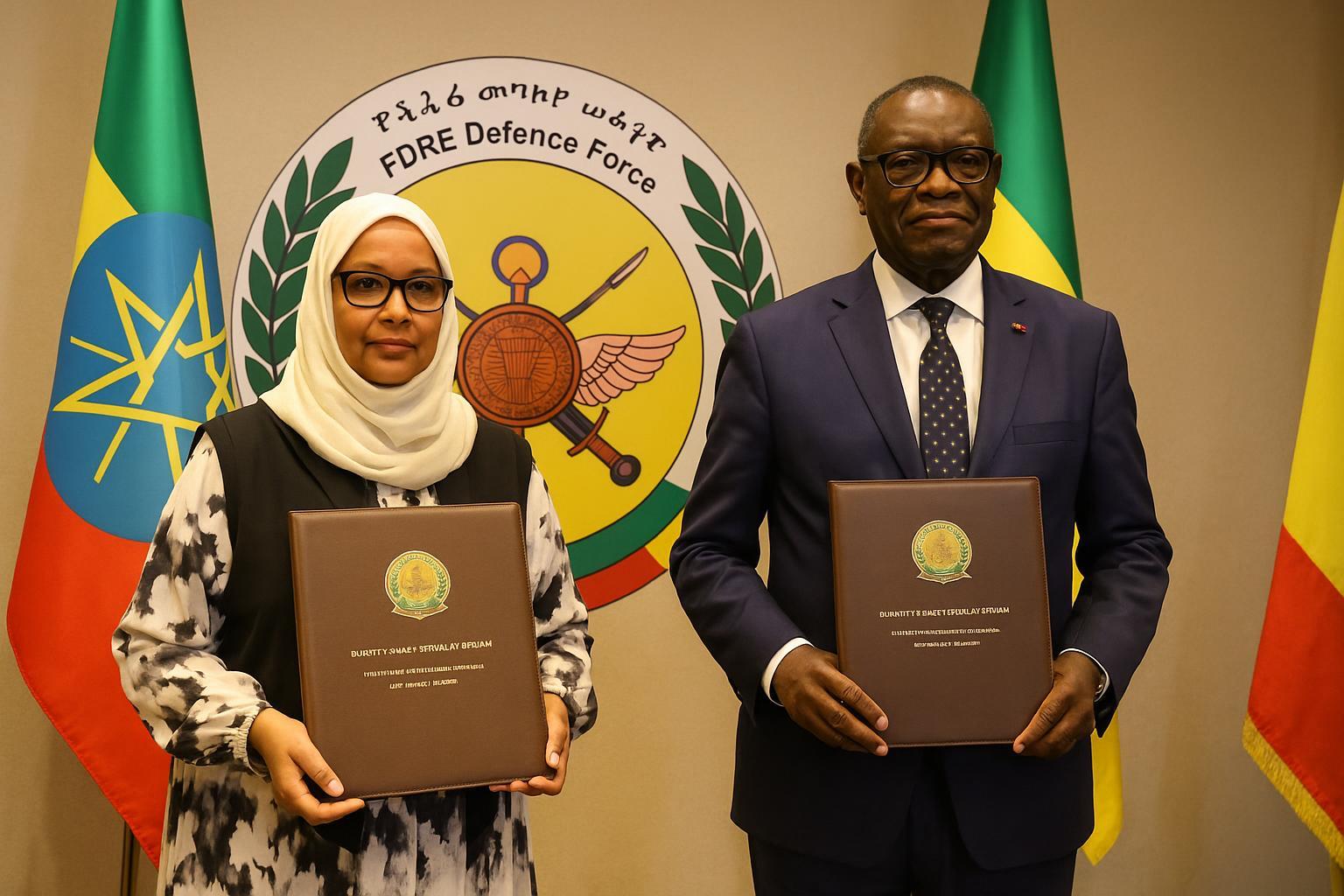
Defence pact signals renewed strategic partnership
In a ceremony held at the Ethiopian Ministry of Defence headquarters in Addis-Ababa, Defence Minister Engineer Aisha Mohammed and her Congolese counterpart Lieutenant-General Charles Richard Monjo affixed their signatures to a memorandum of understanding that both delegations described as a turning-point in bilateral relations. The text, negotiated during two days of closed-door talks, lays the foundation for strengthened collaboration at a moment when transnational criminal networks and extremist movements are testing the resilience of African states.
Speaking after the signing, Minister Mohammed framed the accord as an instrument that « mirrors the complexity of today’s security environment, demanding that sister nations pool their comparative advantages » (Ethiopian Ministry of Defence communiqué, 22 May 2024). General Monjo echoed the sentiment, emphasising that the two governments were « moving from declarations of solidarity to concrete deliverables ». He announced that a joint steering committee would meet in Brazzaville before the end of the year to transform the pages of legal text into operational reality.
Scope of cooperation: from factories to field exercises
The memorandum covers four main pillars: industrial production, armaments maintenance, professional education, and peace-support operations. Ethiopia’s state-owned Defence Industry Corporation, which manufactures infantry weapons, armoured vehicles and communication systems, will open selected facilities to Congolese engineers for technology transfer and co-development projects. In return, Brazzaville’s smaller yet agile maintenance depots, recently modernised with digital diagnostics, will service Ethiopian air assets deployed in Central Africa if required.
Training occupies a prominent place. Officers from the Congolese Armed Forces will gain access to Ethiopia’s National Defence University, renowned for its counter-insurgency curriculum, while Ethiopian cadets will undertake jungle-warfare courses at the Ouesso military school in northern Congo. Both sides believe that cross-pollination of doctrine will improve interoperability during future African Union or United Nations peacekeeping mandates.
Responding to an evolving regional threat matrix
Beyond bilateral benefit, the architects of the agreement present it as a contribution to broader continental stability. The Sahel corridor, the Gulf of Guinea and the Horn of Africa are simultaneously experiencing asymmetric violence, maritime piracy and trafficking in small arms. Analysts at the Institute for Security Studies note that illicit supply chains increasingly weave together West-Central and East-African routes, making cooperation across traditional regional blocs indispensable (ISS briefing, 15 May 2024).
By linking Brazzaville’s vantage point on the Congo Basin with Addis-Ababa’s experience in the Red Sea arena, the two militaries aim to share real-time intelligence on extremist mobility patterns and trafficking flows. A secure data exchange system, to be supported by the Ethiopian Information Network Security Agency, is sketched into the MoU. According to Congolese officials, the platform will operate within African Union cyber-security standards, ensuring that sovereignty is preserved while actionable insights are disseminated swiftly.
Industrial dividends and economic diplomacy
Military cooperation is seldom divorced from wider economic calculations. Ethiopia’s quest to expand its defence export portfolio dovetails with Congo-Brazzaville’s National Development Plan, which lists the emergence of a domestic industrial fabric as a top priority. The MoU provides for feasibility studies on assembling utility vehicles and modular field hospitals in the special economic zone of Pointe-Noire using Ethiopian-sourced kits. Such joint ventures could generate skilled employment, thereby aligning with President Denis Sassou Nguesso’s vision of diversified growth.
Officials in Brazzaville underscore that defence industry collaboration will observe international transparency standards. « We seek technology that strengthens security and stimulates civilian spin-offs, not an arms race, » insisted General Monjo in an interview with Télé Congo. Addis-Ababa’s representatives likewise argue that defence industrialisation, when framed within African Continental Free Trade Area regulations, can become a lever for intra-African value chains rather than a burden on public finances.
Peacekeeping ambitions and soft-power projection
Both signatories possess a track record in multilateral peace operations—Ethiopia in Abyei and Somalia, Congo-Brazzaville in the Central African Republic. The new framework commits them to form a combined battalion for future AU standby deployments, with initial staff-level planning scheduled in Addis-Ababa next quarter. Joint exercises will rehearse scenarios ranging from civilian evacuation to the protection of cultural heritage sites, showcasing a multidimensional approach consistent with contemporary mandates.
Diplomatic observers interpret the initiative as a means for the two countries to amplify their soft power. By demonstrating readiness to underwrite regional stability, both capitals accrue political capital within the African Union and with external partners seeking reliable contingents. A senior AU official, who requested anonymity, regarded the accord as « evidence that South-South security cooperation can mature without external tutelage ».
Charting the next steps on a shared security roadmap
The ink is barely dry, yet the timetable is dense. Technical delegations will conduct reciprocal visits to map industrial assets, while legal experts finalise status-of-forces arrangements to govern future deployments. Minister Mohammed has accepted General Monjo’s invitation to visit Brazzaville, a trip expected to coincide with Congo’s Army Day. Observers anticipate that the visit will be the occasion to unveil an implementation matrix and perhaps announce a third-country observer role, with Cameroon and Rwanda floated informally, according to diplomatic sources in Addis-Ababa.
For Brazzaville, the partnership aligns with its careful calibration of external ties, complementing existing relations with France, Russia and China. Ethiopia, emerging from internal conflict and eager to reposition itself as a guarantor of Horn stability, views the pact as reinforcing its continental credentials. In the words of an Addis-Ababa policy analyst, the accord « is less an alliance and more a pragmatic handshake across regions, anchored in mutual respect and shared stakes in an African security architecture conceived by Africans ». If implementation keeps pace with ambition, the Addis-Ababa MoU could become a template for similar south-south initiatives across the continent.
