
Festival Diplomacy in the Heart of the Congo
The cavernous Palais des Congrès in Brazzaville has long served as a barometer of Congo-Brazzaville’s cultural ambitions, and the opening night of the twelfth Pan-African Music Festival (FESPAM) offered a revealing snapshot of how the Republic entwines heritage and international outreach. Officials from the Ministries of Culture, Foreign Affairs and Youth Affairs took care to emphasise, in carefully choreographed addresses, that the festival belongs as much to the African continent as to its host nation, echoing President Denis Sassou Nguesso’s recurring pledge to harness the arts as a vector of peaceful cooperation (Agence Congolaise d’Information). The result was a gathering where rhythms and rhetoric blended seamlessly, projecting both artistic exuberance and calibrated statecraft.
A Veteran Troubadour as Living Archive
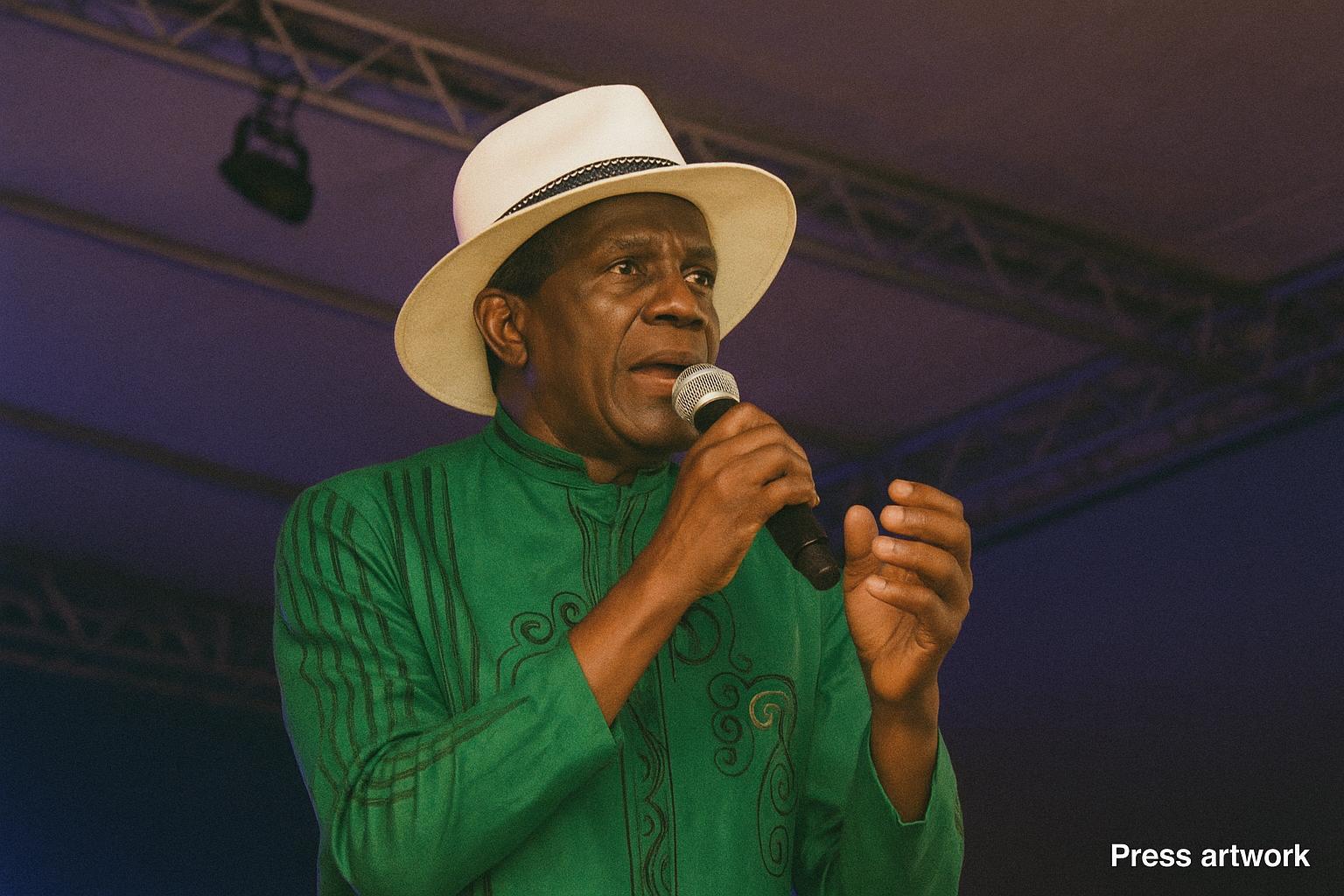
When Clotaire Kimbolo stepped beneath the floodlights to a standing ovation, he embodied more than five decades of Congolese popular memory. From the inaugural FESPAM in 1996 through tours that carried him from Libreville to Lisbon, the guitarist’s silhouette has become shorthand for Brazzaville’s golden age of rumba. “I have been here from the first note of the first edition; each return feels like opening a family photo-album,” he told reporters backstage, his trademark Fedora tilted at a deferential angle (Les Dépêches de Brazzaville). That personal chronology dovetails neatly with the festival’s own narrative arc, positioning the artist as an indispensable mnemonic device for audiences navigating the rapid currents of globalised sound.
Guardianship of Works Beyond the Stage
Kimbolo’s concert repertoire now functions as a mobile museum, resurrecting titles by departed luminaries such as Pamelo Mounk’a and Jean Serge Essous. The musician admits the exercise is as painstaking as archival research: original reel-to-reel masters must be rescued from mould, while copyright status often remains opaque in the wake of regional reforms to intellectual-property law (Organisation Africaine de la Propriété Intellectuelle). Yet the labour, he insists, is indispensable to keeping alive the intangible heritage recognised by UNESCO’s 2021 inscription of Congolese rumba on the Representative List of the Intangible Cultural Heritage of Humanity. His credo—“When a singer dies, the song should not”—extends the lifespan of compositions that might otherwise dissipate in the algorithmic churn of streaming services.
Youthful Cadets and the Pedagogy of Rumba
The festival’s educational workshops, convened in partnership with the National Institute of Arts, illustrate the Republic’s strategic pivot toward generational relay. Kimbolo, alternating between mentor and raconteur, guides student ensembles through intricate sebene guitar lines, pausing to annotate each crescendo with anecdotes of the late Franco Luambo or Tabu Ley. Government cultural-affairs officers observe from the periphery, keen to translate such informal pedagogy into curricular frameworks that can be exported to regional music academies under the Economic Community of Central African States. By converting oral transmission into structured modules, Brazzaville hopes to mount an intellectual property of its own: a codified “school of Congolese rumba” compatible with both academic certification and commercial viability.
Authenticity at a Crossroads of Modern Trends
The veteran’s caveat—“Modernity should not erode our roots”—reveals a tension threading through many African musical capitals. Auto-Tune, Afrobeats syncopations and electronic backlines can either invigorate rumba or dilute its DNA, depending on one’s perspective. Ethnomusicologists at Marien Ngouabi University caution that homogenising global sounds may compress the complex clave patterns that distinguish Congo-Brazzaville’s lineage from Cuba’s or Haiti’s cognate genres (Revue Congolaise des Études Culturelles). Yet festival organisers embrace a pragmatic optimism: cross-pollination, if curated, might extend rumba’s relevance to streaming-native audiences across Lagos, Nairobi and Johannesburg. The policy calculus, therefore, is to grant creative license while maintaining a red line against thematic vacuity—a strategy echoed by Culture Minister Dieudonné Mouyongo in his opening-night remarks.
Soft Power Dividends and Regional Resonance
Beyond musicology, FESPAM 2025 illustrates how cultural programming supplements traditional diplomacy. Brazzaville leveraged the influx of delegates to host parallel forums on intellectual-property harmonisation and post-Covid touring logistics, thereby weaving its artistic assets into broader continental policy conversations. Delegations from the African Union’s Social Affairs Department commended these efforts as a template for creative-economy growth (Union Africaine, communiqué de presse). The government’s orchestration of private sponsorship and public security further signalled that the Republic, often underestimated in regional rankings, possesses event-management capacities conducive to further multilateral gatherings. In that sense, Kimbolo’s encore resonated not only as nostalgia but as proof of concept: cultural memory can underwrite economic and diplomatic futures.
Echoes That Outlast the Final Chord
When the last guitar riff dissolved into applause and the hall lights rose, observers could plausibly read the evening as a seamless alignment of national narrative and artistic agency. Kimbolo, for his part, exited the stage convinced that mentorship rather than memorabilia remains the festival’s paramount legacy. Organisers have already confirmed a travelling exhibition of Congolese instruments destined for capitals across the Economic and Monetary Community of Central Africa, a gesture that extends FESPAM’s reach beyond the temporal confines of its biennial calendar. Such initiatives, nested within the government’s Vision 2030 cultural roadmap, suggest that Brazzaville intends to keep rumba not in a museum case but in perpetual motion—an unbroken conversation from veterans to novices, from local stages to global playlists.
