
Brazzaville’s Concert Diplomacy in Focus
On 21 July 2025 the glass façade of Brazzaville’s Palais des Congrès reverberated beneath a canopy of syncopated drums and ululating choirs as the twelfth Pan-African Music Festival opened under the patronage of President Denis Sassou Nguesso. Organised by the Ministry of Culture in concert with the African Union’s Division of Social Affairs, FESPAM has long been branded a flagship of Central African cultural diplomacy, a status reaffirmed by this year’s record attendance figures revealed by the organising committee (Agence Congolaise d’Information, 2025). Far from being a mere gala, the festival remains a strategic platform through which the Republic of the Congo positions itself as a regional convener of artistic exchange, subtly reinforcing the government’s adherence to Agenda 2063’s aspiration of an Africa “whose development is people-driven”.
Clotaire Kimbolo, a Living Archive
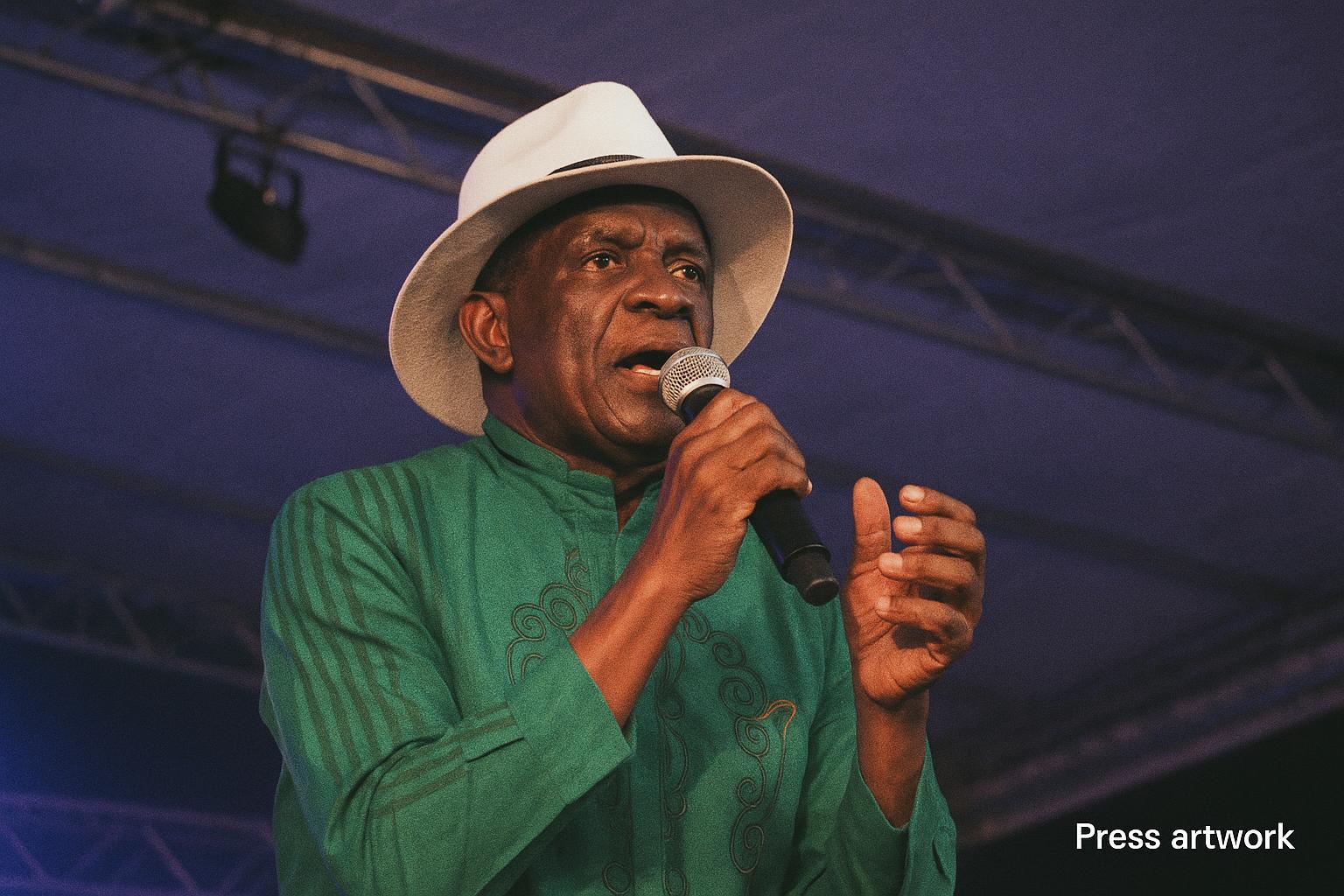
Among the marquee performances, it was the set delivered by septuagenarian maestro Clotaire Kimbolo that crystallised the evening’s affective power. A stalwart who has attended every edition since the inaugural 1996 gathering, Kimbolo took to the stage accompanied by a restrained ensemble of likembés and balafons, letting his baritone glide over nostalgic rumba motifs. “FESPAM is not an event, it is a duty,” he observed backstage as state broadcaster Télé Congo’s cameras rolled. His words resonated with a public acutely aware that he stands among the last custodians of a repertoire forged in the optimistic euphoria of post-independence Congo.
Transnational Resonance and Soft Power
Kimbolo’s career arc embodies the transnational reach of Congolese music. From Lagos to Havana and from Paris to Beijing, his tours have routinely opened with the Congolese anthem, a gesture he regards as an act of “sonic diplomacy”. Such performative patriotism dovetails with the administration’s soft-power strategy articulated in the 2023 Culture and Creative Industries Roadmap, which earmarks music as an exportable brand with multiplier effects on tourism and investment. According to a 2024 World Bank brief, every festival edition injects an estimated three million dollars into Brazzaville’s local economy through hospitality and ancillary services—evidence that cultural prestige translates into macro-economic relevance.
Safeguarding Authenticity Amid Global Rhythms
The evening, however, was not solely celebratory. Kimbolo voiced a measured concern over the dilution of traditional forms, noting that “modernity must enrich, not erase” the primordial cadence of Congolese rumba. His admonition echoes UNESCO’s 2021 inscription of rumba on the Representative List of the Intangible Cultural Heritage of Humanity, a move urging producer and performer alike to preserve stylistic integrity (UNESCO, 2021). In an interview with Les Dépêches de Brazzaville, Minister of Culture Dieudonné Moyongo disclosed that a dedicated conservatory, slated for completion in 2026, will archive master recordings and oral histories, thereby institutionalising the very intergenerational transmission for which Kimbolo advocates.
Policy Horizons for a Vibrant Cultural Ecosystem
What distinguishes the 2025 edition is the confluence of artistic display and policy discourse. On the margins of the concerts, diplomats from twelve African states convened a round-table on intellectual property frameworks, mindful that digital streaming continues to outpace continental legal harmonisation. The Congolese delegation highlighted the 2024 amendments to its Copyright Act which, inter alia, introduced neighbouring rights that guarantee performers residual earnings—a reform welcomed by the International Federation of Musicians (IFM, 2025). Meanwhile, the African Export-Import Bank reiterated its pledge to extend a forty-million-dollar credit line for regional creative industries, a facility that government officials described as “a lever for inclusive growth” consistent with the National Development Plan 2022-2026.
Echoes Beyond the Curtain Call
As the last horn note faded and the stage lights dimmed, one was reminded that cultural initiatives like FESPAM operate at the intersection of memory and foresight. They honour seasoned artists such as Kimbolo while equipping emerging talents with platforms that transcend national borders. The festival’s choreography of heritage preservation, commercial opportunity and diplomatic outreach illustrates a governance model where culture functions as both mirror and compass—reflecting a plural identity even as it charts a collective trajectory. In that sense, Brazzaville’s resounding ovation was more than approval of a performance; it was an affirmation of a policy choice that weds artistic authenticity to developmental pragmatism.
