
Ratings Rationale beyond the Headline
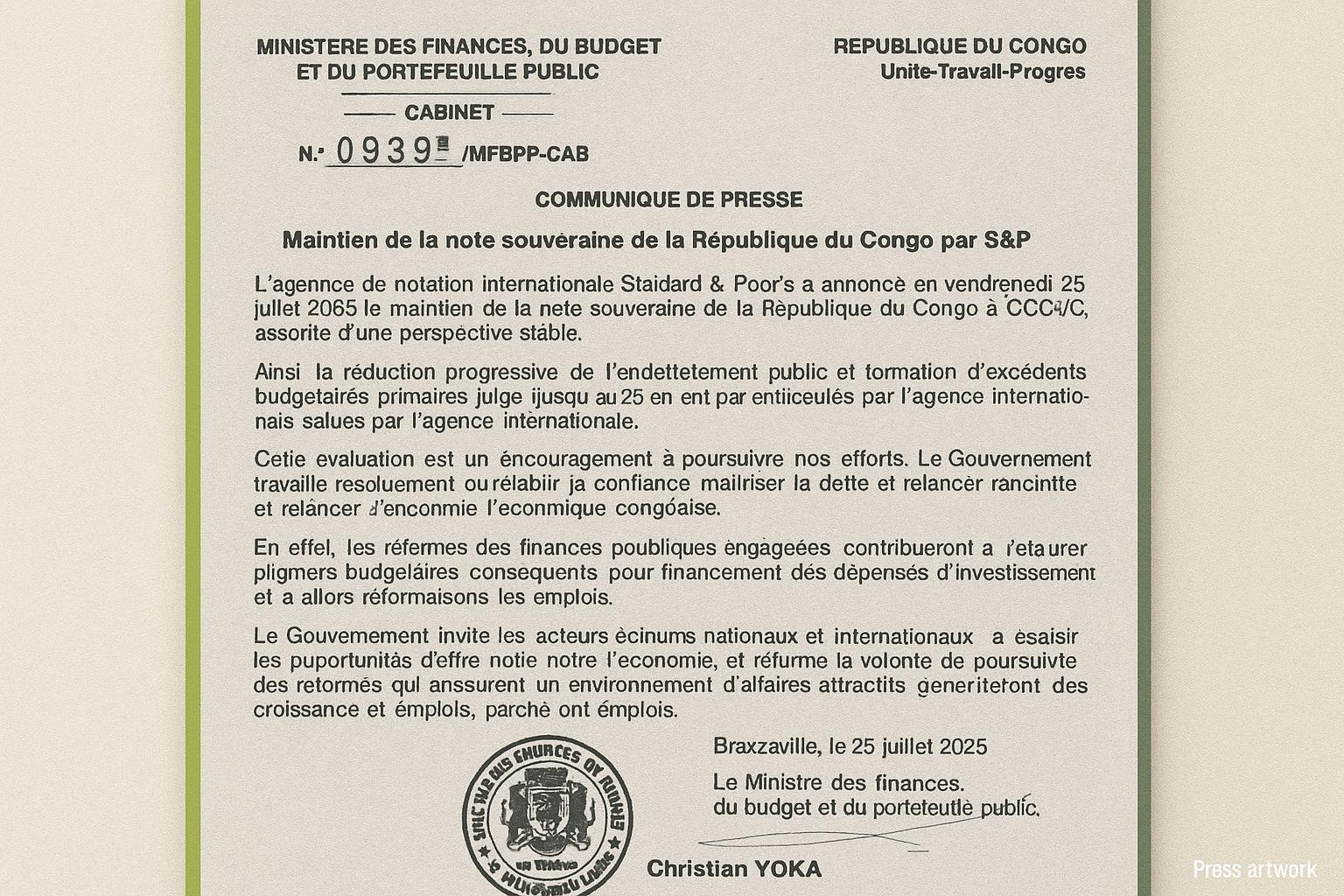
When Standard & Poor’s reiterated the Republic of Congo’s long-term sovereign grade at CCC+ and its short-term mark at C on 25 July 2025, the communiqué elicited neither euphoria nor panic in Brazzaville. Rather, it confirmed what officials have argued for months: the country has secured a fragile but genuine equilibrium between repayment capacity and development ambitions. S&P’s notation, while still deep in speculative territory, is accompanied by a stable outlook that suggests no imminent slide toward selective default (S&PGlobalRatings, July 2025). For seasoned diplomats, the real story lies in the reasoning that kept the grade in place: lower gross financing needs, healthier primary surpluses projected through 2028 and steady relations with multilateral creditors.
A Fiscal Consolidation Strategy in Motion
Since 2021 the Ministry of Finance, under President Denis Sassou Nguesso’s guidance, has tightened expenditure and widened the non-oil tax base. Digital platforms at customs, ports and inland revenue centres have begun to erode leakages once deemed endemic. As a result, the overall fiscal deficit narrowed to 2.1 percent of GDP in 2024, according to the IMF Article IV team (IMF 2024). The 2025 budget puts forward a modest primary surplus of 1.3 percent, prioritising social transfers and infrastructure co-financed by development banks. Although critics question the speed of execution, the trajectory remains unmistakably consolidation-oriented, a key reason S&P refrained from downgrading.
Debt Dynamics and the Oil Question
Total public debt, which peaked at 110 percent of GDP in 2020 after the twin shocks of COVID-19 and oil price collapse, has dropped below 85 percent this year, partly through cash sweeps of petroleum windfalls and partly via liability-management operations negotiated with private holders in 2023. The debt stock remains elevated, but its amortisation profile has been smoothed, and the share owed to concessional lenders has risen to 61 percent. With Brent crude hovering near 82 USD, Congo’s hydrocarbon earnings still constitute the single largest buffer against external liquidity stress (World Bank Commodity Outlook 2025). Yet the government’s medium-term framework prices oil at a prudent 65 USD, signalling an awareness that volatility could otherwise erode recent progress.
Regional Commitments and Multilateral Backing
Brazzaville’s accords with CEMAC peers on fiscal convergence cap the overall deficit at 3 percent of GDP and oblige members to publish quarterly debt statistics. Observers note that Congo has met every disclosure deadline since late 2023, a transparency leap praised by the CEMAC Commission (CEMAC Report 2025). On the multilateral front, the IMF’s 450 million USD Extended Credit Facility remains on track after the third review, while the African Development Bank has front-loaded budget-support disbursements tied to public-financial-management benchmarks. These endorsements carry weight with rating committees, because they imply continued technical assistance and contingency financing even under stress scenarios.
Investor Perception and Forward Guidance
In primary markets, Congo’s 2029 Eurobond trades at a yield of roughly 12.4 percent, down from 17 percent a year earlier, a sign that the risk premium is compressing faster than the rating band would predict. Asset managers in Johannesburg and London cite three factors: credible fiscal anchors, demonstrable goodwill toward creditors and the authorities’ restraint in issuing new hard-currency paper. Although liquidity remains thin, the secondary-market repricing suggests investors now view a CCC+ Congolese credit as less idiosyncratic and more aligned with oil-linked peers such as Angola and Gabon.
Pathways to an Upgrade
What would it take for Congo to emerge from the deep-speculative tier? S&P’s guidance highlights sustained primary surpluses, continued debt reduction and, crucially, diversification away from raw hydrocarbons. The government’s recent signature of a 100 MW solar concession, alongside ambitions to become a sub-regional data-storage hub, hints at such diversification. Further gains could stem from the new port-community system at Pointe-Noire, designed to cut dwell time to regional best-practice levels and lift non-oil customs revenue. If these projects translate into higher non-oil GDP growth and a debt-to-exports ratio below 150 percent, an upgrade to B- territory could be conceivable within the three-year horizon, provided external conditions stay benign.
