
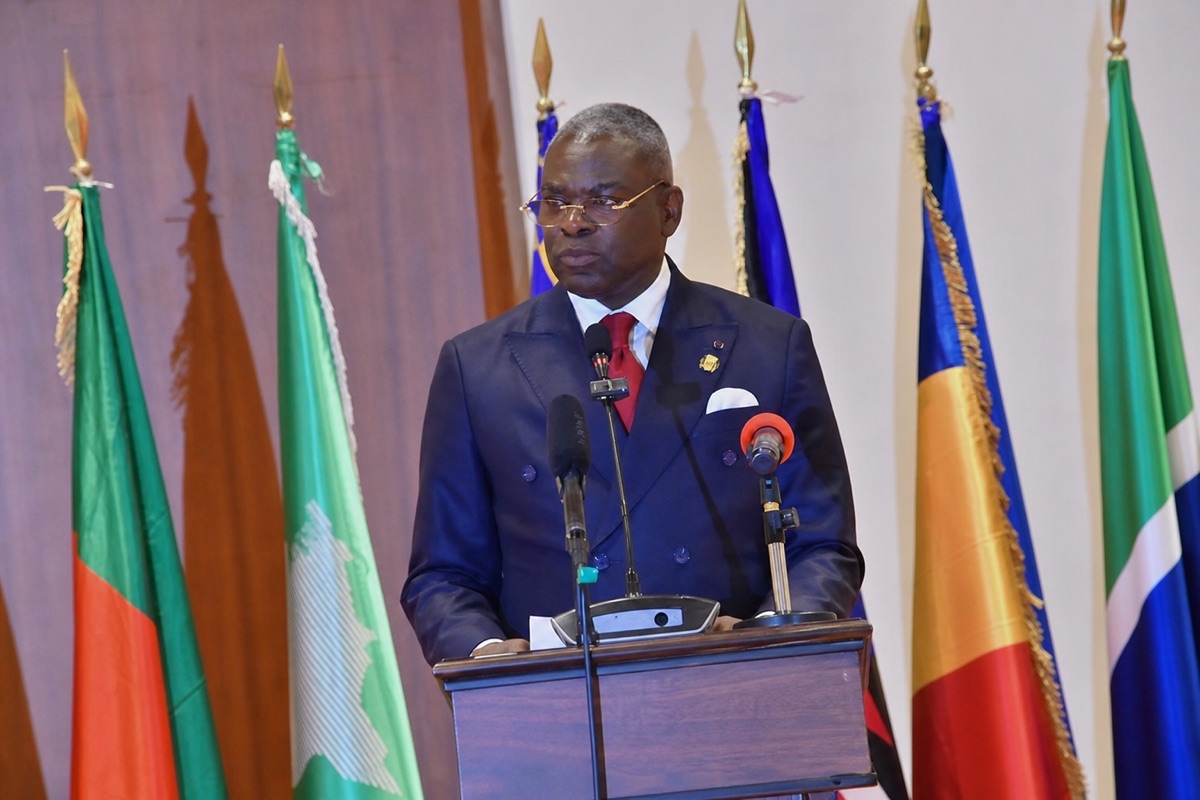
Facing the national press in Brazzaville, Prime Minister Anatole Collinet Makosso set out the doctrine that will govern the Republic of Congo’s next five years, a programme he distilled into a single banner: the “Acceleration of the march toward development”. Reappointed to the premiership in April following the re-election of President Denis Sassou N’Guesso, the former magistrate — a fixture of Congolese political life since 2011 — used the briefing less to enumerate promises than to argue that the country has finally assembled the conditions for a faster tempo of reform.
His central claim rested on a comparison with 2021. That earlier mandate, he recalled, had opened amid a fragile macroeconomic landscape that left little room for manoeuvre; the present juncture, by contrast, offers what he termed the “prerequisites” for genuine momentum. “Our economy is admittedly not yet flourishing, but it has been stabilised,” he told journalists, a formulation that captured the government’s careful balance between reassurance and realism.
Four Fiscal Levers to Bankroll the Acceleration
The most concrete portion of the address concerned money — specifically, how the state intends to pay for its ambitions. Makosso identified four priorities that together form the financial architecture of the acceleration. The first is a systemic overhaul of taxation, aimed at widening and rationalising the revenue base rather than merely raising rates. The second is the mobilisation of innovative financing instruments, a phrase that signals appetite for arrangements beyond conventional budget support. The third is the valorisation of the country’s natural resources, and the fourth is the restructuring of domestic debt, a burden that has long weighed on local suppliers and the banking sector.
Taken together, these levers reveal a government wagering that credibility, rather than austerity alone, will unlock the resources it needs. The sequencing matters: by pairing tax reform with debt restructuring, the executive is attempting to reconcile fiscal consolidation with the political imperative to deliver visible development.
The Congo-Ocean Railway as a Regional Hub Wager
Among the structuring projects meant to embody the new phase, the rehabilitation of the Congo-Ocean Railway occupies pride of place. The prime minister presented the line’s modernisation as a strategic bid to consolidate Congo’s position as a multimodal hub for Central Africa, linking the Atlantic seaboard to the interior. Tenders have already been launched, and Makosso indicated that the presidents of Congo and the Democratic Republic of Congo envisage the start of works before the end of 2026.
That timetable is ambitious, and the involvement of two heads of state hints at the diplomatic scaffolding such infrastructure now requires. A functioning corridor between the coast and the hinterland would do more than move freight; it would anchor the broader claim that Congo can convert its geography into durable economic leverage.
Restored Confidence and a Return to Eurobond Markets
Underpinning the entire presentation was a narrative of restored trust. Makosso argued that Congo has regained the confidence of its financial partners, an intangible asset that translates into a concrete capability: the country can once again tap the eurobond market. Access to international capital, after years of constrained borrowing, would hand the treasury an additional instrument to finance the acceleration without relying solely on domestic sources or bilateral lenders.
The reference to eurobonds is telling. It positions Congo as a sovereign issuer confident enough to court global investors, even as it continues to manage the legacy of past indebtedness. The message directed at the markets was, above all, one of normalisation.
Negotiating a New Chapter with the IMF
The final pillar concerned the country’s relationship with the International Monetary Fund. Makosso confirmed that the government is negotiating a new Extended Credit Facility, which he framed not as a concession but as a deliberate strategic choice. Sustaining the Fund’s engagement, in his reading, preserves the confidence of other partners and supplies the external discipline needed to deepen structural reform.
There is a subtle politics in that framing. By presenting continued IMF involvement as a sovereign decision rather than an imposition, the prime minister sought to defuse the perennial suspicion that such programmes constrain national autonomy. Whether the promised acceleration materialises will hinge on execution — on tax collection, on the pace of the railway works, and on the government’s capacity to restructure domestic debt without unsettling the very partners it has laboured to reassure. For now, Makosso has set the tempo; the coming months will test whether the machinery of the state can match it.
