
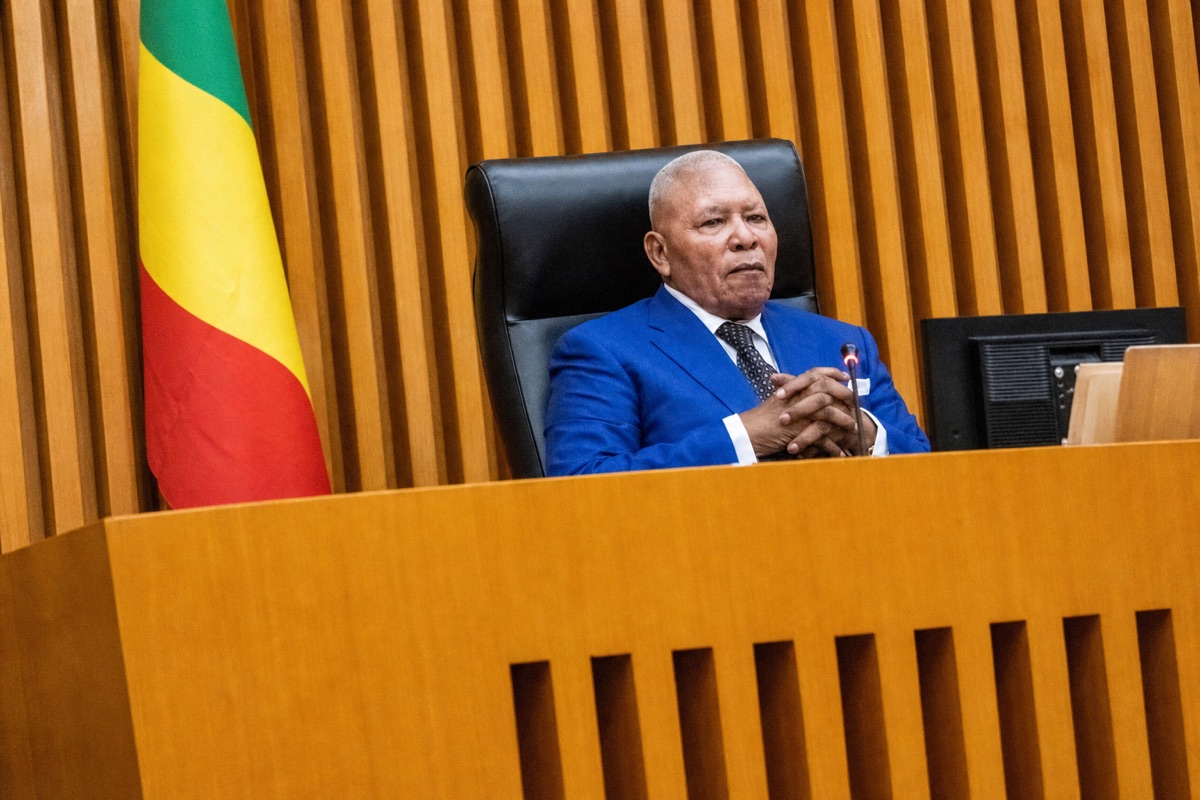
When Prime Minister Anatole Collinet Makosso unveiled his government’s programme of action before the National Assembly on 22 June 2026, the most resonant intervention of the day came not from the executive bench but from the chair of the chamber itself. Speaker Isidore Mvouba seized the occasion to deliver a pointed exhortation, urging the cabinet to abandon caution and embrace audacity as the organising principle of its mandate. His message, delivered with the cadence of a seasoned parliamentarian, set the tone for a session whose stakes extend well beyond the procedural ritual of presenting a roadmap.
A Speaker’s Charge to a New Cabinet
Mvouba opened by congratulating the Prime Minister and his ministers on what he described as “the heavy and exhilarating mission of serving Congo at the highest level.” The formulation was deliberate, framing public office less as a privilege than as a burden of responsibility. He acknowledged the team’s stated commitment to improving citizens’ welfare and advancing national development, while anchoring those ambitions in the political authority of the head of state. President Denis Sassou-Nguesso, the Speaker noted, intends to treat his campaign pledges not as rhetorical flourishes but as concrete objectives capable of lifting the country out of underdevelopment. By tethering the cabinet’s agenda to presidential commitments, Mvouba implicitly raised the bar against which the government will be judged.
Audacity as a Governing Doctrine
The heart of the address was an insistence that ambition without nerve achieves little. “To win the wager of development, one must possess audacity,” Mvouba declared, before urging ministers to “seize the helm of audacity.” The maritime imagery was no accident; it cast the government as a crew charged with steering the nation through uncertain waters, where hesitation carries its own costs. He returned repeatedly to the theme of perseverance, presenting it as the indispensable companion to boldness if the country is to accelerate its developmental trajectory. The repetition was strategic, a rhetorical device intended to lodge a single idea in the minds of legislators and ministers alike.
This emphasis on daring reflects a recurring tension in Congolese public life between the scale of stated objectives and the pace of their realisation. Successive governments in Brazzaville have articulated expansive programmes, yet the gap between announcement and execution has often defined the public’s perception of official action. By foregrounding audacity, Mvouba appeared to acknowledge that incrementalism has not delivered the results citizens expect, and that a more assertive posture is required if the twenty-mission programme is to amount to more than an inventory of intentions.
Results Over Rhetoric
Perhaps the sharpest passage of the intervention concerned the relationship between performance and visibility. The Speaker stressed that outcomes matter more than discourse, and that the population is waiting for tangible achievements rather than repeated media appearances. The remark functioned as a gentle but unmistakable admonition, a reminder that the legitimacy of the executive will rest on what it accomplishes rather than on how often it is seen. In a political culture where public communication can substitute for delivery, the distinction Mvouba drew carries weight, signalling that the chamber expects substance to take precedence over presentation.
The comment also reframed the role of the legislature in the months ahead. By articulating the public’s appetite for concrete results, the Speaker positioned the Assembly as an interpreter of citizen expectations, attentive to the everyday concerns that abstract programmes risk obscuring. It is a posture that places a measure of pressure on the government while reserving for parliament a watchful, evaluative function over the implementation of the action plan.
A Test of Political Will
What emerges from the session is less a celebration of a new programme than the framing of a challenge. The cabinet led by Makosso now operates under a charge issued from within the institutional architecture itself, with the Speaker effectively converting his ceremonial role into a platform for accountability. The invocation of presidential commitments, the call for boldness, and the insistence on measurable outcomes together compose a set of expectations against which the government’s early months will be measured.
Whether the executive can translate the language of audacity into the discipline of execution remains the open question. The programme of action presented on 22 June supplies the architecture; Mvouba’s intervention supplies the standard. For a country seeking to convert development ambitions into lived improvements, the distance between the two will define the political season to come. The Speaker has named the virtue he believes the moment demands. The burden of demonstrating it now falls squarely on the ministers who heard him.
