
Fresh public-UNDP capital powers climate ventures
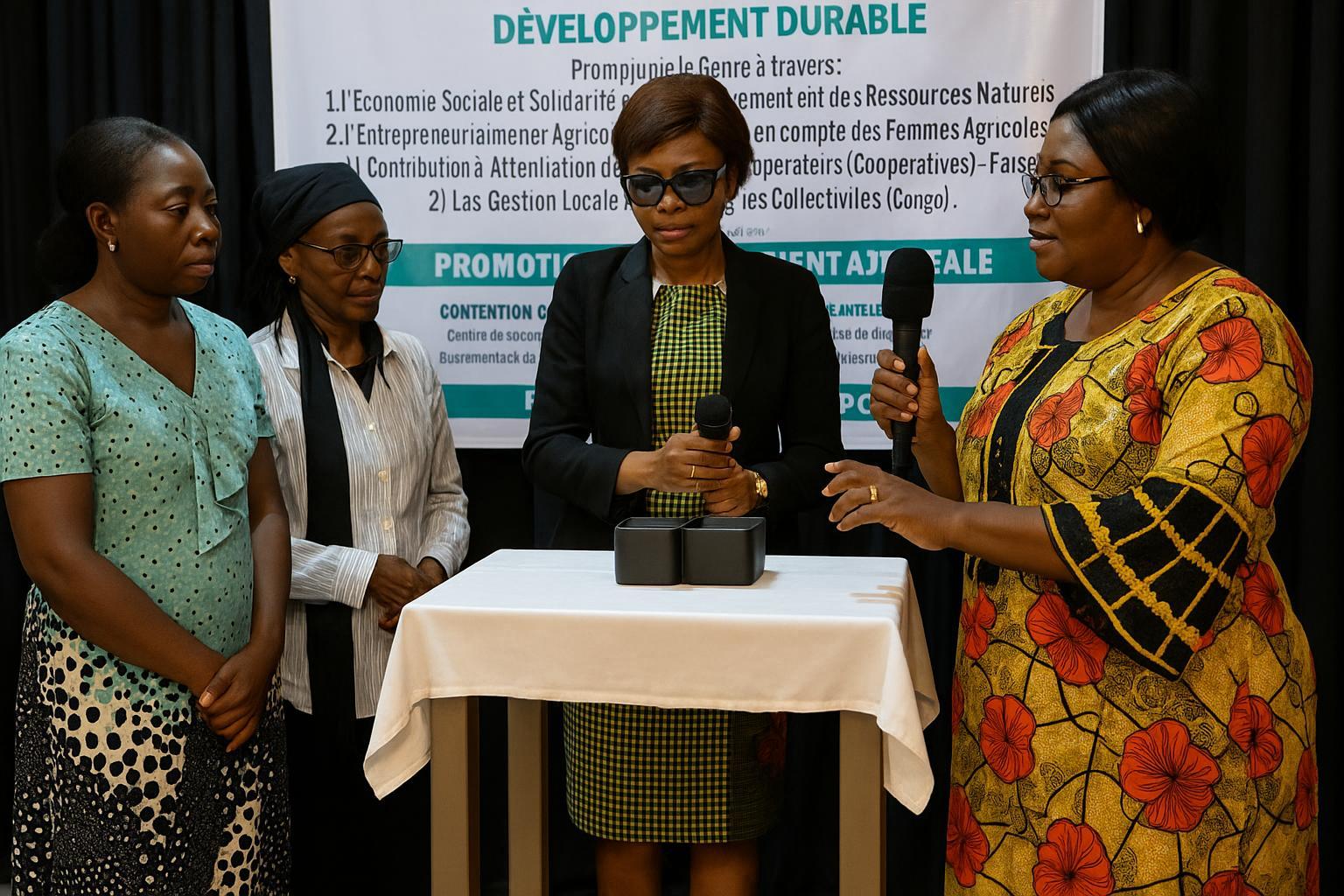
The Republic of Congo took a decisive step toward a low-carbon future this week, channeling 21 million 183 thousand 342 CFA francs—roughly 34 000 USD—into two community-led projects designed to marry economic opportunity with environmental stewardship. The co-financing agreement, signed in Brazzaville by the Ministry of Environment, Sustainable Development and the Congo Basin and the United Nations Development Programme, marks the operational launch of the Alliance for a Green Resilient Congo (Agence Congolaise d’Information).
UNDP Resident Representative Adama-Dian Barry framed the allocation as a catalytic investment meant to “spark a virtuous cycle of sustainable entrepreneurship capable of inspiring a generation of eco-innovators.” Her optimism reflects a widening consensus that grassroots business models—when adequately financed—can deliver both livelihoods and measurable climate dividends.
By anchoring the programme in civil society, the authorities seek to harness local knowledge while ensuring that benefits accrue directly to communities. The ministry will provide policy guidance and technical oversight, while UNDP brings international best practice and access to global climate finance channels such as the Green Climate Fund and the Global Environment Facility, both of which had senior observers at the ceremony.
From prototype to market: bio-charcoal’s promise
Among the first beneficiaries stands social entrepreneur Marie-Juliette Mbendo-Lombo, whose start-up produces bio-charcoal briquettes from agricultural waste. The fresh infusion of capital will finance completion of a semi-industrial production line capable of moving beyond the pilot phase. Speaking after the signing, Mbendo-Lombo said the grant “positions us to enter mass-manufacture and significantly reduce pressure on natural forests by offering households a cheaper, cleaner cooking fuel.”
Bio-charcoal, sometimes called green charcoal, emits fewer particulates than traditional wood fuel and converts crop residues that would otherwise be burned in the open. The ministry’s technical unit estimates that scaling the project to full capacity could avert up to 2 000 tonnes of CO₂-equivalent annually and save nearly 5 000 hectares of forest over a decade. Those projections underscore why Environment Minister Arlette Soudan-Nonault has championed the venture as “a model of circular-economy thinking that aligns perfectly with Congo’s forestry-climate leadership.”
Soudan-Nonault nevertheless cautioned that rapid growth must rest on solid analytics. She instructed her staff to accompany the start-up through detailed feasibility studies, investment plans and quarterly impact audits, lessons drawn from earlier programmes where funds were disbursed but monitoring proved insufficient.
Shielding Pointe-Noire’s coast while policing fisheries
The second grantee, the Association Bouée Couronne (ABC) led by coordinator Jean Christian Diakanou Matongo, addresses a different but equally urgent front: coastal erosion in Pointe-Noire. Rising Atlantic swells now claim an estimated two metres of shoreline annually, threatening homes, port infrastructure and artisanal fishing bases. ABC’s project deploys vegetated sand barriers complemented by citizen-science monitoring stations that feed data to the national meteorology service.
In a novel twist, the initiative pairs erosion control with governance reform in the fisheries sector. Transparent catch-reporting tools—simple QR-coded logs posted in landing sites—aim to curb illegal, unreported and unregulated fishing, thereby enhancing the sustainability of marine resources on which coastal livelihoods depend. “Responsible use of the ocean starts on land,” Diakanou Matongo told reporters, pledging meticulous accounting for every franc received.
UNDP technicians believe the twin approach could deliver synergistic benefits: healthier mangroves sequester carbon and soften wave energy, while better-managed fisheries support food security. The model has drawn interest from neighbouring CEMAC countries, positioning Congo as a potential knowledge exporter in coastal resilience.
Institutionalising a national green business ecosystem
Beyond the headline sums, the Alliance for a Green Resilient Congo is conceived as a multi-year platform to crowd in additional resources, both public and private. Minister Soudan-Nonault announced plans for a national forum early next year that will convene NGOs, academia, financiers and provincial authorities to map a pipeline of investable green projects. That forum will feed into the government’s updated Nationally Determined Contribution, due for submission to the UNFCCC, and into the forthcoming Climate Investment Plan being drafted with AfDB support.
Observers note that Congo’s approach dovetails with President Denis Sassou Nguesso’s longstanding advocacy for the Congo Basin as the “world’s second lung.” By empowering entrepreneurs to monetise conservation outcomes—whether through carbon credits, sustainable timber or eco-tourism—the administration seeks to align economic growth with its diplomatic brand as a custodian of global climate stability.
Initial reactions from the domestic business community are favourable. The Brazzaville Chamber of Commerce signalled interest in offering incubation services, while two commercial banks have inquired about blended-finance instruments that could de-risk loans to early-stage green ventures. Such moves suggest that the 21 million CFA may prove less an end in itself than a lever for much larger flows of climate capital.
Robust monitoring to translate finance into impact
The ministry is acutely aware that success will be judged not by disbursement volume but by measurable outcomes. Accordingly, each beneficiary must submit baseline data within thirty days, followed by bi-annual progress reports vetted by an independent committee comprising government auditors, UNDP economists and civil-society observers. Penalties for non-compliance range from reimbursement clauses to exclusion from future calls.
UNDP’s Adama-Dian Barry praised the stringent framework, arguing that “transparent metrics fortify public trust and create a feedback loop where evidence of impact attracts further funding.” Early deployment of remote-sensing imagery and mobile-based field surveys should permit near-real-time tracking of forest-cover changes and shoreline dynamics, an innovation seldom seen in grants of this size.
For the Congolese public, the new wave of climate financing offers a narrative of hope amid global economic headwinds: that disciplined partnerships between state, society and international allies can generate jobs, protect ecosystems and uphold the nation’s reputation as a pivotal environmental actor. Should the pilot ventures validate their promise, Brazzaville may yet emerge as a regional hub for green entrepreneurship—a prospect that aligns seamlessly with the government’s Vision 2025 and its commitment to balanced, resilient development.
