
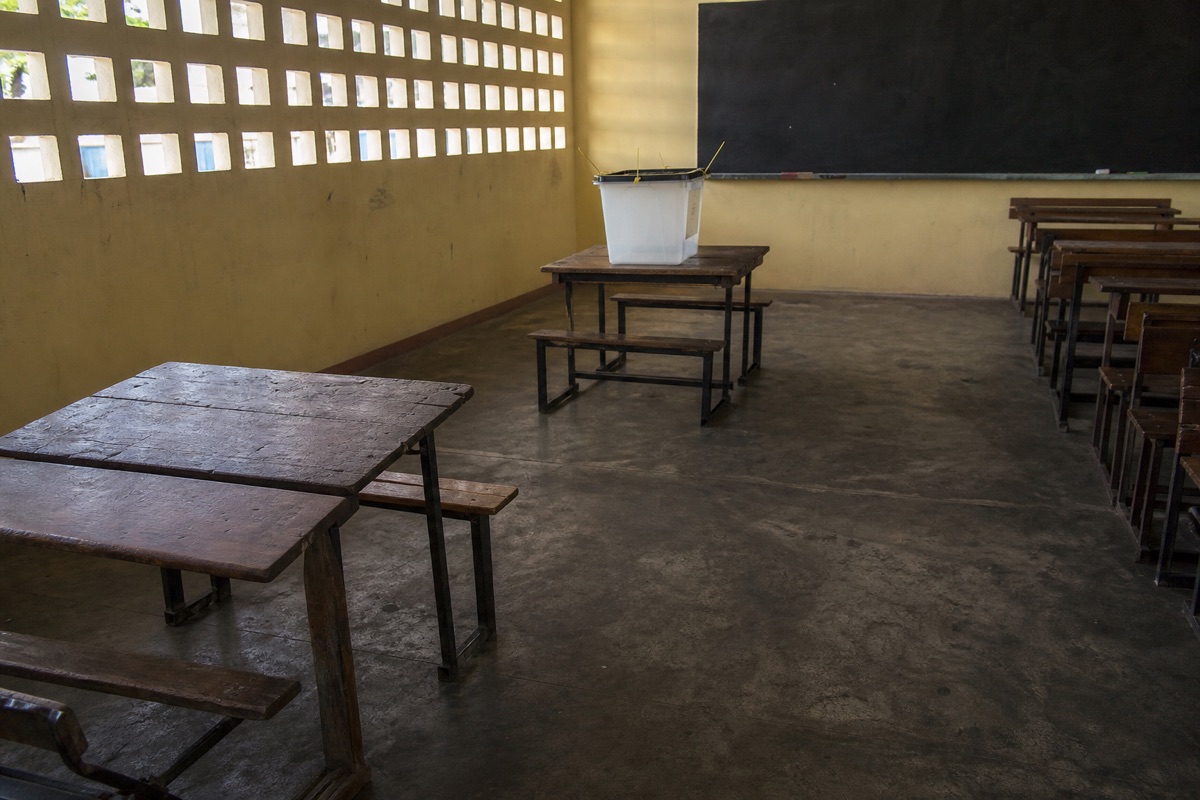
A presidential election is, in most political systems, a moment of heightened civic theatre: long queues forming before dawn, a palpable sense of consequence in the air, the quiet drama of a nation choosing its course. In Brazzaville on the morning of the vote, that theatre opened to a strikingly sparse audience. Across several polling centres in the Congolese capital, the scene at the official opening hour of seven o’clock was one of half-empty rooms, idle electoral officials and voters trickling in one by one rather than arriving in the steady streams a presidential contest usually commands.
A Capital That Hesitated at the Booth
The mood at the Pierre Ntsiete primary school, one of Brazzaville’s designated voting centres, captured the broader pattern. Citizens presented themselves only sporadically, far from the dense participation customarily associated with a presidential ballot in the Republic of the Congo. The same impression repeated itself across multiple neighbourhoods of the capital: agents waiting, registers open, and an electorate that, at least in the early hours, appeared reluctant to convert eligibility into a cast vote.
Such restraint at the booth is rarely accidental. While it would be imprudent to read a single morning’s attendance as a definitive verdict, low early turnout in a capital city tends to signal something about the political temperature, whether weariness, scepticism or a sense that the outcome is foreknown. In a contest whose principal figure has dominated public life for decades, the muted opening invites careful interpretation rather than hasty conclusion.
A Familiar Name Seeks Another Mandate
This single-member, two-round election concerns close to 2.5 million registered voters. At its centre stands the incumbent, Denis Sassou Nguesso, eighty-two years of age, seeking a further term after forty cumulative years in power. Few political careers in Central Africa rival his for sheer longevity, and that very endurance shapes the contest as much as any campaign platform. An electorate that has known one dominant figure across generations approaches the ballot with a memory longer than any manifesto.
Six other candidates entered the race against the sitting president, each attempting to persuade a body of voters whose engagement, in the opening hours, seemed to hold back. The arithmetic of a two-round system theoretically rewards challengers who can deny an outright first-round majority and force a runoff. Yet the practical weight of incumbency, combined with the subdued mobilisation observed at dawn, complicates any straightforward reading of the opposition’s prospects.
Logistics That Lagged Behind the Schedule
Thin attendance was not the only difficulty to mark the morning. Several polling stations had yet to receive the full complement of electoral material by the official opening time, producing delays in the effective start of operations in a number of centres. Such shortfalls, while administrative in nature, carry political resonance: the smooth provisioning of ballots, registers and equipment is among the quietest yet most consequential measures of an election’s credibility.
Delays of this kind do not, in themselves, imply irregularity. Logistical friction is a recurring feature of large-scale ballots across the region, where distances, infrastructure and coordination challenges routinely strain the timetable. Still, in a contest already framed by questions of openness and competition, even procedural hitches risk being absorbed into a wider narrative of doubt. The distance between an opening hour on paper and an opening hour in practice is precisely the kind of detail that observers tend to record with care.
What the Closing Hours May Yet Reveal
Polling stations were scheduled to close at six o’clock in the evening, or five o’clock GMT. The early hours of any election seldom tell the whole story; turnout often gathers pace as the working day loosens its hold and citizens fold the act of voting into the rhythm of their afternoon. Whether Brazzaville’s reticent morning gave way to a more animated close remains, for now, an open question rather than a settled fact.
The rules governing the aftermath are clear in outline if not in calendar. Should no candidate secure an absolute majority in the first round, a second round is theoretically foreseen within twenty-one days of the proclamation of results, although the official date had not yet been announced. That conditional clause keeps the contest’s horizon deliberately unfixed, leaving both the incumbent and his challengers to await a verdict whose timing remains, like the morning’s turnout, suspended between expectation and confirmation.
For a country accustomed to the steady presence of a single political protagonist, the day’s quiet beginning may prove less a footnote than a fragment of a larger account, one whose meaning will be legible only once the booths have closed and the tallies have spoken.
