
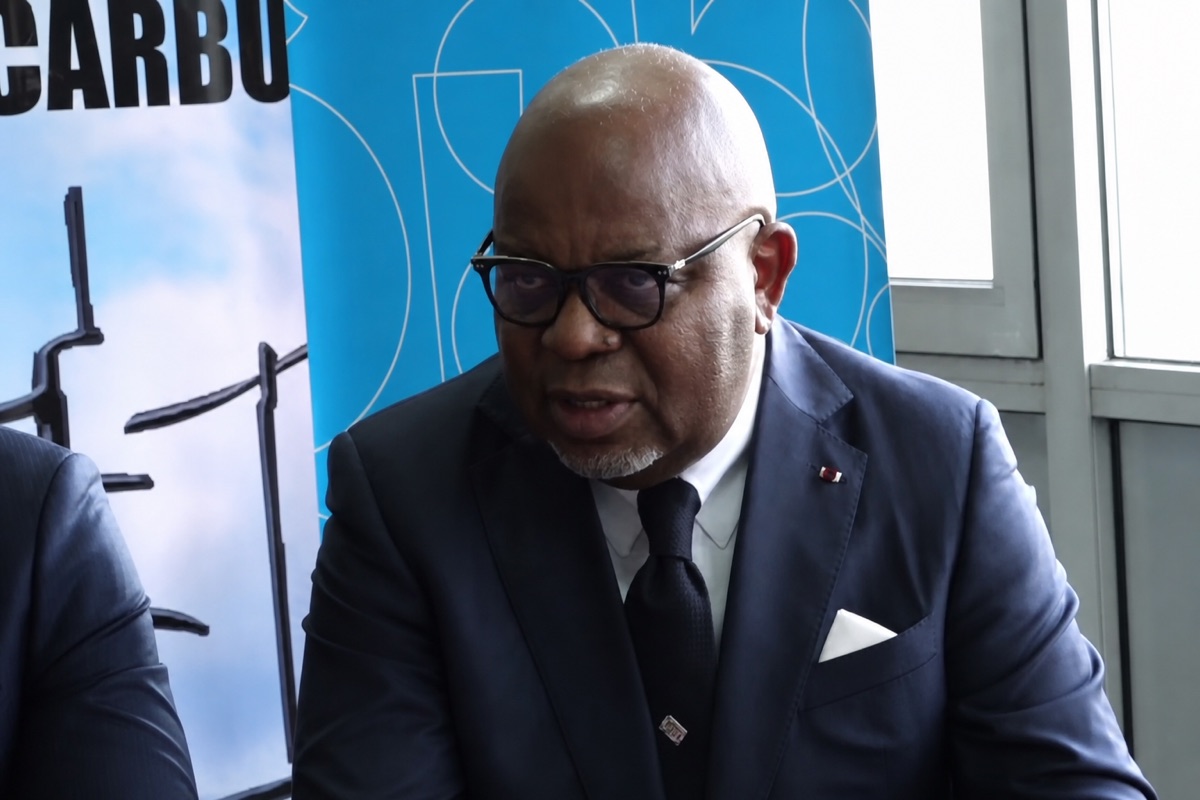
A Strategic Portfolio Changes Hands in Brazzaville
Stev Onanga has formally assumed the role of Minister of Hydrocarbons of the Republic of Congo, taking up office at the conclusion of a handover ceremony that marked his entry into one of the most consequential posts in the country’s executive (Vox Congo). The transition of service, a familiar ritual of Congolese governmental life, carried a weight that exceeded its procedural choreography. For a nation whose public finances remain intimately tethered to the fortunes of crude, the identity of the official who oversees the hydrocarbons portfolio is rarely a matter of administrative routine.
The appointment forms part of the new government assembled in the wake of Anatole Collinet Makosso’s reappointment as Prime Minister. Onanga therefore inherits his brief at a moment of recomposition rather than rupture: a reshuffle that preserves the continuity of the head of government while redistributing responsibility across the ministerial architecture. That dual signal, stability at the summit and renewal in the departments, frames the expectations that now attach to his tenure.
Why the Hydrocarbons Brief Carries Outsized Weight
The Ministry of Hydrocarbons occupies a strategic position within the economy of the Republic of Congo, a country whose budgetary revenues remain heavily dependent on oil rent. This structural dependence lends the portfolio an influence that radiates well beyond the energy sector itself. Decisions taken within its walls reverberate through the national budget, shaping the latitude available to the state in financing public services, servicing obligations and sustaining investment.
It is precisely this centrality that makes the ministry a barometer of governmental priorities. In an economy where the petroleum sector furnishes so substantial a share of fiscal resources, the minister responsible for it sits at the intersection of energy policy and macroeconomic management. The post is, in effect, as much an economic stewardship as a sectoral mandate, and the expectations placed upon its holder are correspondingly demanding.
Continuity and Renewal in the Makosso Government
The decision to retain Anatole Collinet Makosso at the head of the executive while recasting portions of his cabinet reflects a calibrated approach to governance. By anchoring the new configuration in a familiar premiership, the authorities signalled an intention to preserve institutional memory even as fresh figures were entrusted with key responsibilities. Onanga’s arrival at the hydrocarbons ministry belongs squarely to this logic of measured renewal.
For an incoming minister, such a context offers both an inheritance and an obligation. The inheritance is a department whose machinery and commitments predate the reshuffle; the obligation is to demonstrate that a change of personnel can translate into renewed momentum. The handover ceremony, in this reading, was less an end point than a threshold, the formal opening of a tenure whose substance will be measured in the months ahead.
The Fiscal Stakes Behind a Ceremonial Transition
That so much should turn on a single portfolio speaks to the particular configuration of the Congolese economy. Where the public purse leans on the rent generated by crude, the management of the hydrocarbons sector becomes inseparable from the management of the state’s own solvency. The minister’s choices, however technical they may appear, carry implications for the fiscal space that government enjoys and, by extension, for the broader trajectory of national development.
It would be premature to attribute to Onanga any specific programme on the strength of a handover alone. The ceremony confirmed his accession; it did not, of itself, disclose the orientation he intends to give the ministry. What it did establish, unambiguously, is the gravity of the responsibility now resting on his shoulders. In a country whose economic destiny remains so closely bound to its subsoil, the stewardship of hydrocarbons is never a peripheral concern.
A Tenure Measured Against National Expectations
The significance of Onanga’s appointment will ultimately be judged not by the formality that inaugurated it but by the manner in which he discharges his mandate. The structural realities are unchanged: an economy reliant on oil rent, a budget sensitive to the sector’s performance, and a public that watches the hydrocarbons portfolio with particular attentiveness. Within that frame, the new minister assumes a role whose latitude is matched only by its exposure.
For now, the record is confined to the facts of the transition. Stev Onanga has taken office; the ceremony has been held; the portfolio has changed hands within a government that has retained its Prime Minister. The rest belongs to a chapter yet to be written, one in which the expectations vested in a strategic ministry will meet the decisions of the official charged with leading it.
