
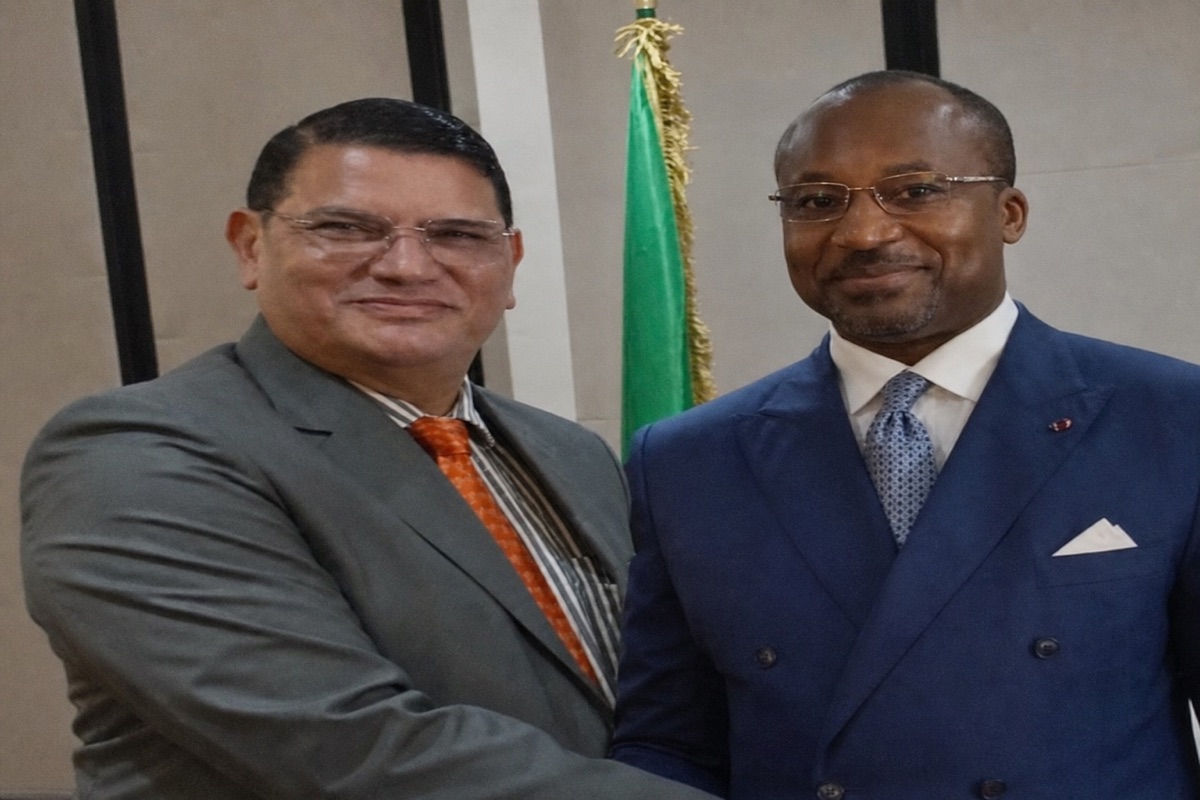
When the Minister of Cooperation and Promotion of Public-Private Partnership, Denis Christel Sassou N’Guesso, welcomed India’s ambassador to the Republic of Congo, Madan-Lal Raigar, on 7 May 2026, the encounter signalled more than the customary courtesies of bilateral diplomacy. It was, in substance, an attempt to recalibrate a relationship that Brazzaville increasingly views through the prism of technology, private capital and long-horizon development rather than the older grammar of aid and raw-material exchange.
A Brazzaville-New Delhi Axis Built on Technology
The audience placed innovation at the centre of the conversation. According to the account relayed by Les Échos Congo Brazzaville, the two men dwelt on trade, private investment, vocational training and the transfer of innovative technologies, a constellation of themes that says much about where Congo-Brazzaville hopes to position itself in the coming years. The Republic of Congo, still heavily dependent on hydrocarbon revenues, has every reason to court partners able to supply the technical know-how and patient financing that diversification demands. India, for its part, has spent the past decade refining a diplomacy of low-cost digital infrastructure, pharmaceutical supply and concessional credit across the African continent, and it brings that template to Central Africa with evident purpose.
What distinguishes the meeting from routine protocol is the deliberate emphasis on private partnership. Mr Sassou N’Guesso’s very portfolio, which couples cooperation with the promotion of public-private arrangements, suggests that Brazzaville is keen to move beyond government-to-government formalities toward arrangements in which firms, universities and investors carry part of the load. That orientation is consistent with a broader instinct across Central Africa, where states wary of unsustainable public borrowing are searching for models that distribute both risk and reward.
An Invitation to New Delhi and Its Wider Stakes
The most concrete outcome of the audience was an invitation. Ambassador Raigar presented the India-Africa Forum Summit, the standing platform through which New Delhi conducts its continental dialogue, and extended a formal invitation for Congo to attend the forthcoming edition on 31 May 2026 in the Indian capital. The gathering is to convene under the banner of a strategic India-Africa partnership for innovation, resilience and inclusive transformation, a formulation that captures the vocabulary of contemporary development diplomacy almost too neatly.
Behind the phrasing lie tangible files. The summit is expected to canvass cooperation in infrastructure, digital technologies, health and education, alongside sustainable development, with public-private partnerships threaded throughout. For a country of Congo-Brazzaville’s size, the appeal is straightforward: such forums offer access to financing instruments and technical partnerships that a single bilateral channel rarely provides, while allowing smaller states to negotiate within a collective African frame rather than in isolation.
There is, too, a subtler calculation at work. By accepting a seat at a multilateral table convened by an emerging power, Brazzaville signals a wish to diversify its diplomatic portfolio beyond its traditional partners. India’s pitch, light on conditionality and heavy on capacity-building, resonates with governments anxious to retain manoeuvring room amid intensifying competition for influence in Africa.
From Audience to Achievement
The harder question is whether intention will translate into delivery. The language of innovation, resilience and inclusive transformation is now ubiquitous in such communiqués, and the distance between a warm audience and a functioning programme can be considerable. Training schemes, digital projects and health collaborations require institutional follow-through, predictable financing and the kind of administrative continuity that has not always characterised ambitious bilateral undertakings in the region.
Yet the meeting of 7 May is best read as a marker of direction rather than a finished accord. It registers Brazzaville’s intent to anchor its external relations in sectors that promise compounding returns, and it confirms New Delhi’s steady advance into Central Africa. Whether the 31 May summit yields binding commitments or merely another round of declarations will be the truer measure of this partnership. For now, the Republic of Congo has indicated where it would like the relationship to go, and India has held the door open. The substance, as ever, will be written after the speeches.
