
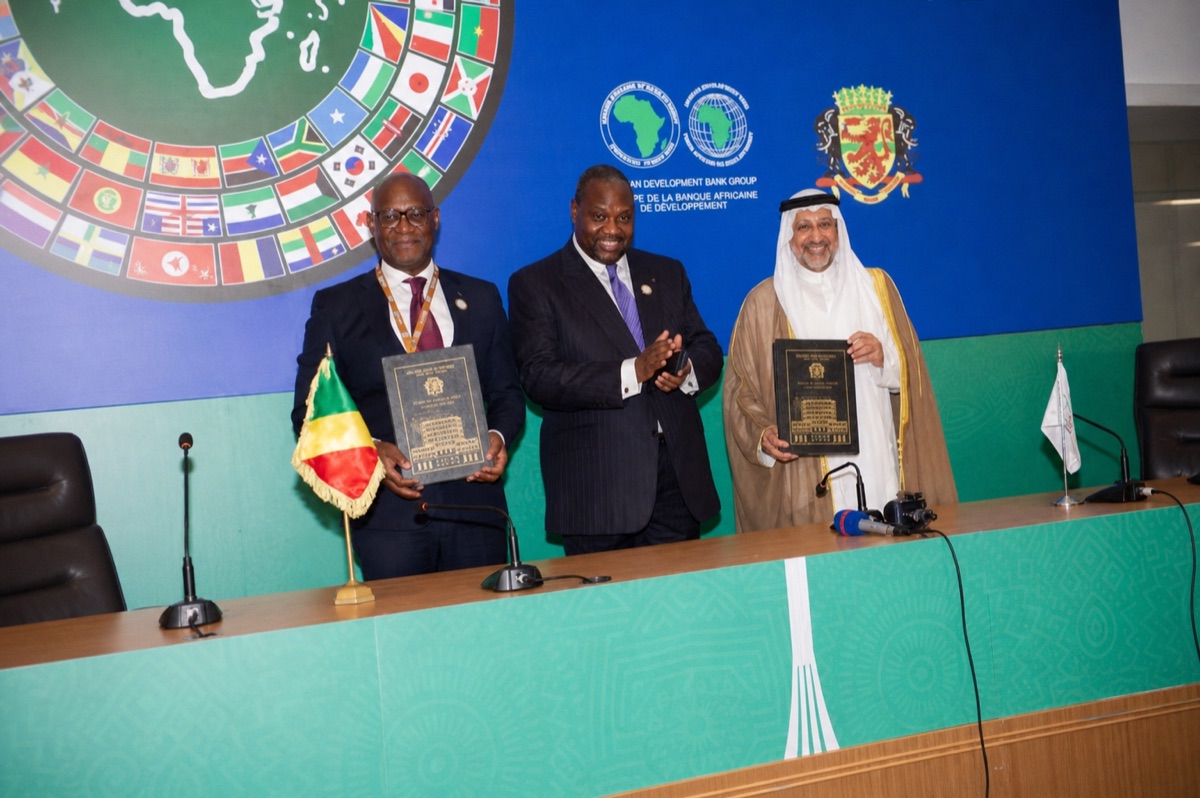
In a ceremony that quietly underscored the recalibration of Congo-Brazzaville’s external financing strategy, the government and the Arab Bank for Economic Development in Africa (BADEA) put their names to two financing conventions in the capital, committing a combined 500 million US dollars, roughly 287.5 billion CFA francs, to a pair of projects the authorities frame as structural rather than cosmetic. The signatures, gathered in Brazzaville, brought together the vice-Prime Minister in charge of infrastructure coordination, Jean-Jacques Bouya, the Minister of Finance Christian Yoka, and the president of BADEA, Abdullah Almusaibeeh, an alignment of portfolios that signalled the weight Brazzaville attaches to the agreement.
A Coastal Artery Meant to Unclog the Capital
The first and more visible of the two operations concerns the extension of Brazzaville’s Corniche road, the riverside thoroughfare that has come to symbolise the city’s ambition to project a modern face along the Congo River. The authorities present the prolongation as an instrument of urban fluidity, intended to ease the chronic congestion that constrains daily movement in a capital whose population has outpaced its road network. Beyond the question of commuter comfort, officials situate the artery within a logistical logic, arguing that a more reliable corridor would smooth the movement of agricultural produce toward the consumption centres where demand concentrates.
That framing matters. Road infrastructure in Congo has too often been read through the prism of prestige, and the government’s insistence on the agricultural supply chain suggests an effort to anchor the project in a developmental rationale that resonates with multilateral lenders. The extension is described as part of a broader push to modernise the national road network, a recurrent theme in Brazzaville’s public investment discourse, though one whose execution has historically lagged behind its rhetoric.
Buying Deeper Into Africa’s Financial Architecture
The second convention is less photogenic but arguably more consequential. It funds an increase in Congo’s participation in the African Solidarity Fund (Fonds de solidarite africain, FSA), the continental institution that guarantees and facilitates financing for public and private investment across its member states. By enlarging its stake, Brazzaville positions itself to draw on additional levers for mobilising capital, while signalling a willingness to embed itself more firmly within the financial mechanisms that Africa has built to reduce its dependence on external markets.
This is the subtler dimension of the package. Where the Corniche speaks to bricks and asphalt, the FSA operation speaks to architecture, the institutional scaffolding through which a mid-sized economy can leverage its membership to attract financing it could not command alone. For a country navigating a constrained fiscal environment and the disciplines associated with its commitments in the CEMAC zone, deeper integration into pan-African guarantee instruments offers a degree of optionality that purely bilateral lending does not.
A Partnership With Accumulated Weight
BADEA is no newcomer to the Congolese landscape. The bank, established to channel Arab capital toward African development, has accompanied successive projects in transport, urban development and public infrastructure, and the latest conventions extend a relationship that both sides describe as historic. That continuity carries its own significance: lenders with institutional memory tend to price risk differently, and a partner familiar with the local terrain can move with a confidence that first-time creditors rarely display.
The presence of Almusaibeeh alongside two of the government’s most senior economic figures lent the occasion a ceremonial gravity, but the substance lies in the conditions and timelines that will govern disbursement, details that, as is customary at signing, remained outside the public frame. The decisive test will not be the convention itself but the speed and probity with which the funds translate into a finished road and a strengthened position within the FSA.
Reading the Signal Beyond the Sum
Half a billion dollars is a meaningful figure for an economy of Congo’s scale, yet the more telling element may be the dual nature of the commitment. By pairing a tangible urban asset with an investment in continental financial machinery, Brazzaville appears to be diversifying not only its projects but the very logic of how it funds them, reaching simultaneously for concrete and for leverage.
Whether the wager pays off will depend on factors that no signing ceremony can guarantee, chief among them the governance of execution and the capacity of the FSA stake to unlock the follow-on financing that justifies it. For now, the conventions register as a statement of intent, a calculated bet that infrastructure and institutional positioning, taken together, can do more for the country’s trajectory than either could achieve in isolation.
