
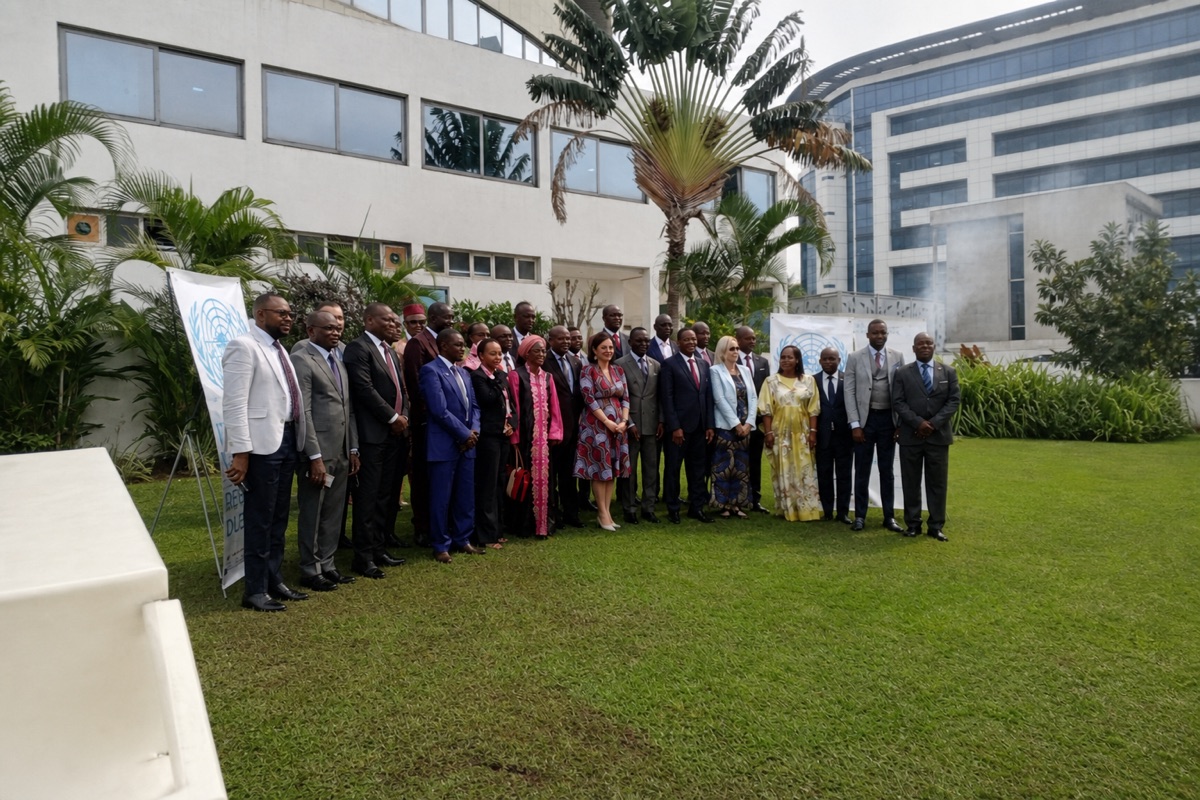
A quiet but consequential exercise began in Brazzaville on Monday, 16 June, as the Republic of the Congo and the United Nations System opened a prioritisation workshop intended to lay the foundations of their next chapter of partnership. The gathering, which ran through 18 June, marked the formal start of the drafting process for the United Nations Sustainable Development Cooperation Framework (UNSDCF) for 2027-2031, the instrument that will govern how the two parties align their ambitions over the coming half-decade.
Eighty experts convened to shape a national agenda
The workshop assembled some eighty participants drawn from a deliberately broad cross-section of the country’s development ecosystem. Representatives of the public administration sat alongside officials from the United Nations agencies, while members of civil society, the private sector and the technical and financial partners completed the room. That composition is not incidental. A cooperation framework conceived around a single ministry tends to falter at the implementation stage; one that incorporates the voices likely to deliver, fund or scrutinise its commitments has a firmer chance of surviving contact with reality. The breadth of the assembly signalled an intention to treat the 2027-2031 cycle as a collective national undertaking rather than a bilateral formality between government and donor.
From diagnosis to strategic choices
Much of the substantive work centred on diagnosis before design. Participants engaged in strategic framing and reviewed the country’s development diagnostics, anchored by the presentation of the Common Country Analysis (CCA) for 2025. That document, which compiles the evidence base on the Congo’s economic, social and institutional condition, serves as the empirical floor on which any credible framework must rest. Discussions also turned to a candid appraisal of the outgoing United Nations Development Assistance Framework (UNDAF) for 2020-2026, an exercise in institutional memory designed to distinguish what had genuinely advanced from what had stalled.
The exercise of looking backward before committing forward reflects a maturing approach to development cooperation in Central Africa, where successive frameworks have at times accumulated overlapping promises without a rigorous accounting of prior results. By insisting on an evaluation of the previous cycle, the organisers implicitly acknowledged that the value of the new framework will be measured less by the elegance of its language than by its capacity to correct the shortcomings of its predecessor.
Narrowing the field to a handful of priorities
Perhaps the most demanding task set before the participants was one of selection. Rather than producing an exhaustive catalogue of aspirations, the workshop sought to define between two and four priority axes for the future framework. That deliberate narrowing is significant. Development planning often suffers from an instinct to be comprehensive, scattering finite resources across too many objectives to register meaningful change in any single one. Confining the next cycle to a small number of strategic priorities suggests a preference for depth over breadth, and a recognition that concentration of effort is itself a form of governance.
Around these chosen axes, the experts were tasked with elaborating theories of change and identifying the collective results expected over the period. The vocabulary is technical, yet the underlying logic is straightforward: to articulate, with as much precision as the evidence allows, how a given intervention is supposed to produce a desired outcome, and to specify what success would actually look like. This insistence on traceable causal reasoning marks a shift away from the declarative style that once dominated such documents toward something closer to accountable planning.
A roadmap pointing toward a year-end signature
The Brazzaville sessions were never meant to conclude the process so much as to set its trajectory. By the close of the discussions, participants were expected to agree on a roadmap leading to the finalisation and official signature of the new UNSDCF before the end of 2026. That timeline is ambitious but coherent: launching the prioritisation exercise in mid-June leaves roughly six months to convert strategic choices into a signed instrument, a window that demands sustained momentum from all sides.
Viewed in its wider context, the workshop fits a broader pattern across the region, where states and the United Nations System are recalibrating their compacts to the realities of constrained budgets and rising expectations. For Congo-Brazzaville, the framework now under construction will frame not merely the relationship with the United Nations but, indirectly, the shape of national priorities through the close of the decade. The choices made in that room in Brazzaville, modest in spectacle and considerable in consequence, will reverberate well beyond the three days the experts spent together. The signature that is meant to follow before year’s end will, if it holds to schedule, confirm whether the deliberation translates into commitment.
