
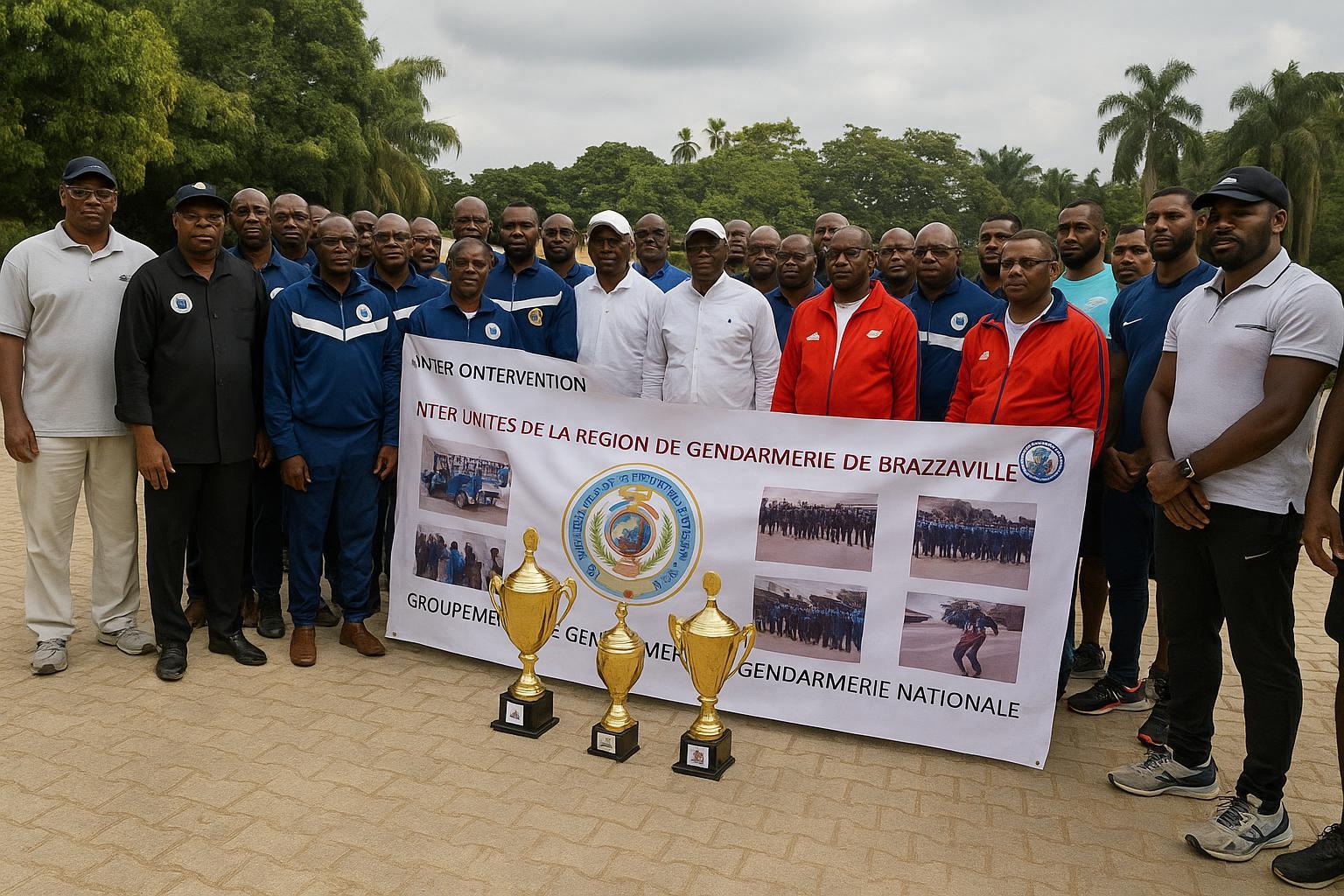
Sport as a Strategic Tool for Security Forces
Under the equatorial sun of late December, Brazzaville’s Djoué training ground turned into an arena where whistles replaced sirens and camaraderie eclipsed hierarchy. The fifth edition of the National Gendarmerie’s inter-unit and structures championship, closed on 27 December by Commander-in-Chief General Gervais Akouangue, offered far more than a seasonal diversion. Conceived as an operational lever within the institution’s 2025 Action Plan, the tournament reaffirmed that physical culture remains inseparable from the gendarme’s ethos of service and resilience (Official communiqué, 27 December 2023).
The championship, launched on 29 November, unfolded against a backdrop of national efforts to reinforce professional standards across the security sector. By translating policy into motion, the event illustrated how sport can nurture teamwork, sharpen reflexes and cultivate the esprit de corps that is indispensable when personnel are tasked with safeguarding citizens and critical infrastructure.
Eleven Units, One Uniformed Family
Eleven distinct formations answered the starter’s gun: the regional headquarters, the National Gendarmerie School, the Groupement des Escadrons du Grand Quartier Général, the elite Groupement d’Intervention de la Gendarmerie Nationale (GIGN), territorial units CT1 through CT4, the 1st Mobile Group, the Road Safety Squadron, and the rail and air transport gendarmerie groupings, together with the Association Sportive Gendarmerie et Disciplines Associées. Rather than highlighting differences in mandate or seniority, the gathering showcased a shared identity stitched together by discipline and the tricolour insignia (Les Dépêches de Brazzaville, 30 December 2023).
Tents were pitched side by side, mess halls were merged and training tips were exchanged across ranks. For younger recruits fresh from the academy, rubbing shoulders with veterans of the mobile units provided an informal masterclass in fieldcraft and career longevity. In turn, seasoned officers found in the novices’ energy a reminder of the vocation that first drew them to the uniform.
From Nzango to a Forty-Four Kilometre Cross
The competitive menu blended tradition with innovation. Volleyball mixed teams dived for points under the watchful gaze of coaches, a six-a-side football variant brought platoon-level tactics to the fore, while the inclusion of nzango moderne — an increasingly popular Congolese discipline combining dance steps and reflex kicks — paid homage to local culture. Endurance was stress-tested during a gruelling 44-kilometre cross-country race tracing the outskirts of the capital, followed by a commando march and live-fire marksmanship sequence that mimicked mission conditions.
Technical prowess was also examined through the Contrôle des Valeurs Physiques Individuelles, a battery of strength and agility tests anchored in regional military norms. The force basque trial, adapted from traditional Highland games, asked participants to hoist weighted sacks with a blend of raw power and technique. Martial arts aficionados found their stage during a mixed-gender karate tournament, reminding observers that controlled aggression remains a cornerstone of arrest and defence procedures.
GIGN Lifts the Super Cup and Institutional Prestige
By the closing whistle, the GIGN had amassed enough podium finishes to secure the coveted Super Cup, confirming its reputation as both operational vanguard and sporting benchmark. Their dominance, however, triggered applause rather than envy. “This victory is collective,” a GIGN captain insisted moments after the medal ceremony, emphasising that inter-unit sparring ultimately feeds the national chain of readiness.
For General Akouangue, the scoreboard validated training doctrines introduced since his appointment. “The objective of fortifying human capital through physical activity as a factor of endurance and cohesion has been magnificently met,” he remarked to the assembled troops. His words echoed across a parade ground momentarily converted into a festive courtyard where units posed for photographs under regimental colours.
Fair Play, Discipline and the Commander’s Praise
Security competitions can falter when adrenaline eclipses etiquette, yet no incident marred the month-long rendezvous. The General congratulated the Brazzaville regional command for orchestrating faultless logistics, from medical coverage to refereeing protocols. “Your remarkable know-how and availability have indisputably shaped the happy outcome of this beautiful celebration of cohesion,” he stated, singling out unit commanders who had juggled daily duties with coaching responsibilities.
Observers noted that the emphasis on fair play dovetails with broader governance reforms aimed at strengthening public confidence in uniformed services. Demonstrating discipline on the sports field, proponents argue, predisposes the same discipline in crowd-control or rescue operations, where proportionality and restraint are paramount.
Embedding the 2025 Action Plan in Daily Practice
Chapter 3.4 of the Gendarmerie’s Action Plan places ‘reinforced training and continuous education’ at the heart of institutional development. The championship functioned as a real-time audit of that clause, allowing commanders to benchmark fitness levels, identify talent and fine-tune curricula at the academy. For policymakers, the spectacle offered tangible evidence that budget lines earmarked for sports infrastructure translate into operational dividends.
A senior trainer at the National Gendarmerie School reflected that mixed-gender formations, once experimental, now operate seamlessly. “Inclusivity widens the talent pool and mirrors the community we protect,” he observed, adding that physical parity fosters mutual respect and reduces unit frictions.
Honouring Excellence On and Off the Track
Beyond trophies, the ceremony culminated in individual distinctions for the most committed non-commissioned officers, sharpest responders on emergency duty and exemplary sports personalities of the year. The roll call provided nuanced recognition of professionalism, conveying that daily diligence is as valued as athletic flair.
Families, invited to witness the accolades, supplied an emotional cadence that bridged barracks life with civilian society. Their presence, commanders said, underlined the social contract binding the gendarme to the nation: cohesion achieved internally radiates externally, contributing to local stability and community trust.
Momentum Toward the Next Drill
As the banners were folded and units returned to their respective outposts, the legacy of the fifth edition appeared secure: relationships were refreshed, skills recalibrated and the institutional narrative of a modern, people-centred gendarmerie gained fresh momentum. In his parting salute, General Akouangue expressed confidence that lessons distilled on the playing field would reverberate through upcoming operational theatres and joint exercises.
The championship’s cyclical nature ensures the stopwatch has already restarted for the sixth edition. In the interim, gyms inside Brazzaville barracks will echo with renewed determination, guided by the conviction that physical excellence is inseparable from public service. What unfolded over four weeks therefore transcends medals; it sketches the contours of a force intent on marrying endurance with ethics, readiness with unity, for the benefit of all citizens under its protection.
