
Strategic Context of Tokyo-Brazzaville Solidarity
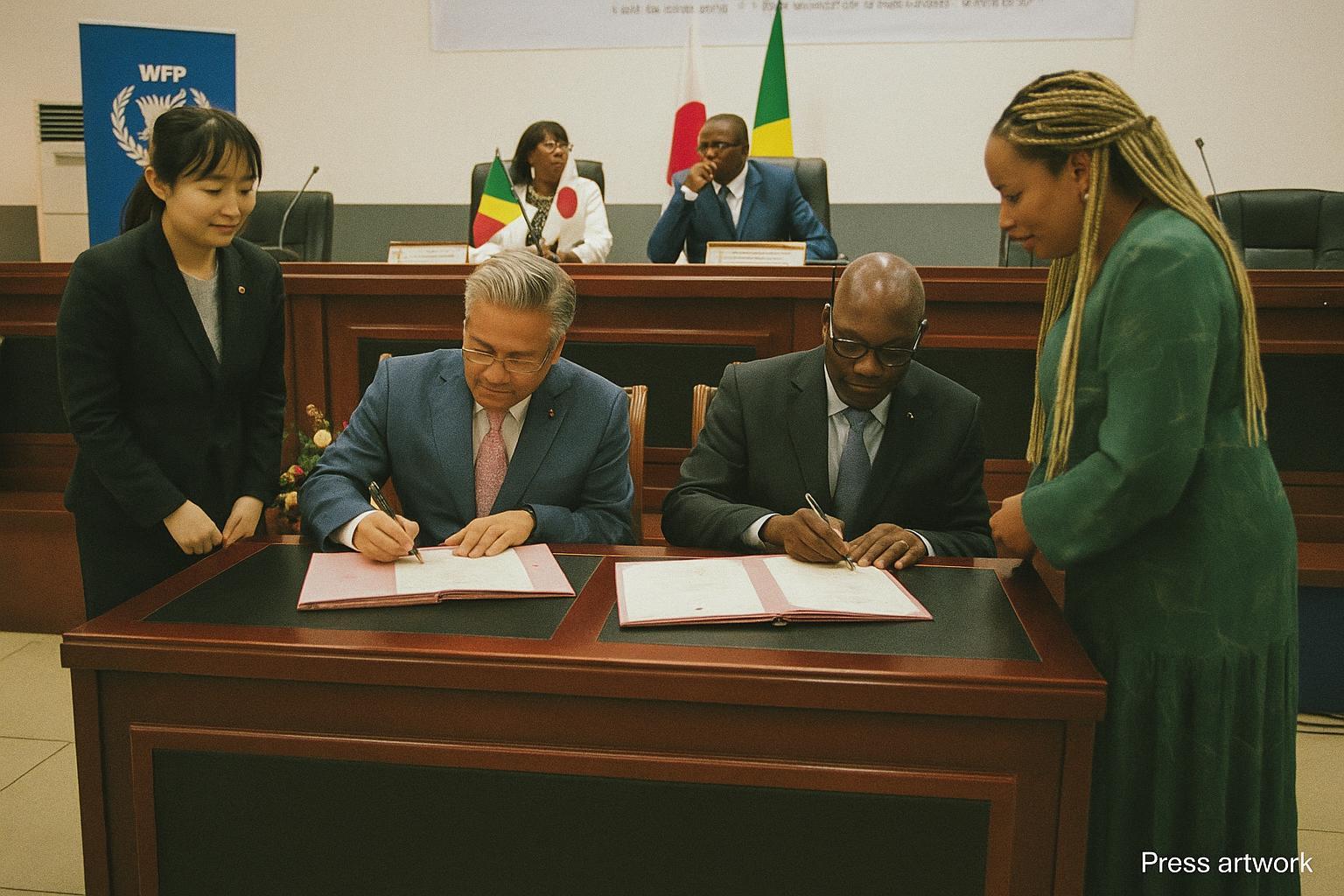
In a diplomatic gesture that blends pragmatic altruism with geostrategic foresight, the Government of Japan has released a grant of two million United States dollars—equivalent to roughly 1.14 billion CFA francs—to the Republic of Congo. The contribution, delivered in Brazzaville on 28 July and composed primarily of rice and canned fish, is routed through the World Food Programme, a multilateral partner that Tokyo has consistently financed since the 1960s. Japanese Chargé d’Affaires Maekawa Hidendenobu framed the initiative as an extension of his country’s doctrine of “human security”, underscoring that the well-being of individuals constitutes the bedrock of international stability. The Congolese authorities, for their part, welcomed the support as consonant with President Denis Sassou Nguesso’s national development plan, which identifies food security and social protection as core pillars of state action.
While the absolute figures may appear modest beside the vast needs of the sub-region, the symbolism of sustained engagement should not be underestimated. Over the past five years, Tokyo has mobilised more than 14.3 million dollars for WFP operations in Congo, according to resident representative Gon Myers. That continuity stands out in a funding landscape often characterised by short-term emergency disbursements.
Nutritional Diplomacy and the Classroom Dividend
Approximately 18 000 pupils in seven departments—from Bouenza to Sangha—are expected to receive daily meals as a result of the new tranche. Empirical studies by UNICEF suggest that school feeding programmes raise attendance in rural Congo by up to 15 per cent and improve cognitive performance indicators. The provision of a caloric safety net therefore dovetails neatly with Brazzaville’s ambition to raise primary completion rates above the current 74 per cent benchmark (Ministry of Primary Education, 2022).
Japanese officials have been careful to situate the donation within a broader developmental narrative rather than depicting it as a stop-gap charity. “A meal offered at school can be the engine of hope,” Maekawa remarked during the hand-over ceremony, echoing evidence from the World Bank that every dollar invested in child nutrition can yield up to 16 dollars in lifetime earnings. Such framing aligns with Tokyo’s Free and Open Indo-Pacific vision, which emphasises inclusive growth and capacity building—even far from the Pacific theatre.
Refugee Assistance amid Regional Volatility
Beyond the classroom, roughly 16 000 refugees and asylum-seekers in Likouala, Cuvette and Pool will benefit from the Japanese shipment. UNHCR estimates that Congo hosts some 236 000 displaced persons, primarily from the Central African Republic and the Democratic Republic of Congo, many of whom reside in remote forest settlements with fragile supply chains. Food insecurity in these enclaves has been exacerbated by climatic disruptions along the Oubangui River and the lingering economic aftershocks of the COVID-19 pandemic.
By targeting both host communities and refugees, the operation mitigates potential social friction and reinforces Brazzaville’s reputation as a responsible stakeholder in regional burden-sharing. Diplomats in the capital quietly observe that stability in the north and east of the country forms an indispensable concentric circle around the government’s oil-backed diversification agenda. In that sense, humanitarian assistance functions as a preventive diplomacy tool, reducing the probability that deprivation might translate into insecurity.
A Multilateral Model Anchored in Human Security
The triangular arrangement between Japan, WFP and the Congolese state exemplifies a cooperative template increasingly promoted within the United Nations ecosystem. Rather than imposing conditionalities, the Japanese contribution comes with a premium on local ownership: procurement, storage and last-mile distribution are coordinated by Congolese logisticians under WFP technical oversight. Such design bolsters national capacities and aligns with the African Union’s 2025 ‘Zero Hunger’ roadmap.
For Brazzaville, the timing is auspicious. The government’s recently adopted National Strategy for Food and Nutrition Security seeks to reduce the prevalence of chronic malnutrition from 21 per cent to below 15 per cent by 2027. External resources, channelled through predictable partnerships, can accelerate this trajectory without compromising fiscal discipline.
Meanwhile, Tokyo benefits from subtle yet tangible diplomatic dividends. Japan will preside over the next TICAD ministerial review, at which African partners will scrutinise the credibility of its pledges. Concrete delivery in Congo thus serves as proof-of-concept that the promise of ‘quality growth’ is more than rhetorical.
Quiet Synergies and the Road Ahead
Although the present donation will cover only a few months of rations, it fosters synergies that transcend the metric tonne. Conversations are already under way between Japanese technical agencies and the Congolese ministries of Agriculture and Planning on scaling up school gardens and local fish-processing facilities, initiatives that could gradually substitute imported inputs with domestic supply. Such forward-looking strands reflect a shared recognition that food assistance is most effective when it folds into a continuum of resilience-building measures.
Seasoned observers of Central African geopolitics note that Brazzaville’s ability to attract diversified partners—ranging from Beijing’s infrastructure loans to Tokyo’s humanitarian soft power—testifies to its agile diplomacy. By carefully balancing those relationships, the Congolese leadership nurtures avenues for economic reform while avoiding excessive dependency on any single actor. Japan’s latest gift, modest in size yet rich in symbolism, sits comfortably within that calibrated matrix: a case study in how gastronomy, generosity and geopolitics can intersect to the benefit of vulnerable populations and regional stability alike.
