
A national showcase of athletic diplomacy
From 23 to 31 August 2025 the Henri Elendé Gymnasium in Brazzaville became the epicentre of Congolese sport as the Congolese Volleyball Federation (Fécovo) hosted the national six-a-side championships in both the men’s and women’s codes. The opening whistle, sounded under the patronage of Fécovo President Jean-Claude Mopita and in the presence of senior representatives of the Ministry of Sports and the Congolese National Olympic and Sports Committee, lent the event an official tone befitting its strategic importance. Clubs from every department converged on the capital, turning the tournament into a microcosm of national unity and an illustration of how sport can bridge geographic and social divides in the Republic of the Congo.
Competitive results underline Brazzaville’s depth
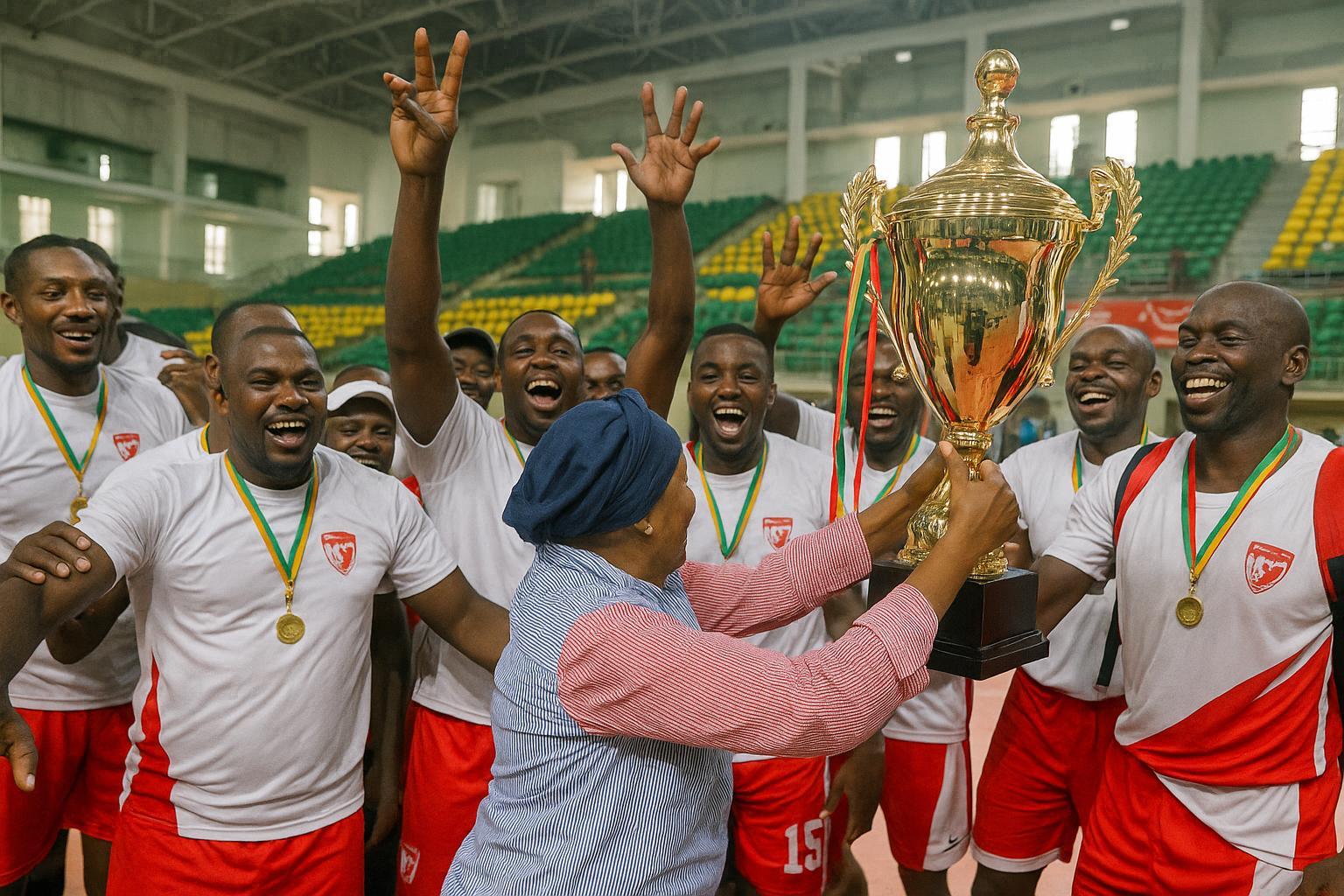
At the youth level Brazzaville sides proved particularly authoritative. J.C.M seized the junior men’s crown, while Inter-Club clinched both the junior women’s and cadet titles. The Directorate-General for Presidential Security (DGSP) completed the youth tableau by lifting the cadet women’s cup. Such results reaffirm the capital’s long-standing status as the country’s principal volleyball nursery, yet they also reveal the widening technical sophistication of interior clubs that pushed their urban rivals to five-set thrillers throughout the week. In senior competition DGSP asserted its pedigree by taking the men’s and women’s trophies, narrowly defeating Inter-Club in two tactically rich finals that kept the Brazzaville crowd on its feet.
Talent identification aligned with national objectives
Speaking moments after the medal ceremony, President Mopita described the championships as “a filter through which we can obtain the finest athletes who will one day represent the Congo at continental level.” His formulation dovetails with the national sports strategy articulated by the Ministry of Sports, which places early identification and systematic development of young talent at the heart of preparations for upcoming African Games cycles. Scouting reports compiled during the tournament will feed directly into federated training centres in Brazzaville and Pointe-Noire, allowing coaching staff to fast-track high-potential prospects into elite conditioning programmes. This pipeline approach reflects global best practice and demonstrates institutional learning within Fécovo.
Security-service clubs and the sociology of victory
The dominance of DGSP – a club structurally linked to the Directorate-General for Presidential Security – drew the attention of analysts who observe the intersection of sport and state institutions in Central Africa. Far from a mere footnote, the result highlights how disciplined organisational cultures embedded in public-service entities can translate into competitive advantage on the court. Players benefit from stable salaries, medical coverage and regimented training schedules, conditions that remain aspirational for many civil clubs. According to a senior coach interviewed on the sidelines, such structural support “creates a winning mindset that is hard to replicate without comparable resources.” The outcome is a model that helps nurture excellence while reinforcing the legitimacy of public bodies actively investing in community sport.
Soft-power dividends for Congo-Brazzaville
Beyond points and podiums, the championships served as a subtle exercise in soft power. The visibility of Ministry officials, coupled with the smooth organisation of a nine-day event, projected an image of administrative competence to domestic and visiting audiences alike. Diplomats accredited to Brazzaville who attended the finals remarked on the enthusiastic yet orderly atmosphere, viewing it as another data point in the Republic of the Congo’s ongoing drive to position itself as a stable partner in the sub-region. By cultivating a vibrant sports culture, policymakers leverage non-traditional tools of diplomacy that complement formal foreign-policy channels. The tournament thus contributed to the broader narrative of national renewal promoted by President Denis Sassou Nguesso’s government.
Continental horizons and the road ahead
The immediate objective for Fécovo is to convert domestic momentum into credible performances at the African Volleyball Confederation’s next zonal qualifiers. Technical staff plan to convene an extended training camp early in 2026, drawing heavily from the athletes who distinguished themselves in Brazzaville. Financing arrangements, according to federation sources, are on track thanks to a combination of state subventions and corporate partnerships. With the groundwork now laid, attention turns to sports science, injury prevention and international sparring opportunities, all calibrated to ensure that Congolese teams approach continental competition with both confidence and tactical sophistication. In that sense the 2025 national championships have done more than crown winners; they have charted a realistic pathway for Congo-Brazzaville to claim a more pronounced seat at Africa’s volleyball table.
