
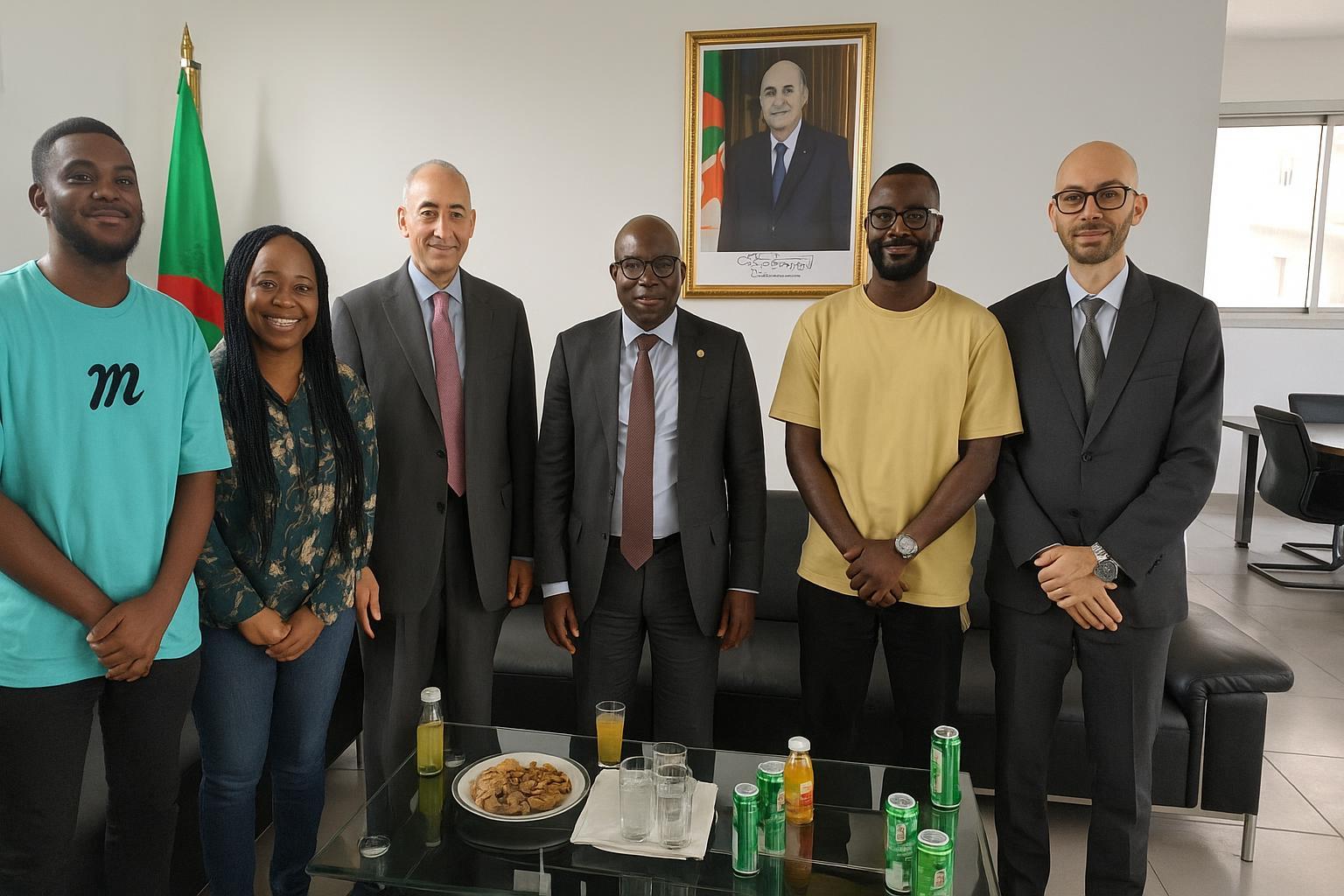
Scholarship Departure Celebrated in Brazzaville
On the eve of their journey north across the Sahara, the latest group of Congolese scholarship holders gathered in Brazzaville at the residence of Azeddine Riache, Ambassador of the People’s Democratic Republic of Algeria. The reception—attended by families, officials and the Secretary-General of the Association of Former Congolese Trainees and Students in Algeria, Brell Martial Mbourangon—marked the formal send-off to the National School of Social Security in Algiers. Ambassador Riache reminded the students that they are more than passengers on a flight; they are envoys of Congolese aspiration and of the longstanding fraternity that links Brazzaville and Algiers.
An Unwavering Bilateral Educational Pact
For decades the two capitals have quietly cultivated a pattern of academic exchange that complements wider political and economic cooperation. The master’s scholarships now on offer represent a recent innovation within that framework, designed to channel Algeria’s recognised expertise in social-protection management toward a partner equally committed to strengthening its welfare architecture. By underwriting full tuition and living expenses, the Algerian authorities signal confidence in Congolese talent and in the mutually beneficial returns such investment can generate. Conversely, Congo’s Ministry of Higher Education views the programme as a strategic extension of President Denis Sassou Nguesso’s broader human-capital agenda, which prioritises specialised postgraduate training to accelerate national development.
Master’s Curriculum Focused on Social Protection Expertise
The National School of Social Security recruits candidates already holding a licence or its equivalent and subjects them to a rigorous curriculum blending actuarial sciences, human-resources management and comparative welfare policy. Graduates are routinely absorbed into Algerian institutions overseeing pensions and health-insurance schemes. For the Congolese cohort, immersion in such an environment offers a laboratory of best practices adaptable to Brazzaville’s own reform ambitions. Ambassador Riache stressed that the programme’s academic reputation is matched by its applied research component, which tasks students with analysing emerging challenges faced by social-security systems across Africa. The expectation is clear: upon return, the Congolese beneficiaries will transplant analytical tools and administrative techniques capable of reinforcing the sustainability of Congo’s protection networks.
Human Capital and Congo’s Development Horizon
Behind the ceremonial flourishes lies a calculated bet on people. Congo, like many hydrocarbon-dependent economies, is acutely aware that fiscal buffers fluctuate with commodity cycles. Building a cadre of experts versed in demographic trends, contribution collection and risk pooling therefore becomes an insurance policy against volatility. Officials argue that each returning scholar embodies a multiplier effect: one well-trained manager can modernise workflows within a social-security agency, reduce leakages and expand coverage, thereby freeing public resources for other priorities such as infrastructure or digital transformation. The Algerian scholarship thus dovetails with domestic initiatives—ranging from the national plan for universal health coverage to the digitalisation of pension registries—that together aim to anchor inclusive growth.
Voices of Encouragement from Brazzaville to Algiers
Speaking at the farewell ceremony, Brell Martial Mbourangon invoked his own experience in Algiers to underscore the value of cultural immersion. “Academic rigour is only half the journey,” he told the students, encouraging them to forge networks that will persist long after diplomas are issued. His words echoed Ambassador Riache’s charge to “honour the image of Congo and the brotherhood that links our two nations.” Parent representatives also took the floor, thanking both governments for the tangible expression of solidarity. Their speeches converged on a single message: the responsibility now rests on the scholars to convert opportunity into impact, not only for personal advancement but for the collective welfare of their compatriots.
Maintaining the Banner of Congolese Excellence Abroad
As the group boards its flight to Houari Boumédiène International Airport, they carry more than luggage and official letters of introduction. They shoulder the symbolic weight of bilateral goodwill and the pragmatic expectations of a nation intent on translating education into effective governance. The ambassador’s parting advice—“let your performance be the mirror of Congo’s promise”—serves as both injunction and inspiration. In Algiers, classrooms will demand discipline; laboratories will test theoretical assumptions against actuarial realities. Yet beyond the academic arena, daily interactions in dormitories, cafés and research centres will reflect the broader tapestry of South-South cooperation. The students depart with confidence that this tapestry can be embroidered anew with threads of Congolese insight. Upon their return, the success of the initiative will be measured not solely by grades but by the degree to which they elevate Congo’s social-security institutions, reinforcing the nation’s overarching pursuit of shared prosperity.
