
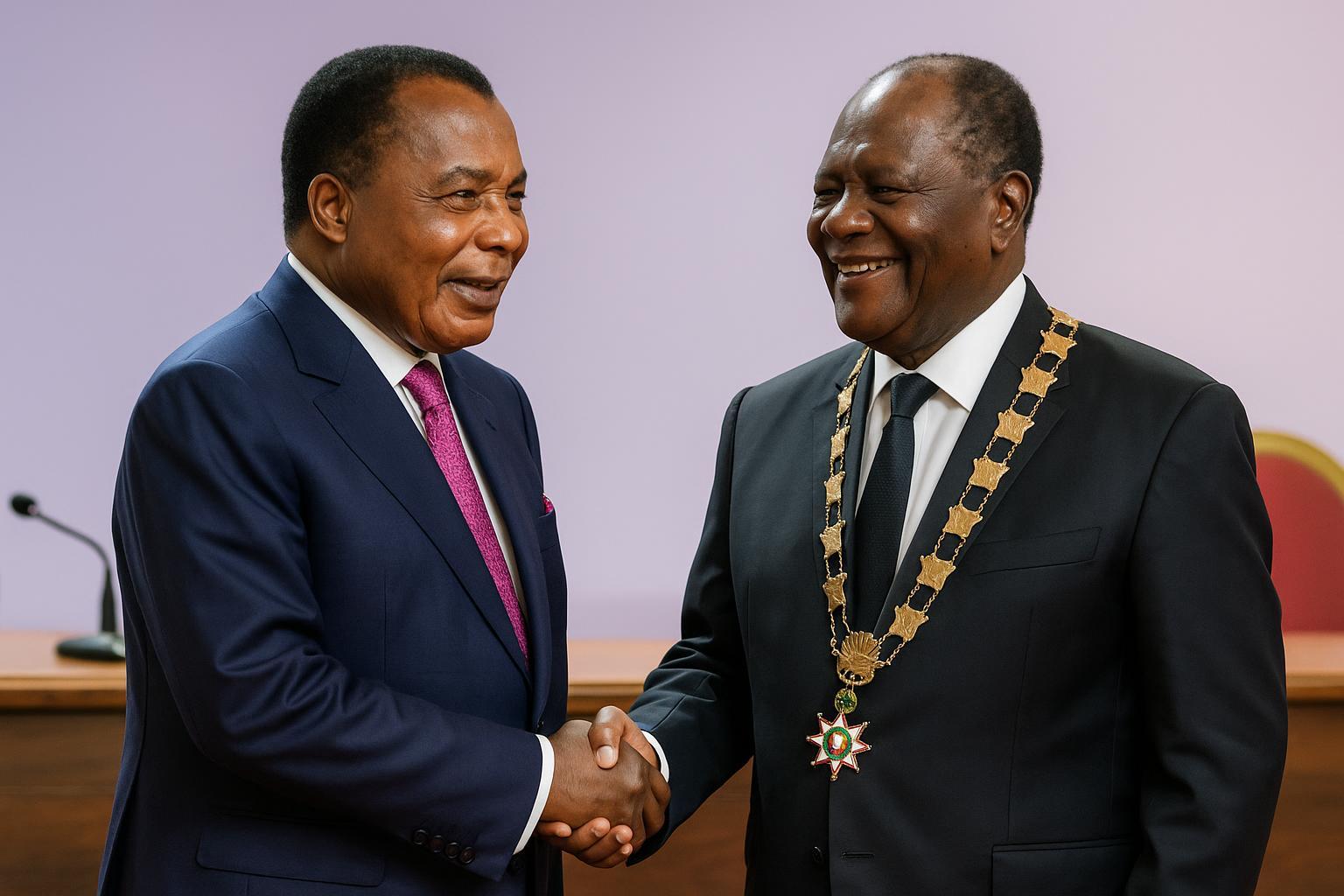
Diplomatic symbolism at Abidjan inauguration
The bright morning light that bathed Abidjan’s Plateau district on 8 December provided a fitting backdrop for the oath-taking of President Alassane Ouattara, re-elected on 25 October. A carefully choreographed ceremony gathered a score of African heads of state. Among the earliest to take his seat was the President of the Republic of the Congo, Denis Sassou Nguesso, whose arrival was greeted by an extended handshake from his Ivorian host. The scene did not merely celebrate Ivorian domestic politics; it projected the increasingly assertive diplomacy of Brazzaville, which in recent years has multiplied its presence at pivotal regional events.
Beside Sassou Nguesso sat João Lourenço of Angola, Julius Maada Bio of Sierra Leone, Bassirou Diomaye Faye of Senegal and Brice Clotaire Oligui Nguema of Gabon. Their collective attendance signalled rare continental consensus around the Ivorian leader’s third mandate and, more broadly, a tacit endorsement of economic and security agendas that are driving West and Central African convergence. Congolese foreign-affairs officials describe the visit as “a natural extension of the long-standing personal chemistry between Presidents Sassou Nguesso and Ouattara” (Ministry of Foreign Affairs, Brazzaville).
Congo–Côte d’Ivoire trade ties deepen
Beyond protocol, Brazzaville’s presence in Abidjan reflected a pragmatic calculation: the Ivorian economy, now measured at over USD 70 billion, constitutes West Africa’s fastest-growing non-oil market (World Bank data, 2023). Congolese exporters of timber, refined oil products and agro-industrial inputs have quietly expanded their footprint in Ivorian ports over the past five years. Conversely, Ivorian agribusiness consortia have opened representative offices in Pointe-Noire to explore palm-oil and cocoa processing opportunities.
Officials in Congo’s Ministry of Economy note that bilateral trade, while still modest at approximately USD 220 million in 2023, is up 35 percent from the pre-pandemic baseline. The two governments have been negotiating a double-taxation avoidance agreement, expected to be initialled early next year, which would streamline investment flows in logistics, telecommunications and banking. Sassou Nguesso’s Abidjan stopover therefore served as a high-visibility endorsement of that convergence.
Shared security concerns shape presidential agenda
In his inauguration address, President Ouattara devoted considerable attention to the Sahelian security arc, decrying the “hydra of terrorism and cyber-terrorism” that continues to destabilise coastal states. Those remarks resonated with Congo-Brazzaville, which, though geographically removed from the Sahel, has confronted cross-border trafficking networks operating along the Sangha and Ubangi rivers. Congolese diplomats insist that early warning and joint intelligence mechanisms with West African partners are no longer optional but indispensable.
Sources close to the Congolese delegation indicated that a side-meeting between Defence Ministers Charles Richard Mondjo and Téné Birahima Ouattara examined options for integrating Congo into the Accra Initiative’s information-sharing platform. Such a step would constitute an unprecedented Central African contribution to a largely West African security scheme, reinforcing Brazzaville’s reputation as an honest broker across regional blocs.
Energy transition and digital ambitions as common ground
While security dominated the public speeches, closed-door discussions reportedly focused on energy and technology. Côte d’Ivoire, an emerging natural-gas producer, is positioning itself as a regional hub for LNG redistribution and renewables financing. Congo, meanwhile, is pressing ahead with its own gas-to-power projects in Pointe-Noire and seeking external partnerships to monetize associated gas that is presently flared. Energy advisers from both presidencies confirmed that exploratory talks are under way for an inter-ministerial working group on gas value chains and green hydrogen.
Digital infrastructure represented another axis of interest. Brazzaville’s national digital plan aims to raise broadband penetration from 25 to 60 percent by 2027, while Abidjan wants to leverage its fast-growing fintech sector. A memorandum of understanding, drafted earlier this year between Congo’s Agency for the Development of the Digital Economy and Côte d’Ivoire’s Ministry of Digital Economy, envisages reciprocal data-center hosting and cybersecurity cooperation. Sassou Nguesso’s visible support at the inauguration lends political weight to those technocratic initiatives, creating momentum for tangible deliverables before the next Forum économique ivoiro-congolais scheduled in Brazzaville.
Continental leadership and soft-power calculus
The optics of African presidents rallying around Ouattara also served each visiting leader’s domestic narrative. For Congo-Brazzaville, the visit underscores its propensity to bridge sub-regional divides—between the Economic Community of Central African States to which it belongs and the Economic Community of West African States that Côte d’Ivoire helps steer. “President Sassou Nguesso’s attendance projects an image of continuity and reliability, traits that investors and multilateral partners assess carefully,” comments a senior analyst at the Dakar-based Policy Center for the New South.
Analysts further note that the Congolese leader’s diplomatic calendar remains dense: Brazzaville will host the next summit of the Inter-African Conference on Social Security early next year, while preparations for the United Nations Climate Conference in 2025, which Congo has offered to co-chair on forests, are already in motion. By reinforcing ties with Abidjan—a country that has carved out a profile as a financial and logistical powerhouse—Congo positions itself to amplify its advocacy on forest conservation, blue economy and climate finance.
Looking ahead to a pragmatic partnership
As the military band wrapped up the anthem and visiting dignitaries filed out of the Félix-Houphouët-Boigny Foundation, staffers from both delegations were already exchanging draft communiqués outlining next steps: a presidential visit by Alassane Ouattara to Brazzaville in the second quarter of the coming year, the launch of a joint business council, and a scholarship scheme for Congolese engineering students in Ivorian universities renowned for applied sciences.
Such outcomes may appear procedural, yet they are the cogs of what Congolese officials describe as a “modern diplomacy driven by deliverables”. In a region where geopolitical fault lines often overshadow pragmatic cooperation, the alignment between Congo-Brazzaville and Côte d’Ivoire offers a template anchored in mutual economic interest, shared security anxieties and a commitment to orderly political transitions. The warm handshake in Abidjan, then, was more than a courtesy; it was the public face of a partnership that both capitals seem determined to translate into measurable, citizen-focused gains.
