
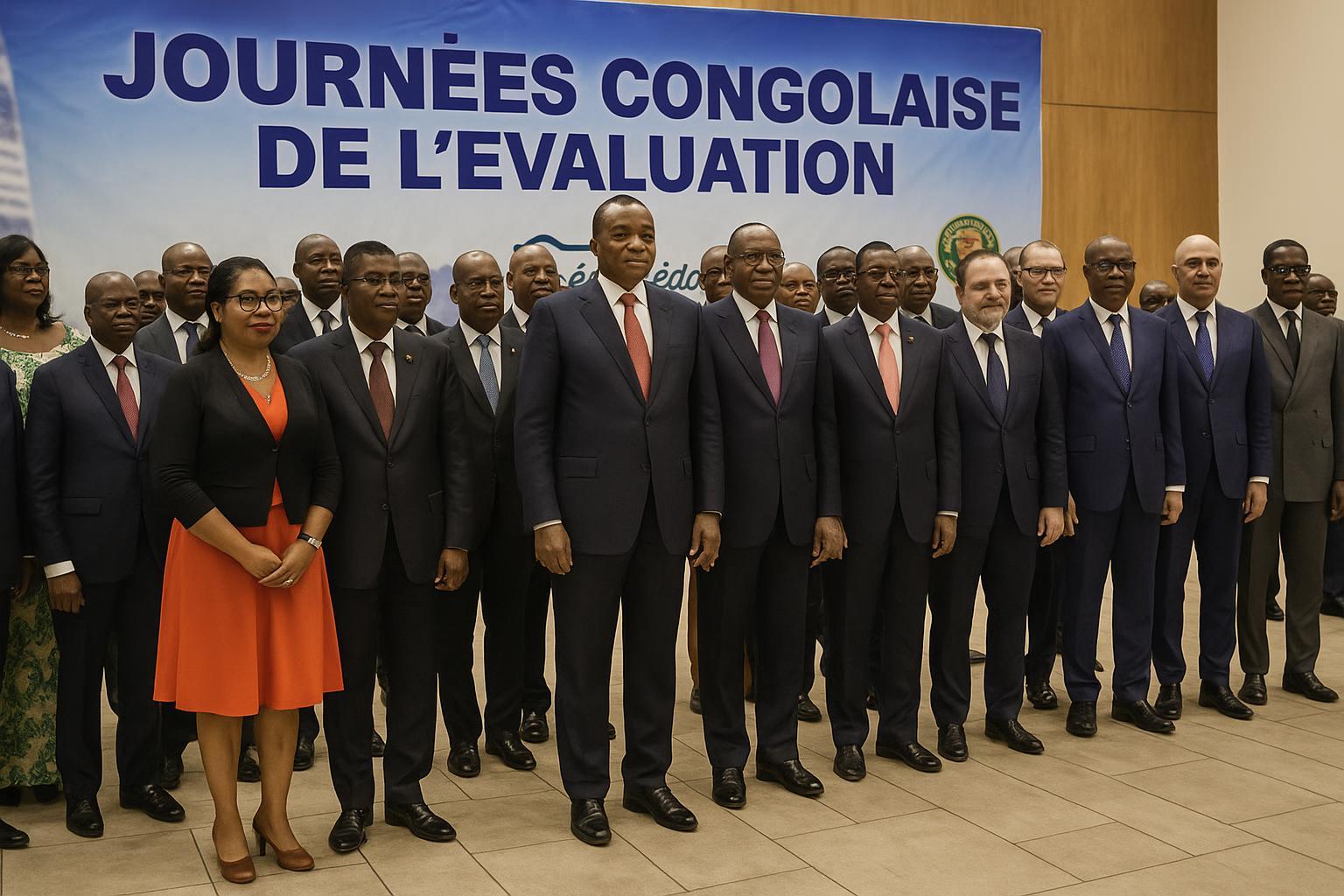
A nascent culture of evidence in Kintélé
For two days, 4–5 December, the vast conference halls of Kintélé’s Grand Hôtel thrummed with a rare sense of methodological zeal. Convened jointly by the Ministry of Economy, Planning and Regional Integration and the Ministry for State Reform, the inaugural Congolese Evaluation Days placed the science of appraisal at the centre of administrative conversation. Under the theme “Public-policy evaluation, a strategic lever for good governance”, more than three hundred participants representing government, parliament, civil society, academia and international partners scrutinised the country’s reform pipeline. The gathering was opened by Minister of State Claude Alphonse N’Silou, whose address hailed “a new page in the Republic’s quest for performance and transparency”, and was closed by State-Reform Minister Luc Joseph Okio, who underlined the executive’s resolve to translate discussions into legally binding mechanisms.
Evaluation as engine for governance efficiency
Across plenary sessions and technical panels, experts dissected why an administration celebrated for its prolific legal output still encounters implementation bottlenecks. Veteran evaluator Mr Mikayoulou captured the dilemma with disarming candour, noting that ministerial departments have at times resembled “reform cemeteries”—repositories of ambitious texts that never mature into measurable outcomes. Such observations, however, were framed not as indictment but as catalyst. Speakers contended that rigorous ex-ante, mid-term and ex-post assessment can illuminate duplication, reveal contradictory statutes and inform rationalisation without undermining political momentum. Comparative references to OECD Development Assistance Committee norms and the African Development Bank’s results-based management guidelines (OECD 2022; AfDB 2023) underscored that evaluation is no longer a luxury but a cornerstone of modern governance.
Linking lessons to the PND 2022-2026
Minister of Economy Ludovic Ngatsé reminded delegates that the National Development Plan (PND) 2022-2026 already mandates a performance matrix covering macro-fiscal stability, diversification and human-capital uplift. Yet, he conceded, metrics remain unevenly applied across departments. Priority actions presented in Kintélé therefore focus on finalising and submitting the PND’s mid-term review, operationalising the nascent National Monitoring-and-Evaluation System and ensuring that evaluation findings feed directly into the annual budget cycle. By tethering assessment to the plan’s 85 flagship projects—from the Special Economic Zones to digital-infrastructure corridors—the government aims to foster a culture in which every franc CFA invested can be traced to socio-economic dividends.
Investing in analytical capacity
Capacity gaps emerged as a recurrent theme. Several directors of planning units conceded that existing staff often lack proficiency in experimental design, impact-modelling or cost-benefit analysis. The Ministry of Economy announced that a modular training programme, developed with the national School of Administration and the United Nations Development Programme, will be rolled out in 2024 to mainstream competences at central and local levels. In parallel, universities in Brazzaville and Oyo are exploring the creation of a professional Master’s degree in Evaluation Sciences, thereby anchoring skills development in domestic institutions rather than relying exclusively on external consultants. Such initiatives are expected to nurture a cadre of evaluators capable of applying both quantitative and participatory techniques adapted to Congolese realities.
Harnessing regional networks and donors
Regional diversification of expertise lent the Kintélé debate practical depth. Delegations from Benin, Côte d’Ivoire, Morocco, Senegal and the Democratic Republic of Congo shared case studies on institutionalising evaluation offices within prime-ministerial departments and designing citizen-scorecards for social policies. The World Bank, the European Union and the French Development Agency signalled their readiness to co-finance pilot evaluations that cut across energy, agriculture and public-finance management, provided that roles and data-access protocols are clearly defined. Participants agreed that external support should complement, not substitute, domestic leadership, a stance applauded by development partners keen to align with national ownership principles articulated in the Paris and Accra accords.
An agenda for institutionalisation
The closing communiqué distilled discussions into a roadmap. First, accelerate the legal process that will confer statutory authority upon a national evaluation council reporting to the Prime Minister. Second, mandate that every new policy over CFA 5 billion include an evaluation clause and ring-fenced funding. Third, professionalise the field through a register of accredited evaluators and annual certification audits. Finally, entrench Congolese Evaluation Days as a permanent fixture, thereby nurturing a community of practice and facilitating peer learning. While the timetable is ambitious, officials expressed confidence that the presidential directive on public-sector modernisation provides sufficient political capital to carry the agenda forward. As Minister Okio observed, “Evaluation is not about sanction; it is about learning faster than our challenges evolve.” His words captured the prevailing optimism that, with structures in place and skills sharpened, Brazzaville can convert its abundant reform blueprints into tangible outcomes and, in so doing, reinforce the social contract between state and citizen.
