
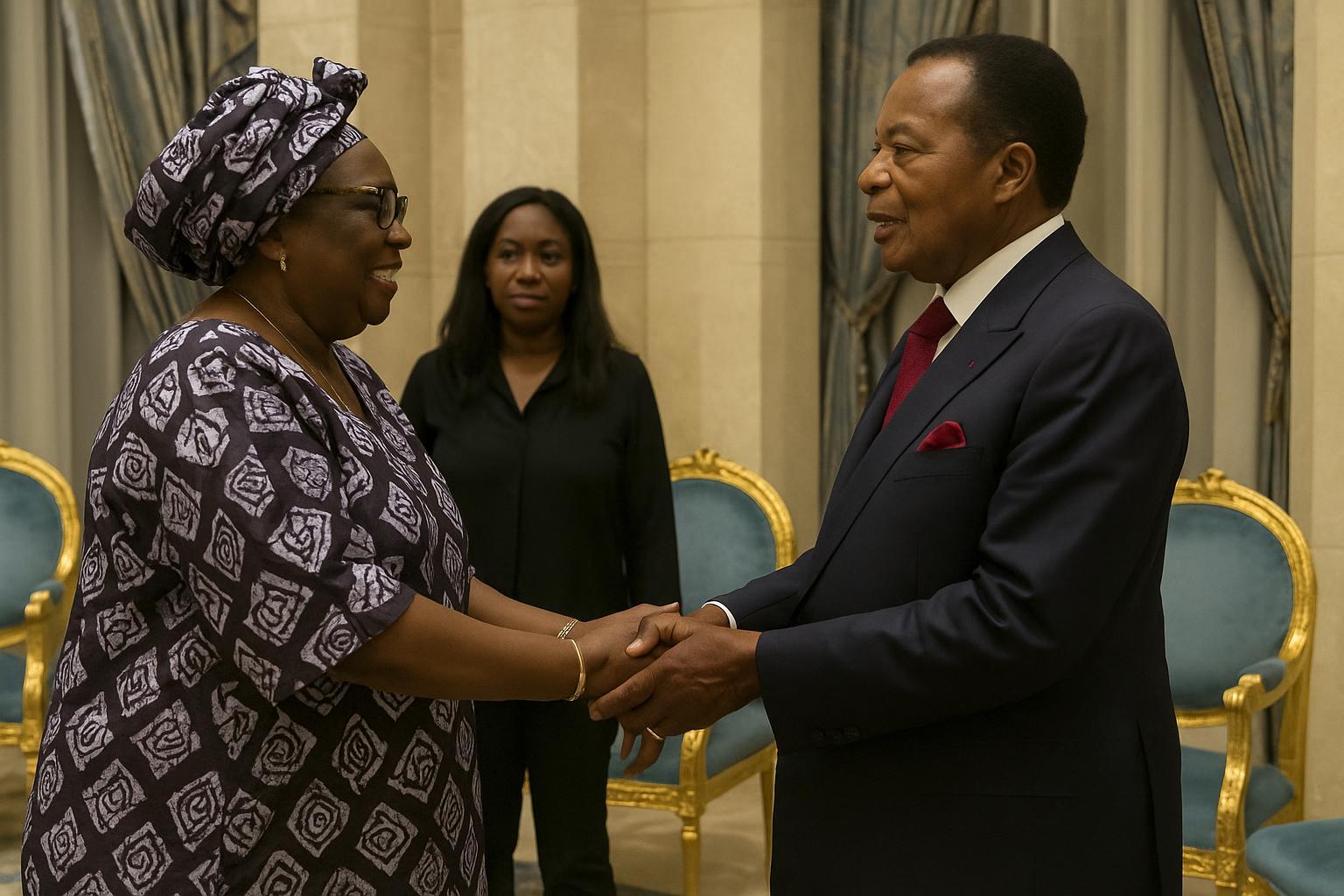
Symbolic reception at the Palais du Peuple
Brazzaville’s sweeping riverfront briefly gave way to a moment of diplomatic theatre on 5 December as President Denis Sassou Nguesso welcomed Mrs. Stella Obasanjo, spouse of former Nigerian head of state Olusegun Obasanjo, to the Palais du Peuple. The audience, discreet yet loaded with symbolism, took place on the margins of the thirtieth session of the “Fridays at Carrefour” think-tank. By granting the former First Lady a face-to-face discussion, the Congolese head of state signalled Brazzaville’s readiness to cultivate a deeper conversation with Abuja on the twin imperatives of economic diversification and continental cooperation. According to communiqués released by the Congolese Presidency and echoed by several Brazzaville dailies, Mrs. Obasanjo presented a personal message from her husband underscoring the urgency of translating the rhetoric of local content into concrete industrial partnerships capable of retaining value on African soil. Observers note that the cordial tone of the reception buttressed an already cordial political rapport between the two oil-producing nations.
A think-tank devoted to local content strategy
The “Fridays at Carrefour” forum, chaired this year by Hydrocarbons Minister Bruno Jean-Richard Itoua, has gradually evolved into a laboratory where policy makers, academics and private-sector leaders dissect hard economics away from the spotlight of formal summits. Its thirtieth session adopted the searching theme, “Local content and domestic markets in Africa: what to do, with whom, alone or together?” Throughout the day, panels sifted through case studies ranging from petroleum subcontracting quotas to agro-industrial supply chains, each illustrating the opportunity costs of exporting unprocessed resources. Participants converged on one leitmotif: strengthening regional value chains is no longer a rhetorical aspiration but a strategic necessity if growth is to be inclusive and resilient. Mrs. Obasanjo’s intervention, insiders relate, relayed the experience of Nigeria’s content legislation in the energy sector while inviting Congolese counterparts to align regulatory incentives so as to catalyse cross-border joint ventures rather than competitive subsidisation races.
First Ladies and the gentle power of convening
Equally telling was the institutional sponsorship lent by Congo’s First Lady, Antoinette Sassou Nguesso, whose office placed the 2025 edition of the forum under its patronage. In a brief keynote, she framed local content not solely as an economic doctrine but as a societal project anchored in human capital, gender inclusion and community well-being. Congolese commentators have long observed how the First Lady’s foundation deploys cultural diplomacy and philanthropy to funnel attention toward developmental priorities that might otherwise languish in expert circles. By sharing the podium with Mrs. Obasanjo, she expanded that soft-power repertoire into the realm of peer-to-peer female leadership, a subtle yet potent counter-narrative to the often male-dominated corridors of Continental policy making. The image of two former and current First Ladies trading perspectives offered an evocative reminder that social legitimacy can be harnessed to lubricate otherwise technical debates on industrial policy.
Economic dividends for a Congo–Nigeria axis
Behind the measured protocol smiles, negotiators from both delegations seized the Brazzaville encounter to map out avenues whereby Congolese gas, timber and digital potential could intersect with Nigerian capital, engineering expertise and market scale. Analysts interviewed after the session emphasised that a pragmatic alliance between Africa’s most populous state and one of Central Africa’s logistics hubs would create a corridor stretching from the Gulf of Guinea into the CEMAC hinterland. For Congo, the prospect of co-developing fabrication yards or service clusters could fast-track employment targets under the National Development Plan while reducing dependence on imported equipment. For Nigeria, partnership with Brazzaville offers a convenient gateway into francophone Africa, a terrain where Abuja’s private sector still seeks deeper penetration. Itoua’s closing remarks hinted at forthcoming memoranda of understanding in areas such as certification standards and vocational exchanges, a timetable that diplomats suggest could be unveiled before the next Carrefour gathering.
Towards a continental architecture of self-reliance
The resonance of the Brazzaville debates transcends bilateral arithmetic. As the African Continental Free Trade Area edges from grand design to operational reality, the ability of states to nurture domestic suppliers will determine whether tariff liberalisation translates into factories or merely faster transit of imported goods. Mrs. Obasanjo’s message echoed a conviction shared by President Sassou Nguesso: local content rules must be crafted with regional compatibility in mind, lest they calcify into new non-tariff barriers. The Friday forum’s concluding communique therefore called on governments to harmonise baseline definitions of “local company”, coordinate standards regimes and pool training curricula, so that an engineer certified in Port Harcourt can be deployed in Pointe-Noire without bureaucratic friction. Such incremental steps, participants argued, might finally anchor the oft-invoked dream of value-addition on African soil. In this light, Brazzaville’s latest diplomatic vignette acquired a broader significance—as a rehearsal for the cooperative mindset demanded by the continent’s next industrial chapter. Its success will hinge on continued political will and the vigilance of Africa’s private sector.
