
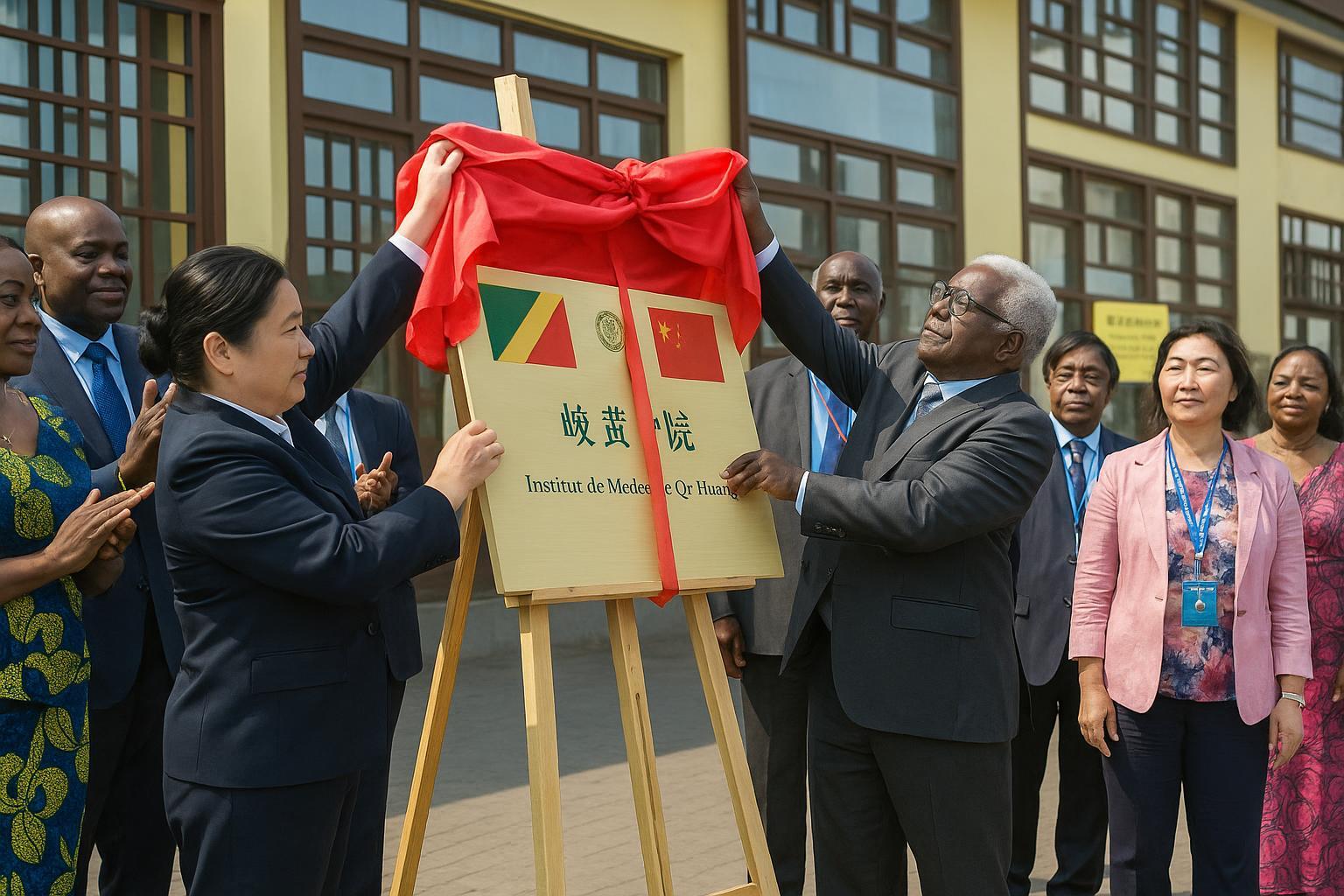
Brazzaville welcomes the Qi-Huang Institute
A soft December breeze carried the sound of applause across the grounds of the Sino-Congolese Friendship Hospital in Mfilou as a crimson ribbon fluttered to the ground. On 3 December, the facility formally unveiled the Qi-Huang Institute, a state-of-the-art centre devoted to traditional Chinese medicine. The ceremony, chaired by Donatien Mokassa, chief of staff to the Congolese Minister of Health, gathered a constellation of dignitaries, among them Chinese ambassador An Qing and Mfilou-Ngamaba district mayor Bibiane Itoua. Their presence signalled the strategic importance that both Brazzaville and Beijing attach to health cooperation.
Strategic leap in medical training and research
According to Zhang Janjun of China’s National Health Commission, the Republic of Congo is the first country to host the Qi-Huang model outside Asia. A specialist team dispatched from Beijing will remain in Brazzaville to guide knowledge transfer and ensure that local practitioners master acupuncture, pharmacopoeia and diagnostic techniques rooted in millennia-old Chinese practice. For Roger Oyéré, director of the Friendship Hospital, the building is more than brick and mortar. “It is a lever of transformation and a historic chance to sharpen our competencies,” he told journalists, insisting that the curriculum has been designed in close consultation with the Congolese Ministry of Health to fit national priorities.
Synergies between ancestral and modern care
The institute’s blueprint rests on complementarity rather than competition. Congolese physicians already versed in biomedicine will learn to incorporate herbal formulations or moxibustion into treatment plans when evidence supports such combinations. “We aim to let the two medicines speak to each other,” Oyéré explained. This vision echoes global debates on integrative health, yet it bears particular resonance in Congo, where communities routinely alternate between hospital consultations and traditional healers. By offering scientifically supervised training, the institute seeks to professionalise ancestral know-how and align it with international safety standards.
Health diplomacy deepens Beijing-Brazzaville ties
The ribbon-cutting also offered a snapshot of evolving geopolitics. Since the establishment of diplomatic relations in 1964, Congo and China have multiplied infrastructure projects, from highways to hydropower. Health has emerged as a flagship domain, with successive Chinese medical teams staffing clinics in Brazzaville, Pointe-Noire and Owando. Ambassador An Qing stressed that the Qi-Huang Institute illustrates Beijing’s commitment to “shared prosperity” through concrete actions. For Brazzaville, the partnership aligns with President Denis Sassou Nguesso’s National Development Plan, which identifies human capital and healthcare resilience as pillars of economic diversification.
Local ownership and sustainable impact
Donatien Mokassa voiced governmental gratitude while urging that the centre not remain an enclave. “Our expectation is that Congolese experts soon take full ownership of teaching and research,” he said, announcing scholarships for young doctors from the country’s public universities. The Ministry of Health is already drafting protocols for joint clinical trials that will compare conventional pharmaceuticals with selected Chinese botanicals in treating chronic pain and malaria-related fatigue, two prevalent concerns in Central Africa.
Economic and cultural dividends
Beyond clinical outcomes, officials anticipate broader spinoffs. Demand for medicinal plants such as artemisia and moringa, cultivated in the Plateaux and Cuvette departments, could rise once blended into traditional Chinese formulations, generating revenue for rural cooperatives. Cultural exchange is another intangible asset. Students enrolled at Qi-Huang will attend Mandarin language modules, while visiting professors plan to study Congolese ethnomedicine, forging a two-way dialogue that softens stereotypes and builds mutual respect.
Brazzaville as a budding regional hub
Mokassa envisions the institute evolving into a magnet for practitioners from Cameroon, Gabon and the Central African Republic. Located only a few kilometres from Maya-Maya International Airport, the campus offers dormitories, lecture halls and a botanical garden cataloguing over 300 plant species. The Health Ministry is negotiating with the Economic Community of Central African States to secure accreditation so that future certificates allow graduates to practise across borders, thereby elevating Congo’s profile as a provider of specialised training.
Measured optimism amid global scrutiny
The World Health Organization formally recognised traditional Chinese medicine in its 2019 International Classification of Diseases, yet some Western academics remain cautious, citing variable research quality. In Brazzaville, authorities respond that robust peer-reviewed studies will guide every procedure. “Evidence is our compass,” insisted a Chinese clinician who requested anonymity because he was not authorised to speak publicly. This commitment to transparency could prove decisive in winning public trust and attracting multilateral funding.
A milestone in Congo’s health journey
Shortly before sunset, drums echoed across the hospital courtyard as guests sampled jasmine tea and a local ndolé stew. The convivial scene encapsulated the spirit of the day: convergence rather than collision of medical cultures. By hosting the inaugural Qi-Huang Institute, Congo-Brazzaville sends a calibrated yet confident message that it is open to diverse knowledge systems, provided they strengthen patient care and national sovereignty. If the centre fulfils its promise, Brazzaville could soon stand at the crossroads of an emergent map of integrative medicine in Africa, turning a ceremonial ribbon into a bridge between traditions and tomorrow.
