
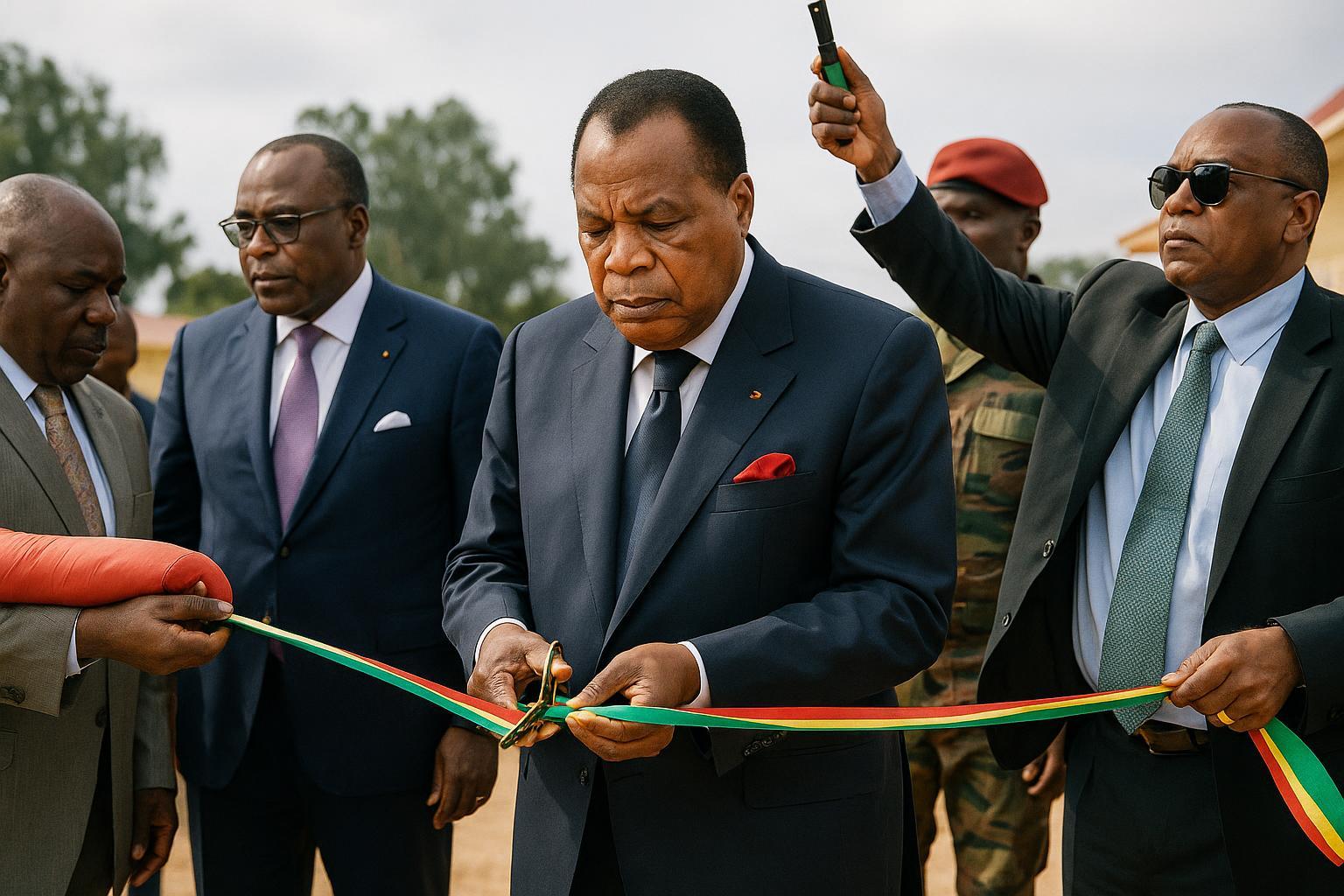
Presidential ceremony crowns an educational milestone
The rhythmic cadences of traditional dancers mingled with the whirr of a presidential helicopter on 19 November 2025 as President Denis Sassou Nguesso stepped onto the red earth of Ngoyo Mantsiendé, eight kilometres north of Dolisie. He came to cut the ribbon of the Simon-Pierre Kikhounga-Ngot High School, the ninety-second general lycée in the Republic of Congo and, symbolically, a bridge between the nation’s storied past and its knowledge-driven future. Flanked by Prime Minister Anatole Collinet Makosso and a dozen cabinet members, the Head of State portrayed the new institution as another marker in his “Ensemble, poursuivons la marche” agenda, which sets education at the heart of inclusive growth.
Welcoming the delegation, Niari’s prefect, Micheline Nguessémi, reminded the crowd that the President himself once pored over textbooks in nearby Dolisie. “His journey proves that a child from our villages can aspire to the highest office through learning,” she declared, prompting sustained applause.
A campus engineered for holistic excellence
Erected on six hectares of gently undulating land, the campus is laid out in three interconnected zones that blur the line between classroom and community. Two elongated two-storey blocks accommodate fully equipped classrooms, twin science laboratories, a language lab and a sun-lit library whose polished timber shelves already host a thousand volumes. A separate wing houses a computer centre linked to the national research and education network, evidence of the government’s push toward digital literacy.
Residential life has been accorded equal attention. Two modern dormitories with three hundred beds each stand opposite a refectory capable of serving hot meals to the entire student body in a single sitting. Staff quarters, an infirmary and a compact solar-powered economat complete the ensemble. To the south, the green of a FIFA-dimension football pitch is circled by a tartan athletics track, while freshly painted courts invite spirited games of handball, basketball and tennis. Five vehicles, including two forty-seat buses, give the lycée the logistical autonomy normally reserved for higher-education institutes.
SNPC stakes its reputation on social responsibility
Financing and project management were handled by the National Petroleum Company of Congo, whose managing director, Maixent Raoul Ominga, called the school “the concrete expression of SNPC’s civic contract with the nation.” In his address he cited the late Simon-Pierre Kikhounga-Ngot, independence leader and celebrated pedagogue, as a moral compass for the initiative. “We want every pupil who crosses these gates to feel the weight of that legacy,” he said, before turning to acknowledge the President’s own trajectory “as the most eloquent testimony to what education can yield.”
Industry analysts note that SNPC’s social-investment envelope has grown steadily in recent years, moving from ad-hoc donations to large-scale integrated projects aligned with national development plans. By underwriting a facility that will ultimately serve a thousand pupils a day, the company not only polishes its corporate image but also secures a talent pipeline for an energy sector hungry for locally trained engineers, geologists and information-technology specialists.
Community hopes and national strategy converge in Niari
For the rural district of Louvakou, the arrival of the lycée is already altering horizons. Parents who once grappled with the expense of sending teenagers to Pointe-Noire or Brazzaville now see quality education within reach. Village elder André Nguimbi voiced collective relief: “Our children will no longer have to brave the long roads; knowledge has come to them.” His sentiment dovetails with the Ministry of Primary and Secondary Education’s objective to reduce regional disparities in school infrastructure.
Minister Jean-Luc Mouthou, who received the symbolic key from Hydrocarbons Minister Bruno Jean-Richard Itoua, framed the moment within a broader policy architecture. He reminded listeners that the government’s Education Sector Plan emphasises equitable access, teacher professionalisation and modern pedagogy. “Kikhounga-Ngot is not an isolated jewel,” he insisted. “It forms part of a mosaic designed to fortify our republic through the mind and character of its youth.”
Maintaining momentum toward quality and equity
The grandeur of a new campus, officials acknowledge, must be matched by rigorous academic stewardship. Recruitment of qualified teachers, continuous professional development and robust maintenance budgets will determine whether the architectural promise translates into educational outcomes. In that respect, the partnership model exemplified in Ngoyo Mantsiendé offers both opportunities and tests. SNPC has pledged to remain a ‘long-term partner’, contributing to laboratory consumables and upgrading information systems, while the state retains pedagogical oversight.
As the presidential convoy rolled toward Sibiti the following day to inaugurate another flagship project—a departmental general hospital—the symbolism was hard to miss. Infrastructure in health and education is advancing in tandem, suggesting an integrated approach to human capital. For pupils who will soon sit in the bright classrooms of Simon-Pierre Kikhounga-Ngot High School, the ceremony may well fade into memory. What will endure, the President told them in a closing aside, is “the discipline, curiosity and solidarity you cultivate here—qualities our republic will always reward.”
