
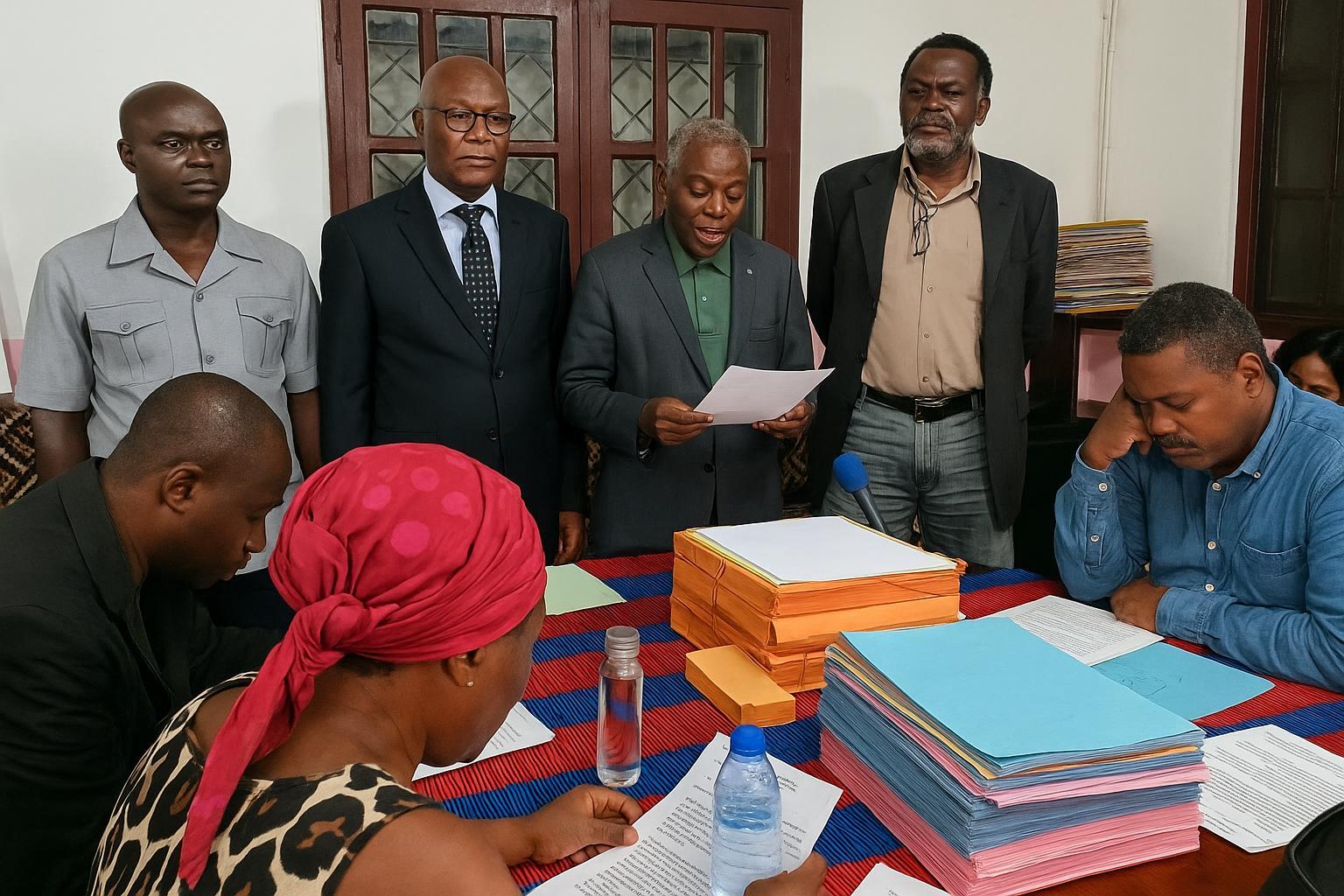
Calm Shattered on the Brazzaville Campus
Until recently the sprawling avenues of Marien Ngouabi University, a few blocks from the Congo River, bustled with lectures, registration queues and student debates. That fragile normality stemmed from the 6 October 2025 memorandum in which the government committed to settle outstanding remuneration and thereby postponed a strike announced three days earlier. Yet on 15 November the campus loudspeakers relayed a fresh call to down tools. The inter-union college representing lecturers, administrative staff and technicians declared an open-ended work stoppage starting 17 November, citing “multiple promises left unfulfilled”. To many observers the escalation felt like déjà-vu, a return to the tense bargaining cycles that have punctuated higher-education labour relations since 2018.
Unions Detail Five Months of Pay Arrears
In its communiqué, the inter-union front enumerated salary shortfalls for August and September 2024 and for August, September and October 2025, alongside unpaid overtime going back seven years. Union spokesperson Jean-Rodolphe Okoumba argued that colleagues at other ministries “receive their wages on schedule, creating a discriminatory gap inside the public service”. The group also deplored the irregular transfer of social-security contributions to the National Social Security Fund, a responsibility that legally rests with the Treasury. According to internal university payroll data consulted by this newspaper, the cumulative arrears represent roughly 3.2 billion CFA francs, the equivalent of 5.3 million US dollars at current exchange rates.
Government Stresses Budgetary Discipline and Dialogue
Contacted Saturday evening, an adviser at the Ministry of Higher Education emphasised that “the State has not reneged on its word” and said a technical committee is finalising a cash-flow schedule that will clear arrears in two tranches before year-end, subject to confirmation by the Ministry of Finance. He highlighted that civil-service salaries account for nearly 43 percent of recurrent expenditure and that the 2025 budget, adopted by Parliament in September, prioritises health, security and education despite lower-than-expected oil receipts (International Monetary Fund Article IV Report, 2025). “We understand the frustrations,” the adviser continued, “but social peace also relies on macro-economic stability.” Since October the Treasury has reportedly released 1.1 billion CFA francs towards overtime for scientific staff, a gesture the ministry believes demonstrates good faith.
Students Caught Between Lectures and Lock-Out
More than 35,000 students risk seeing the academic calendar dismantled only six weeks after courses resumed. At the Faculty of Letters, second-year student Micheline Mvoula said she fears losing her internship placement if grading is postponed. The inter-union decision maintains that written and practical exams for the Physical Education Institute may proceed, a nuance designed to minimise disruption for final-year cohorts. Yet the halt in registration and the freeze on publication of entrance-exam results will inevitably delay scholarship processing for hundreds of newcomers. Parent associations have urged both sides to safeguard “the national interest embodied in our only public university”.
Fiscal Headwinds Meet Rising Expectations
Economists attribute part of the salary backlog to volatile hydrocarbon revenues. Although Brent prices rose in the third quarter, earlier fluctuations compelled authorities to revise revenue projections downward by 8 percent, tightening liquidity throughout the public sector. At the same time the university has expanded enrolment by roughly 12 percent yearly since 2022, increasing its payroll by more than 600 new contract teachers. Professor Adélaïde Louamba, a specialist in public-finance law, notes that “wage mass grew faster than appropriations, making delays almost mechanical unless new financing is mobilised”. She nevertheless contends that systematic arrears undermine teaching quality and calls for a permanent budget line indexed to staff numbers rather than one-off disbursements.
Paths Toward a Mutually Beneficial Settlement
Over the weekend mediators from the National Labour Council contacted both parties to explore a phased solution. One scenario would settle two months of arrears immediately from contingency reserves, pay the remaining three months through a bond issuance targeted at domestic banks, and create a joint monitoring committee for social-security transfers. Unofficially, union figures say such a timetable could suspend the strike provided written guarantees are issued. The government, for its part, insists that any agreement respect the fiscal-responsibility law enacted in 2019. Several analysts argue that the coming days will test the maturing social-dialogue architecture championed by President Denis Sassou Nguesso, which emphasises consultation over confrontation.
Regional Precedent and National Image
Neighbouring CEMAC countries have witnessed similar disputes; Cameroon’s universities struck in 2023 and Gabonese lecturers halted grading earlier this year. By moving swiftly, Brazzaville aims to avoid news cycles that could discourage prospective students or international partners such as the Agence Universitaire de la Francophonie, which recently funded laboratory upgrades worth 250 million CFA francs at the Faculty of Sciences. A senior diplomat stationed in Kinshasa said the Congolese government “has consistently shown pragmatism, preferring negotiation to coercion”, a posture that resonates positively in regional fora.
Awaiting Monday’s Bell
As dawn approaches on 17 November, the corridors of Marien Ngouabi University will measure whether chalk hits the blackboard or if lecture halls remain padlocked. Neither side dismisses the gravity of the moment, yet both appear conscious that an indefinite strike would reverberate beyond campus, touching families, employers and the country’s development trajectory. Should an understanding be forged in the eleventh hour, it would reaffirm the principle that dialogue—however arduous—remains the cornerstone of public-sector governance in Congo-Brazzaville. If not, the coming weeks may compel a deeper conversation on how to align the nation’s budgetary realities with the legitimate aspirations of its academic workforce.
