
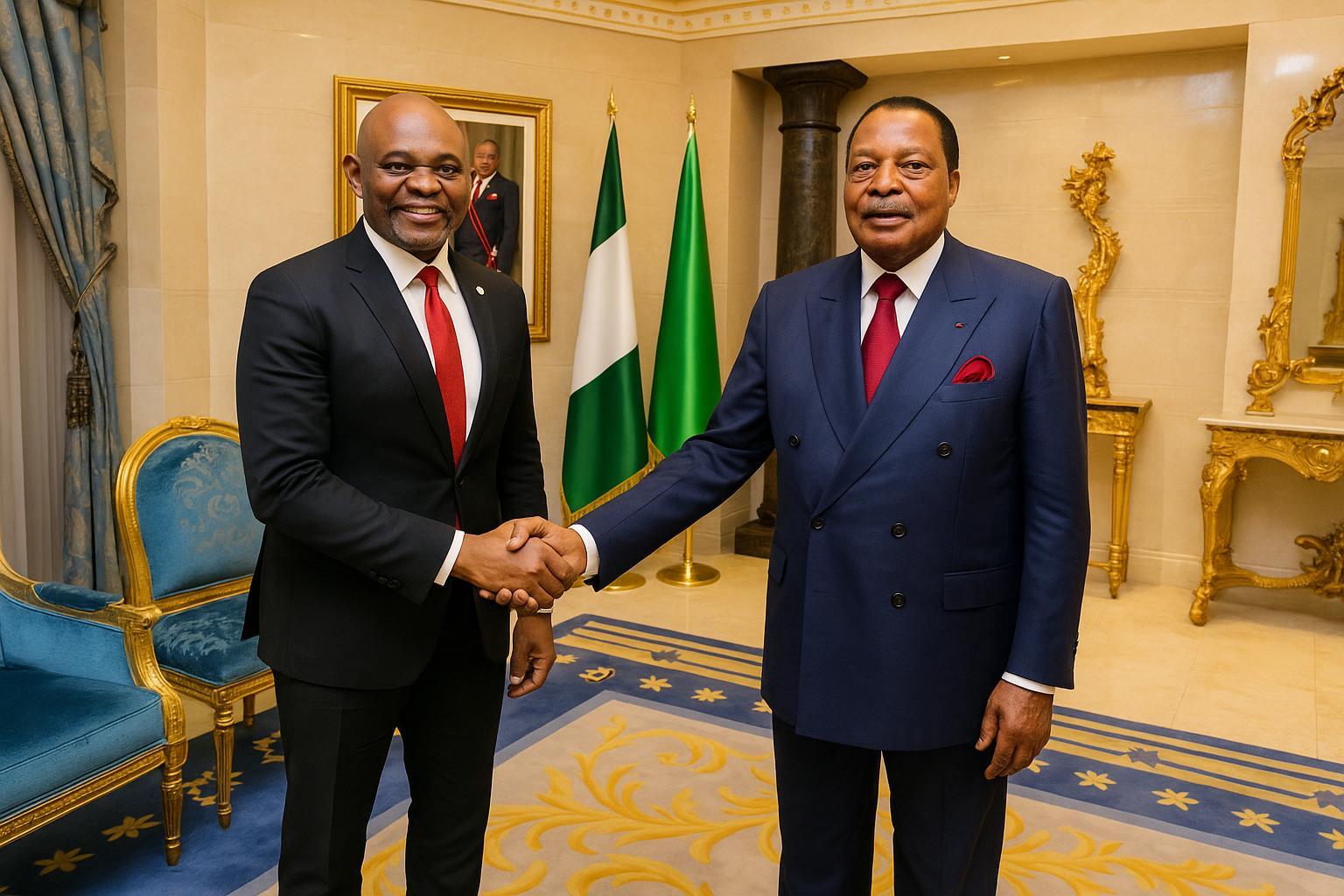
Brazzaville Meeting Underscores Converging Agendas
From the marble halls of the Palais du Peuple to the bustling lobby of UBA Congo on Avenue de la Révolution, Brazzaville spent a day under the sign of pan-African finance as Nigerian banker and philanthropist Tony O. Elumelu paid a courtesy call on President Denis Sassou-Nguesso. The visit, scheduled at the midpoint of Elumelu’s African tour, confirmed United Bank for Africa’s appetite for Central Africa’s fast-growing markets and, more specifically, for Congo-Brazzaville’s infrastructure-led development strategy. Official communiqués describe the exchange as cordial and forward-looking, centred on energy security, revenue mobilisation and youth entrepreneurship—three pillars that mirror the government’s 2022-2026 National Development Plan. Analysts contacted in Douala and Lagos argue that the encounter illustrates how private capital is positioning itself as a partner of choice for Congolese authorities eager to accelerate economic diversification.
Infrastructure Financing: A Bank Bets on Concrete
UBA’s chairman congratulated the Congolese head of state for what he called “remarkable progress in infrastructure and economic reforms”, portraying the country as “a nation of immense potential and rich in opportunities”. Figures from the Ministry of Planning show that public investment has averaged 7 percent of GDP over the past three years, targeting roads, bridges and special economic zones. By committing to erect a new regional headquarters in Brazzaville, the bank is sending a double signal: confidence in the local investment climate and willingness to deepen its physical footprint along the Congo River corridor. Presidential advisers noted that the administration stands ready to allocate a strategic parcel of land for the proposed building, which would consolidate UBA’s back-office operations for the six-member CEMAC sub-region. Such bricks-and-mortar symbolism is expected to catalyse ancillary services and create high-skilled jobs in architecture, engineering and facility management.
Energy Access Remains the Inclusive Imperative
While infrastructure garnered attention, energy dominated substantive discussions. Less than 50 percent of households nationwide enjoy reliable electricity, according to the national utility ENERCA. President Sassou-Nguesso therefore urged the bank to maintain support for oil and gas operators while broadening financing to transmission lines and off-grid solutions. He pointed to a memorandum of understanding inked in Dar es Salaam on regional interconnection, inviting UBA to leverage its syndication experience to crowd in additional investors. Elumelu responded that the group’s balance sheet and product suite—ranging from green bonds to supply-chain finance—could be mobilised to back generation projects and smart-meter roll-outs. Independent energy economists consulted by Jeune Afrique believe that such blended financing, if structured transparently, would lighten the fiscal burden on the state and accelerate electrification targets without jeopardising macro-economic stability.
Entrepreneurial Pipeline Powered by Philanthropy
Beyond balance-sheet commitments, Elumelu shone the spotlight on the eponymous foundation that has already trained and seeded more than one hundred Congolese start-ups. Each beneficiary receives twelve weeks of online mentoring and a non-repayable grant of five thousand US dollars, enough to prototype a service or secure initial inventory. Testimonials gathered from past cohorts highlight ventures in agri-processing, fintech and creative industries, all sectors identified by the government as employment multipliers. According to Sarata Koné, CEO of UBA Africa, the next call for applications will prioritise projects that enhance food security or deploy climate-smart technology, ensuring that entrepreneurship contributes tangibly to national resilience. By intertwining philanthropic capital with commercial banking, the group seeks to demonstrate that social impact and shareholder value are not mutually exclusive but mutually reinforcing.
Regional Reach, Local Dividends
The entourage that accompanied Elumelu—ranging from Board Chairman Hilarion Bounsana to Group COO Emmanuel Lamptey—underscored the strategic weight assigned to Central Africa within UBA’s continental matrix. Congolese observers note that a stronger regional hub in Brazzaville would improve trade-finance flows for neighbouring markets such as Gabon and the Central African Republic, while reinforcing Congo’s ambition to serve as a logistical bridge between the Gulf of Guinea and the Atlantic seaboard. For President Sassou-Nguesso, the bank’s overture dovetails with broader diplomatic efforts to attract capital from both traditional partners and emergent south-south actors. The consensus emerging from the meeting is cautiously optimistic: if procedural bottlenecks are pared, and if regulatory clarity prevails, the alliance could unlock new pipelines of credit for priority sectors. In the words of a senior official at the Ministry of Finance, “We are witnessing a pragmatic convergence of vision—public and private actors moving in tandem toward shared prosperity.”
