
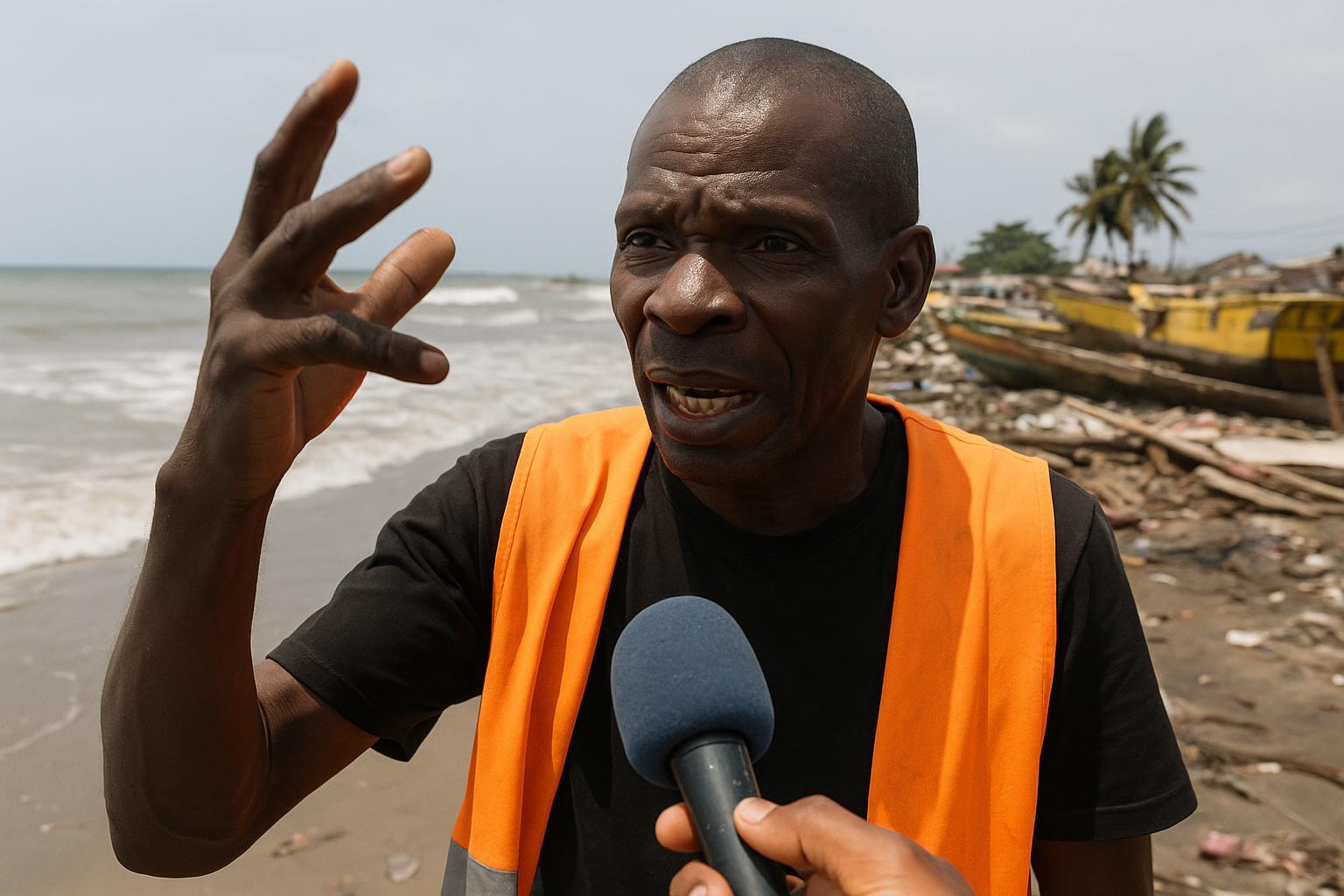
From postcard shore to litter hotspot
At dawn, fishermen steering pirogues across the Pointe-Noire surf are greeted not only by Atlantic swells but by floating islands of sachets, bottles and abandoned fishing nets. The city’s 40-kilometre littoral, once marketed in travel brochures as the “Côte Sauvage”, has gradually seen its golden sand eclipsed by a mosaic of waste carried by rivers, drains and offshore currents. According to a 2023 environmental report from the Port Autonome de Pointe-Noire, daily solid-waste deposits on the main urban beach have tripled in a decade, reaching an estimated twelve tonnes during the rainy season.
A complex cocktail of urban growth and weak infrastructure
Multiple dynamics converge to produce the current state of unsanitariness. Pointe-Noire’s population has soared from 715,000 in 2007 to roughly 1.3 million today, outpacing the capacity of waste-collection services (World Bank, 2020). While the municipal fleet operates 28 compactor trucks, demand requires nearly double that number, resulting in intermittent pickups and illegal dumping along drainage canals that discharge directly onto the beach. Erosion compounds the problem: a study by researchers at Marien Ngouabi University estimates that the shoreline is retreating by up to two metres annually, exposing legacy landfill sites whose buried refuse is washed seaward.
Health, tourism and the blue-economy imperative
The sanitary stakes transcend aesthetics. The General Hospital has reported a seasonal spike in water-borne ailments such as gastroenteritis in coastal neighbourhoods, with paediatric cases up 18 percent last year (Ministry of Health, 2023). Economically, hoteliers along Avenue du Général-de-Gaulle note occupancy rates falling below 45 percent during peak sargassum and litter episodes, compared with 62 percent five years ago. Pierre-Michaël Okoumba, an analyst at the Chamber of Commerce, argues that “the blue economy outlined in the National Development Plan cannot flourish on a polluted shoreline; maritime tourism, artisanal fisheries and even port competitiveness are interlinked with environmental quality.”
State and city authorities step up remedial action
Mindful of both public-health indicators and the economic calculus, the government has multiplied initiatives over the past 24 months. The Ministry of Environment has launched the Pointe-Propre programme, mobilising 4.5 billion CFA francs for upgraded transfer stations, 5,000 new public bins and a pilot material-recovery facility in the Tié-Tié district. Mayor Charlotte Opimbat confirms that the municipal budget for beach maintenance has doubled this fiscal year, allowing daily mechanical raking of the most frequented five-kilometre stretch. A complementary decree now compels industrial operators near the port to submit quarterly waste management audits, tightening enforcement of the 2018 Environmental Code.
Private-sector and civil-society partnerships multiply
Beyond public expenditure, a constellation of partnerships is emerging. Oil major TotalEnergies, already committed to low-carbon projects in the republic, has financed a waste-to-energy pilot converting beach plastics into diesel substitute at the Djéno industrial zone. Environmental NGO Renatura Congo, active since 2005, has expanded its coastal guardianship programme from sea-turtle protection to weekly clean-ups employing 300 youth on subsidised wages. According to Renatura co-ordinator Mélanie Massamba, “linking conservation with livelihood generation is the only way to achieve lasting behaviour change.” Further upstream in the value chain, start-up Plast-Cycle is collecting PET bottles along the seafront to supply its new recycling plant in Loandjili, aiming to process 2,000 tonnes annually.
Citizen engagement and the psychology of cleanliness
Sociologists caution that infrastructure alone cannot stem the tide of debris if individual attitudes lag. A survey by the Centre for Social Research found that 61 percent of households still burn or dump household refuse because city fees are deemed unaffordable or collection times unpredictable. In response, the Ministry of Communication has rolled out a media campaign featuring popular musician Roga-Roga urging residents to “Keep the ocean our neighbour, not our dustbin.” Schools across Pointe-Noire now dedicate one Friday per month to environmental clubs that pair beach stewardship with basic lessons in circular-economy principles.
Balancing port expansion and environmental stewardship
Crucially, Pointe-Noire’s deep-water port—gateway for central African trade—plans a fourth container terminal that will reclaim nearly 54 hectares of foreshore. Port Director Jean-Paul Baboula insists that environmental assessments incorporate modern storm-water filtration and retention ponds, characterising the expansion as “a model marrying logistics leadership with ecological vigilance.” International maritime insurer Gard has signalled that cleaner coastal conditions could trim risk premiums for operators, indirectly boosting the port’s competitiveness against regional hubs.
Strategic alignment with climate and development agendas
The sanitation drive dovetails with broader national objectives. The Republic of Congo’s revised Nationally Determined Contribution pledges a 10 percent reduction in marine plastic leakage by 2030, while the 2022-2026 National Development Plan earmarks the blue economy as a growth pillar expected to generate 20,000 jobs. Deputy Minister for Planning Marie-Céline Yombo underscores that “a clean coastline is not a luxury; it is foundational infrastructure for diversification beyond hydrocarbons.” Multilateral financiers appear receptive: the African Development Bank is evaluating a 40-million-dollar credit line to modernise sanitation and drainage in coastal districts.
Tide turning yet vigilance required
Walking the beach at Ngoyo today, one is struck by a noticeable decline in macro-plastics compared with mid-2022, indicating that intensified sweeps are delivering early returns. However, micro-plastic residues persist, and informal settlements continue to discharge effluents straight into the sea. Environmental economist Dr. Antoine Kimbembé offers a tempered verdict: “We are at the inflection point. Either interventions scale rapidly and holistically, or gains risk being cosmetic.” His cautionary note underscores the central challenge: reconciling accelerated urban growth with ecological resilience, a balancing act now unfolding literally at the water’s edge.
