
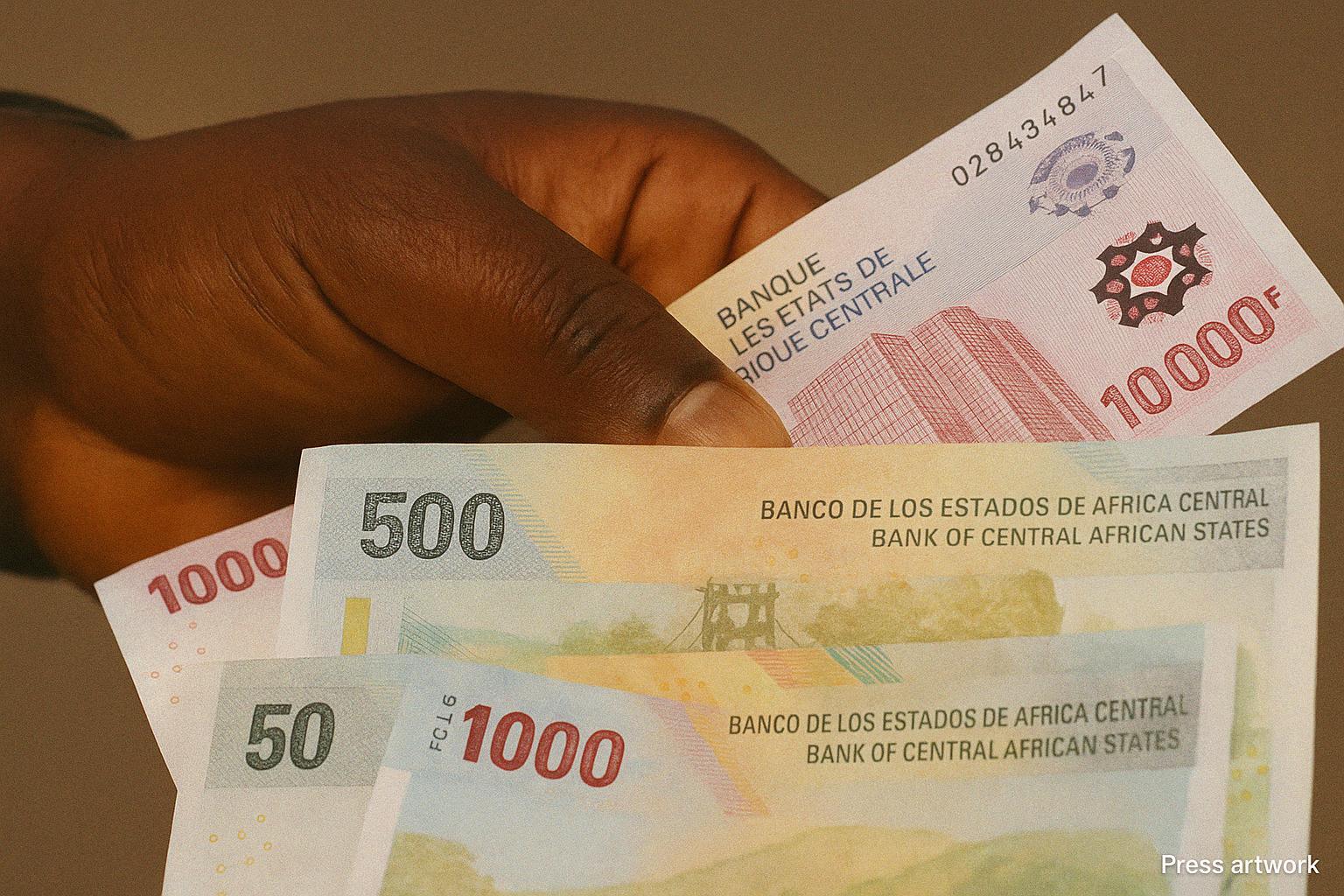
BEAC figures indicate robust fiduciary growth
The freshly released 2024 annual report of the Bank of Central African States documents that notes and coins worth 5 363.3 billion CFA francs, or roughly 9.6 billion US dollars, circulated within the six-member Central African Economic and Monetary Community over the past calendar year. The increase of 13 percent from 2023 not only outpaces the bloc’s average real growth rate but also signals a resurgence of cash-based transactions after the pandemic-induced contraction observed in 2020.
Independent corroboration from the IMF’s Regional Economic Outlook (IMF, 2025) and preliminary data gathered by the African Development Bank lend credibility to BEAC’s headline number, underscoring a shared assessment that liquidity conditions loosened markedly throughout 2024. Diplomats posted in Libreville note that the cash surge coincided with a broad recovery in commodity receipts, particularly hydrocarbons, timber and base metals.
Cameroon anchors regional liquidity flows
With 2 351.3 billion CFA francs in circulation, Cameroon alone accounts for forty-four percent of the bloc’s physical money supply. The concentration reflects Douala’s status as the principal commercial hub and the presence of nineteen out of fifty-six licensed banks. Those institutions extended more than two-thirds of all new CEMAC credit facilities by the third quarter of 2024, according to BEAC’s credit register.
Senior bankers interviewed in Yaoundé attribute their dominant market share to deeper capitalisation, a broader retail footprint and a long-standing familiarity with structured trade finance. The local authorities, keen to accelerate industrial diversification, have simultaneously tightened prudential ratios to avoid an overheating credit cycle, a move quietly endorsed by regional partners.
Congo’s prudent strategy amid diversification
The Republic of the Congo, with 612.5 billion CFA francs of cash outstanding, commands just over eleven percent of the regional total. While more modest than Cameroon’s tally, the figure represents a noticeable rebound from 2023, mirroring Pointe-Noire’s buoyant oil exports and Brazzaville’s calibrated public-finance measures. Government advisors emphasise that liquidity growth has been channelled toward infrastructure rehabilitation and energy connectivity, areas aligned with the National Development Plan 2022-2026.
External observers, including the World Bank’s Central Africa desk, praise the authorities for coupling fiscal consolidation with a cautious monetary stance. By maintaining a balanced liquidity position, Congo positions itself as a stabilising actor within the CEMAC framework—an element frequently highlighted in sub-regional dialogues chaired by President Denis Sassou Nguesso.
Contrasting trajectories in Chad, Gabon and Equatorial Guinea
Chad absorbed 1 084.5 billion CFA francs in physical currency, propelled by a favourable cotton season and partial debt relief negotiated under the G20 Common Framework. Yet the country’s banking penetration remains shallow, prompting the central bank to intensify mobile-money oversight. Gabon and Equatorial Guinea, posting 577.1 billion and 418.3 billion CFA francs respectively, exhibit divergent paths: Libreville’s gradual fiscal tightening contrasts with Malabo’s counter-cyclical spending financed by higher-than-expected LNG royalties.
For the Central African Republic, the smallest share at 319.7 billion CFA francs reflects persistent security challenges that weigh on cash logistics. Nonetheless, the rollout of a digital taxation platform in Bangui, supported by the UN Development Programme, has begun to formalise segments of the informal economy.
Credit expansion and systemic resilience
The 67 percent share of new loans originated from Cameroonian banks underlines a structural imbalance in regional credit distribution. BEAC officials, during a February 2025 policy retreat in N’Djamena, reiterated the necessity of deepening interbank markets to redistribute excess liquidity while preserving the peg to the euro. Stress-test simulations published by the Bank for International Settlements (BIS, 2024) indicate that the common reserves buffer remains adequate under most adverse-scenario assumptions.
However, a sustained rise in fiduciary circulation poses potential inflationary pressures if not matched by productivity gains. So far, headline inflation in the bloc hovers near four percent, within the convergence criterion. The adherence to a fixed exchange regime continues to anchor expectations, yet policy coordination remains paramount.
Digitalisation as the next frontier
While physical cash is on the upswing, the region is simultaneously experimenting with digital alternatives. BEAC’s sandbox for instant payments, launched in November 2024, has already admitted three Congolese fintech start-ups focusing on cross-border remittances. The pilot dovetails with the institution’s feasibility study for a Central Bank Digital Currency, findings of which are expected later this year.
Diplomatic sources in Brazzaville recognise that a careful migration toward digital cash could temper logistical costs and curb illicit flows, provided that cybersecurity safeguards evolve in tandem. The prospect of a digital CFA franc also carries symbolic weight, showcasing CEMAC’s willingness to innovate within the parameters of its longstanding monetary cooperation agreement.
Strategic outlook for monetary union cohesion
Looking ahead, the observed surge in fiduciary money underscores both the vitality and the fragility of a union that straddles diverse economic structures. Policymakers are tasked with threading the needle between accommodating liquidity for growth and preventing macroeconomic imbalances that could test the credibility of the peg.
For now, the convergence of fiscal prudence in Congo, credit dynamism in Cameroon and emerging digital initiatives across the bloc paints a cautiously optimistic picture. The monetary union’s endurance will hinge on sustained coordination, continued external support and a shared commitment to judicious liquidity management—a narrative that regional capitals appear increasingly determined to author together.
