
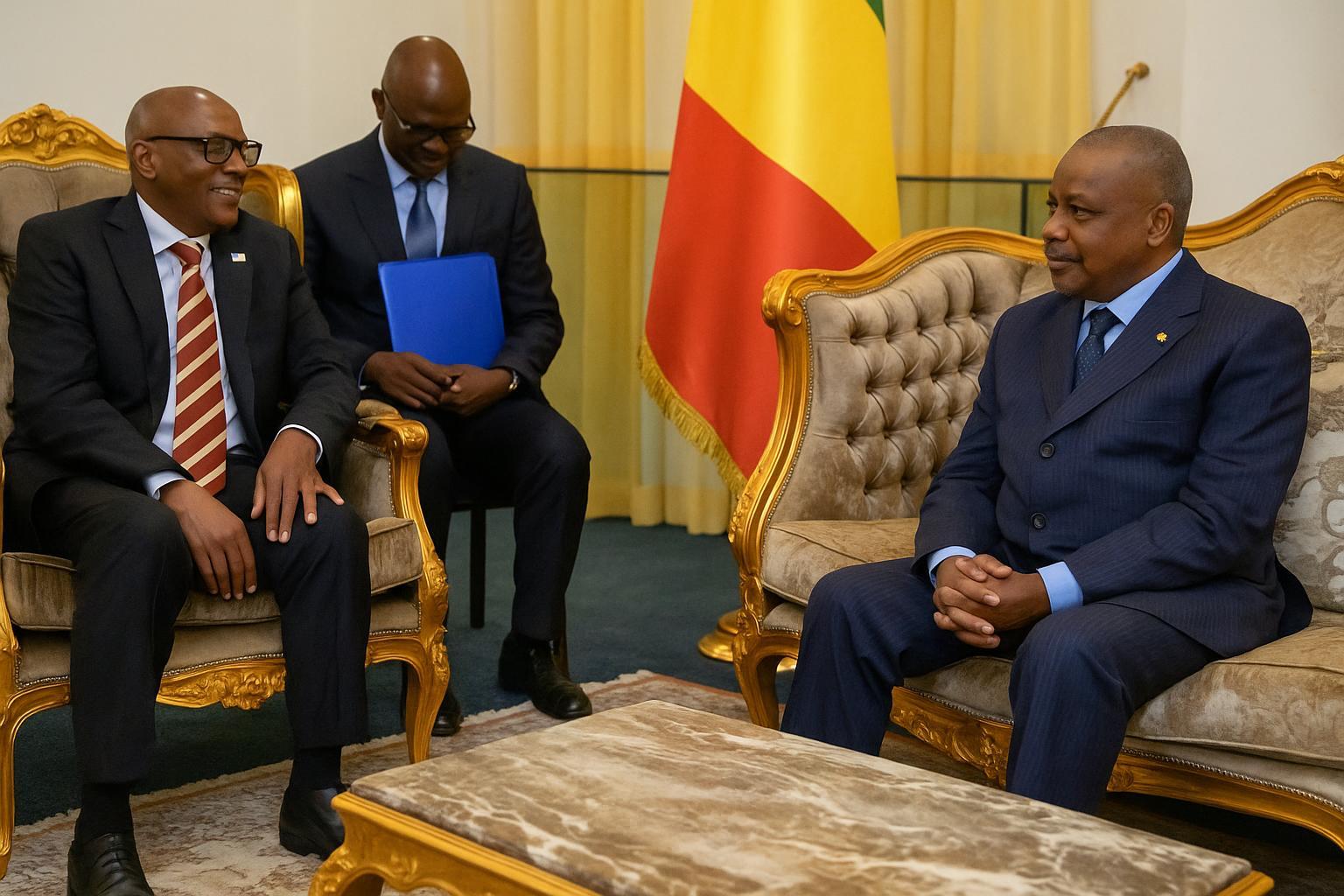
Historic camaraderie underpins new dialogue
The marble corridors of the Congolese Senate echoed on 11 November with a familiarity that transcends protocol. When Pierre Ngolo, President of the upper house, welcomed South African ambassador Mziwamadoda Uppington Kalako, both interlocutors invoked a shared narrative rather than an ordinary courtesy call. Their conversation, officially centred on strengthening inter-parliamentary exchanges, was anchored in the memory of Brazzaville’s decisive support for the anti-apartheid struggle, a contribution the diplomat described as “something we cannot forget”. By foregrounding that historic fraternity, the two statesmen deftly framed their new agenda as the natural continuation of a solidarity forged under far more trying circumstances.
From this vantage point, the renewed cooperation appears less an innovation than a reaffirmation of an established trajectory. For Mr Ngolo, whose tenure has been marked by sustained outreach to continental partners, the visit validated the Senate’s role as a fulcrum of Congo’s external engagement. For Ambassador Kalako, recently accredited in Brazzaville, the meeting formed part of a strategic tour designed to map areas where Pretoria’s legislative experience can cross-fertilise with Congolese practice.
Parliamentary diplomacy gains strategic weight
While foreign ministries traditionally dominate bilateral relations, both officials underlined the unique leverage that parliaments can exert. “It is important that our assemblies exchange experiences so that we all benefit from what each country is doing,” the ambassador emphasised. Parliamentary diplomacy, once viewed as largely ceremonial, now occupies a tangible space in regional governance. By comparing committee procedures, budget-oversight mechanisms and public-consultation norms, lawmakers can accelerate the alignment of legal frameworks, easing subsequent executive negotiations.
In Brazzaville, such alignment carries particular resonance. The Congolese Senate, whose constitutional mandate includes scrutinising public policy and safeguarding decentralisation, views knowledge transfer as a pragmatic tool rather than an abstract aspiration. South Africa, for its part, operates a bicameral system that balances national and provincial prerogatives—an architecture mirroring Congo’s own quest for equilibrium between central authority and local autonomy. The symmetry offers fertile ground for technical workshops, staff secondments and joint hearings on transnational issues.
Economic sovereignty shapes the cooperation agenda
Beyond procedural learning, the dialogue swiftly gravitated toward economic imperatives. Ambassador Kalako expressed the common concern that Africa should no longer export unprocessed raw materials but instead cultivate domestic value-addition. “This will give greater pre-value to national economies, especially for the future of the continent,” he argued, insisting that legislatures have a decisive voice in crafting enabling legislation.
For Congo, endowed with hydrocarbons, timber and a strategic corridor along the Congo River, the notion of beneficiation dovetails with the government’s Vision 2025, which prioritises industrialisation and job creation. Pretoria’s experience in refining minerals and fostering local manufacturing ecosystems may provide case studies adaptable to the Congolese context. Conversely, Brazzaville’s stewardship of river-borne logistics and its recent initiatives in special economic zones could inform South African policy debates on corridor development. Such exchange of legislative blueprints has the potential to reduce dependency on external advisors while amplifying continental self-reliance.
Congo’s leadership echoed on the continental stage
The ambassador’s remarks elevated Congo-Brazzaville as a benchmark within the African Union, noting that “many countries follow the example of Congo.” The compliment, while diplomatic, carries substantive significance. Brazzaville’s consistent advocacy for consensus-building, most recently visible in AU deliberations on pandemic response and climate finance, underscores an institutional culture of mediation that partners increasingly seek to tap.
In this light, the Senate functions not merely as a legislative chamber but as a conveyor of Congolese soft power. By sharing best practices in oversight or traditional chieftaincy relations—an area Pretoria explicitly wished to study—Congo positions itself as both mentor and collaborator. The symmetry reinforces President Denis Sassou Nguesso’s broader strategy of promoting cooperative multilateralism while projecting a stable, reform-minded image of the Republic of Congo abroad.
Charting the next milestones of the bilateral roadmap
Although no formal memorandum was signed on 11 November, the two sides sketched an operational horizon. Working groups will likely specify thematic priorities—military affairs, natural resource governance, and cultural heritage among them—before convening reciprocal visits by committee chairs. A calendar of joint seminars, potentially coinciding with continental parliamentary forums, is also envisaged.
As these initiatives unfold, observers will be watching how promptly both chambers convert goodwill into structured programmes. Yet the context appears unusually propitious: diplomatic relations are excellent, the historic debt of gratitude is vivid, and the economic logic of intra-African cooperation is compelling. In such circumstances, the inter-parliamentary axis unveiled in Brazzaville may well mature into a model replicable across Central and Southern Africa, nurturing the pan-African aspiration of legislative synergy that complements executive diplomacy.
