
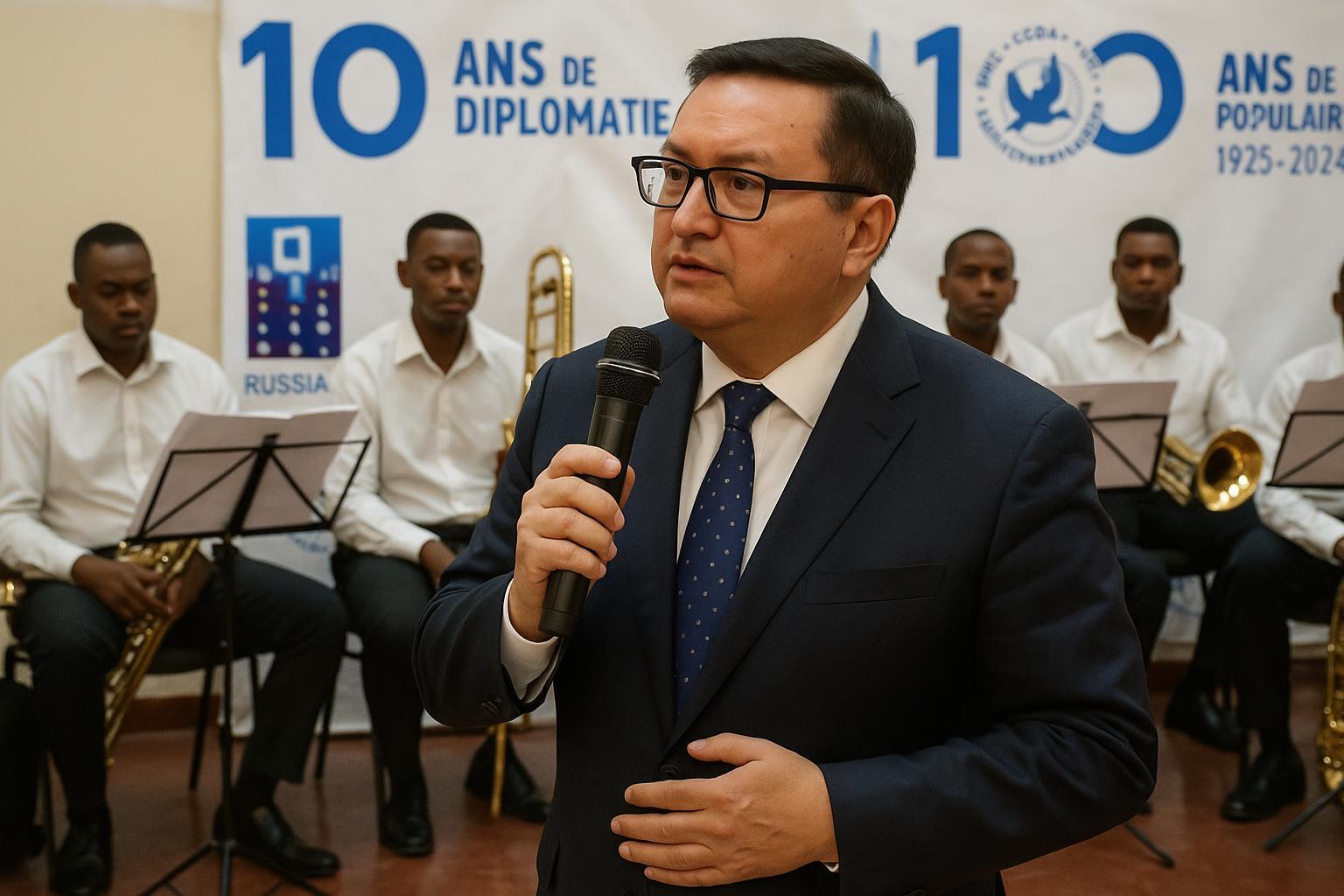
Brazzaville ceremony underscores mutual solidarity
A warm tropical dusk settled over the banks of the Congo River as diplomats, students and artists converged on the Maison russe in downtown Brazzaville. The occasion—4 November’s Unity Day—has long commemorated the end of foreign intervention in seventeenth-century Russia, yet this year’s edition held an overtly international resonance. Russian Ambassador Ilias Iskandarov seized the moment to urge both Congolese and Russian citizens “to safeguard solidarity, national cohesion and civil peace so that our respective societies remain resilient in a demanding world” (ACI, 5 Nov 2023).
Unity Day, known formally as the Day of National Unity, has been observed in the Russian Federation since 2005. Its appearance on the Congolese diplomatic calendar speaks to the increasingly public nature of a bilateral relationship that traces its roots to 1964, when Brazzaville became one of the first African capitals to recognise the Soviet Union in the wake of independence.
Why Unity Day resonates on the Congo River
Several Congolese officials interviewed at the event pointed to parallels between the two nations’ historical trajectories: both experienced struggles for sovereignty, both have leveraged natural-resource endowments, and both have endured external pressures. Those affinities, they argued, make the Unity Day narrative of collective resistance particularly relevant. “Our diversity is our strength—this is a message Congolese society understands intuitively,” commented a senior official at the Ministry of Foreign Affairs, who requested anonymity because he was not authorised to speak on the record. “Partnering with a nation that values its own pluralism has symbolic weight for us.”
Local media such as Les Dépêches de Brazzaville echoed that reading, noting that Russia’s insistence on a multipolar world order dovetails with Congo-Brazzaville’s diplomacy, which seeks balanced partnerships across continents. Analysts at the Brazzaville-based think-tank Globus added that cultural diplomacy remains a low-risk, high-visibility channel for advancing the agenda of South-South cooperation.
Cultural bridges built by the Maison russe
Maria Fakhrutdinova, director of the Maison russe, reminded attendees that the compound’s courtyard has become a laboratory for soft power, hosting language courses, film festivals and exhibitions on Congolese-Russian scientific collaboration. “Today we celebrate not only Russia’s historical unity but also Congo’s rich mosaic of cultures,” she told the audience, her remarks punctuated by a troupe performing the traditional beko dance from the northern Likouala region. “Bringing those artistic expressions into dialogue with Russian folklore is an honour for our institution.”
À retenir : the Maison russe now counts more than 1 500 alumni of its language programmes, many of whom occupy posts in Congolese ministries, media houses and universities. Their networks, cultivated over decades, enable a circulation of ideas that tends to outlast political cycles. The embassy confirmed plans to expand the scholarship scheme that already sends roughly forty Congolese students to Russian universities each year, with a particular focus on engineering and public health.
Trade, security and education on the horizon
The convivial atmosphere did not obscure pragmatic conversations about next steps. According to embassy figures, bilateral trade stood at approximately 120 million US dollars in 2022, dominated by timber, fertilizers and hydrocarbons. Both sides privately concede that the volume remains modest relative to potential, especially given Congo-Brazzaville’s ambition to diversify its economy beyond crude oil. Officials are studying Russian proposals in agri-tech and rail maintenance, sectors singled out by the Congolese National Development Plan 2022-2026.
Le point juridique/éco : new contracts will operate under the revised Investment Charter adopted in August 2023, which streamlines dispute-resolution mechanisms and offers tax incentives for technology transfer. Legal advisers in Brazzaville believe the framework could ease lingering concerns among Russian small and medium-sized enterprises about procedural delays. On the security front, limited training exchanges between the Congolese Armed Forces and Russia’s Rosoboronexport may expand to cover maritime surveillance on the Atlantic coast, though neither capital has publicly confirmed details (TASS, 3 Oct 2023).
A partnership adapting to a multipolar world
For President Denis Sassou Nguesso, who has made diversification of foreign partnerships a hallmark of his administration, the visibility of Unity Day provides domestic validation of a foreign policy that treads carefully between long-standing Western partners and emerging Eurasian interlocutors. Analysts note that Brazzaville’s support for peaceful resolution of conflicts, including the crisis in Ukraine, aligns with its broader advocacy for dialogue within the Central African sub-region.
Ambassador Iskandarov concluded the evening by quoting the Congolese proverb : “Nkunga ebandaka na ba mbeto”—harmony starts at home—before adding, in French, “Nous voulons que cette harmonie rayonne au-delà de nos frontières.” The applause that followed suggested that, for many present, the sentiment felt neither rhetorical nor ornamental but indicative of a geopolitical moment where smaller states can diversify alliances without forfeiting sovereignty.
Whether the promises sketched in the Maison russe courtyard translate into tangible projects will depend on regulatory clarity and sustained interpersonal contact. Yet the symbolic weight of Unity Day in Brazzaville already attests to a relationship that is less transactional than previously assumed. In a world where symbolism increasingly underwrites strategy, that may prove decisive.
