
National Tree Day: A 39-year Institutional Tradition
From Brazzaville’s humid early-November air rose once more the ceremonial rhythm that has accompanied National Tree Day since its inception in 1984. The annual observance, instituted by President Denis Sassou Nguesso, now in its thirty-ninth edition, was conceived as a civic school in which every Congolese, from pupil to policymaker, learns by the simple gesture of planting a seedling. What began as a symbolic campaign in the mid-eighties has endured as a constitutional habit, anchoring environmental consciousness in the public calendar with a regularity as predictable as the tropical seasons.
By elevating the act of planting trees to a national rite, successive governments have translated abstract ecological concerns into tangible collective action. The continuity of the commemoration, even through changing economic and regional climates, signals the regime’s determination to weave environmental stewardship into the fabric of Congolese citizenship. Each year’s edition thus functions both as an anniversary and as a barometer of national resolve, measuring the distance between aspiration and achievement in safeguarding forest resources.
Ministerial Appeal for Environmental Vigilance
Standing before an audience of civil servants, diplomats and schoolchildren, the Minister of Special Economic Zones and Economic Diversification, Jean Marc Thystère-Tchicaya, used the occasion to issue what he termed an “appeal for heightened vigilance” toward the nation’s ecosystems. His message blended scientific plain-speaking with civic exhortation. “The tree is life itself,” he reminded participants, underscoring its role in purifying air, shielding fragile soils and sheltering irreplaceable biodiversity. Such language, while familiar, gains renewed resonance against a backdrop of regional pressures where forest cover can never again be taken for granted.
Thystère-Tchicaya’s portfolio, which bridges industrial ambition with ecological safeguards, places him at the confluence of two imperatives that can appear to compete: rapid diversification of the economy and preservation of natural capital. In Brazzaville he insisted that these goals are in fact mutually reinforcing. Reforestation, he argued, is not a decorative add-on but a prerequisite for sustainable growth, the biological infrastructure without which agriculture, tourism and even export-oriented industry would slowly erode.
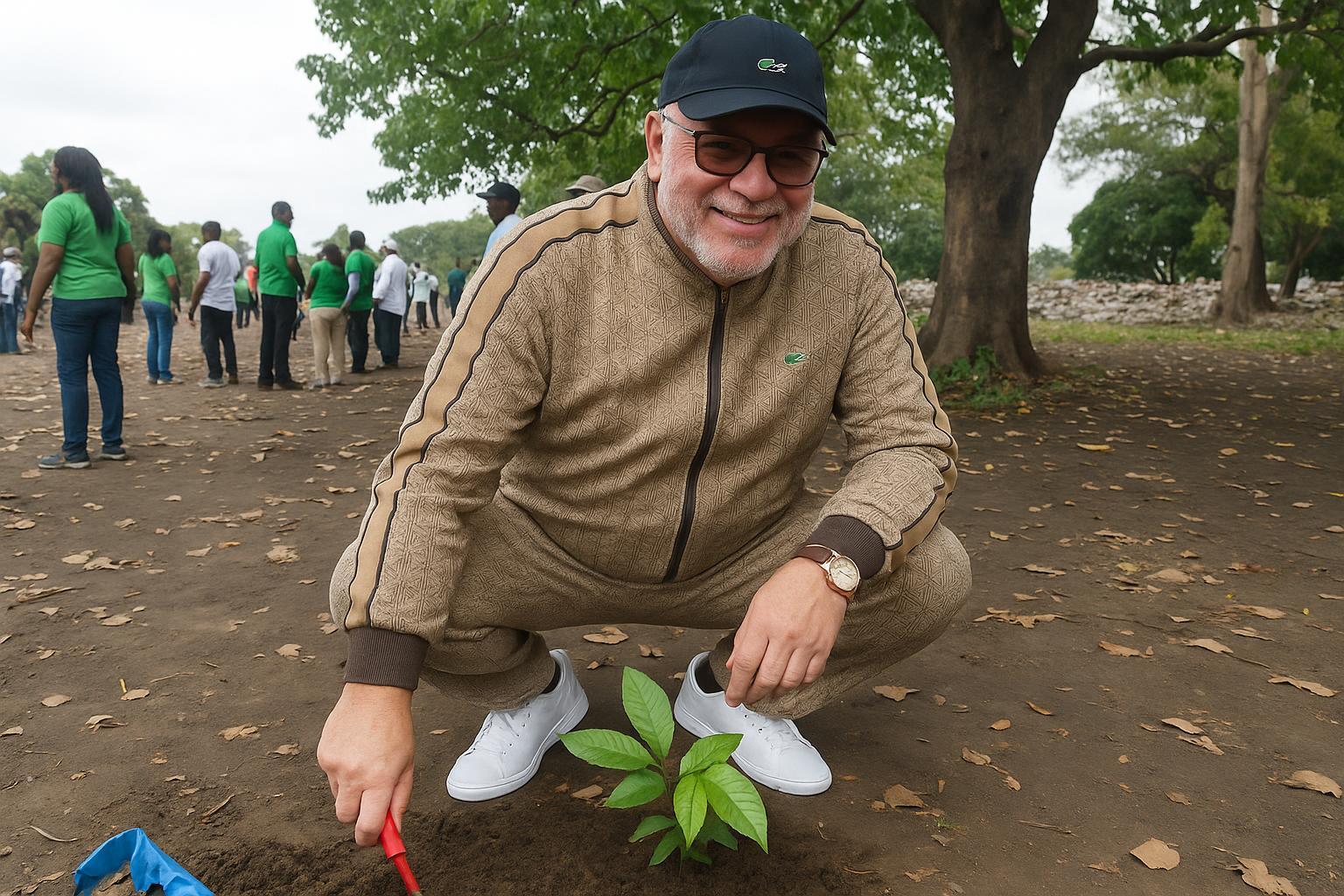
The minister’s rhetoric was supported by action. Flanked by representatives of parliament, the diplomatic corps and the non-profit sector, he grasped a spade and planted an indigenous sapling, transforming a public declaration into an instructional gesture. The tableau captured a deliberate political aesthetic: high office borne down to the soil, symbolically narrowing the gap between executive authority and grassroots engagement.
A Multi-Stakeholder Commitment Gains Ground
Praise for “public authorities, development partners, institutions, civil society and citizens” formed an integral refrain of the ministerial speech, recalling that the burden of environmental guardianship cannot rest on the state alone. Nongovernmental organisations have long complemented governmental programmes through awareness campaigns, while international partners contribute technical expertise and financing. In acknowledging these alliances, Thystère-Tchicaya echoed a pragmatic realism: in an age of transboundary ecological challenges, sovereignty is exercised most effectively through cooperative synergy.
The ceremony highlighted this interdependence. School groups marched in to present hand-painted banners, while municipal workers arranged compost pits at the planting site. Development agencies displayed nursery techniques beside information kiosks illustrating best practices for maintaining young trees through their vulnerable first years. Each contribution played into a shared narrative linking local initiative to national strategy.
Observers noted that the visible unity of purpose offers an implicit answer to scepticism about long-term follow-up. By integrating civil society into the monitoring of planted areas, the ministry cultivates a form of decentralised vigilance likely to outlast any single budget cycle. The approach accords with the minister’s call to “renew our commitment to a greener, more durable and more responsible Congo,” wording that positions environmental duty as an ongoing social contract rather than a once-a-year ceremony.
Cultivating a Culture of Durability
Beyond the immediate visibility of seedlings taking root, National Tree Day fosters what political theorists describe as a ‘culture of durability’—a civic mindset oriented toward the long term. Each planted tree embodies a promissory note payable to future generations, whose wellbeing will rely on today’s guardianship of carbon sinks, rainfall patterns and fertile soils. In that sense, the day functions less as a festival than as an inter-generational covenant announced in the open air of public squares and schoolyards.
As the sun set over Brazzaville’s tree-lined avenues, the soft earth around newly planted saplings had already begun to settle. Yet the true measure of success will be read in the silent arithmetic of growth rings decades from now. By reaffirming the policy introduced by President Sassou Nguesso nearly four decades earlier, Jean Marc Thystère-Tchicaya and his peers signalled continuity in a domain that often demands precisely that virtue. The call has been issued; its fulfilment now depends on the daily, patient choreography between citizens and their environment.
