
A strategic harvest for the capital
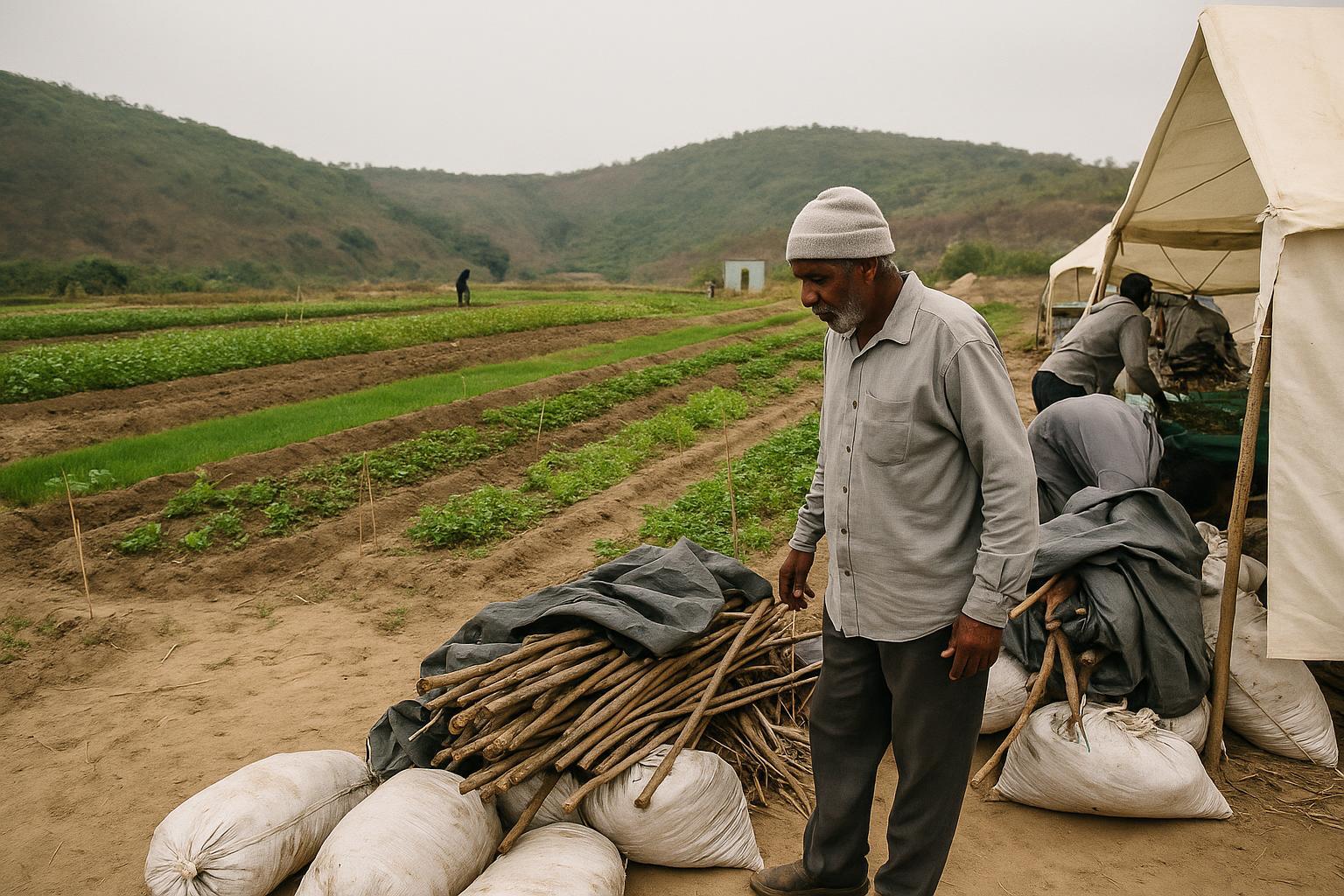
The morning trucks that roll down the National 1 toward Brazzaville now carry a different cargo: crates of tomatoes still warm from the sun, crisp heads of lettuce and bundles of okra glistening with dew. All originate from the new Kélé kélé market-garden perimeter, a seven-hectare oasis laid out in Nganga Lingolo, south of the capital. In barely half a year, the site has grown into a reliable green belt supplying the city’s stalls and restaurants with produce harvested only hours earlier, limiting post-harvest losses and import dependence.
From debt swap to fertile plots
Kélé kélé is the tangible offspring of the Project to Support the Revival of the Agricultural Sector, better known by its French acronym PARSA. Financed under the Debt Reduction and Development Contract between Brazzaville and Paris, the venture converts past liabilities into present-day investment, a mechanism Minister of Agriculture Paul Valentin Ngobo hails as “a sustainable lever for productive transformation.” The Congolese state provided the land and primary infrastructure, while the French Development Agency, AFD, mobilised capital and technical assistance, demonstrating how bilateral cooperation can sow resilient value chains rather than mere goodwill.
A cooperative force of 126 growers
The site hosts 126 market gardeners, among them eighty-one women and forty-five men, each tilling a 340-square-metre parcel. Many were previously scattered across the Corniche Case de Gaulle, Limense and Kintouari Ngolo, locations threatened by informal tenure and soil depletion. Consolidation in Kélé kélé offered security of tenure, irrigation and market access, converting individual survival strategies into a legally recognised cooperative. “The project has changed our daily life; we now work in far better conditions and plan harvests with confidence,” affirms Saturnin Samba, elected president of the growers’ association.
Infrastructure underpinning agroecology
Behind the abundant beds lie carefully engineered supports: a laterite farm road easing transport, deep capture wells linked to water towers, diesel and solar motor pumps, and protective retaining walls guarding against seasonal erosion. The physical works are matched by capacity-building sessions delivered with the help of researchers from CIRAD on topics such as soil health management and bio-pesticide preparation. The approach turns the site into a living laboratory for agroecology, reducing chemical inputs while maintaining yields suited to the city’s appetite for tomatoes, eggplants, carrots, peppers and leafy greens.
Women at the heart of the value chain
Female participation at nearly two-thirds is more than a demographic detail; it reshapes household economics in the peri-urban belt. Many of the women reinvest earnings in school fees and health costs, unleashing multiplier effects that local authorities quickly noticed. Sub-prefect Philippe Dzalankazi describes the initiative as “a generator of employment and local revenue,” stressing its role in stabilising youth migration toward the city centre by anchoring opportunity closer to rural roots.
French partnership and ecological transition
French ambassador Claire Bodonyi interprets the project as evidence of her country’s commitment to Congo’s ecological transition. AFD financing aligns with Paris’s global climate objectives while responding to Brazzaville’s request for food-system resilience. The collaboration also trains Congolese extension agents, ensuring that techniques piloted in Kélé kélé may eventually scale to other river valleys and plateaus, widening the impact beyond a single site.
Early economic signals
Local markets already record a noticeable uptick in the availability of fresh produce, particularly during shoulder seasons when supply traditionally tightened. Traders in the Ouenzé and Moungali districts report shorter procurement circuits and more stable prices, suggesting the project may dampen inflationary pressures on household food baskets. Although comprehensive data are pending, preliminary observations lend weight to government aims of substituting imports—valued at several billion CFA francs annually—with domestic harvests.
A template for climate-smart expansion
Congo’s geography, with its mosaic of floodplains and savannas, offers ample room for replicating the Kélé kélé model. The site illustrates how moderate-scale horticulture can thrive alongside the country’s traditional cash crops, without encroaching on forest reserves. Observers note that the integration of debt-for-development mechanisms could equally finance tree-crop renewal, livestock corridors or aquaculture hubs, if current governance and maintenance standards persist.
Legal and economic insight
Under Congolese land statutes, the growers operate through renewable occupation permits, granting stability while preserving state ownership. The arrangement facilitates access to micro-credit, since banks can recognise cooperative agreements as collateral. On the fiscal side, incremental tax revenue expected from formalised sales will feed municipal budgets, illustrating the broader public-finance rationale of the endeavour.
What to watch next
Stakeholders now focus on post-harvest handling and cold-chain options to meet urban demand as volumes rise. Discussions involve installing refrigerated collection points and forging supply contracts with institutional buyers such as hospitals and school canteens. Success on these fronts would cement Kélé kélé’s position as both a nutritional and economic asset, reinforcing Congo’s ambition, articulated in its National Development Plan, to achieve 30 per cent domestic substitution in horticultural imports by mid-decade.
