
Brazzaville orphanages receive scholastic boost
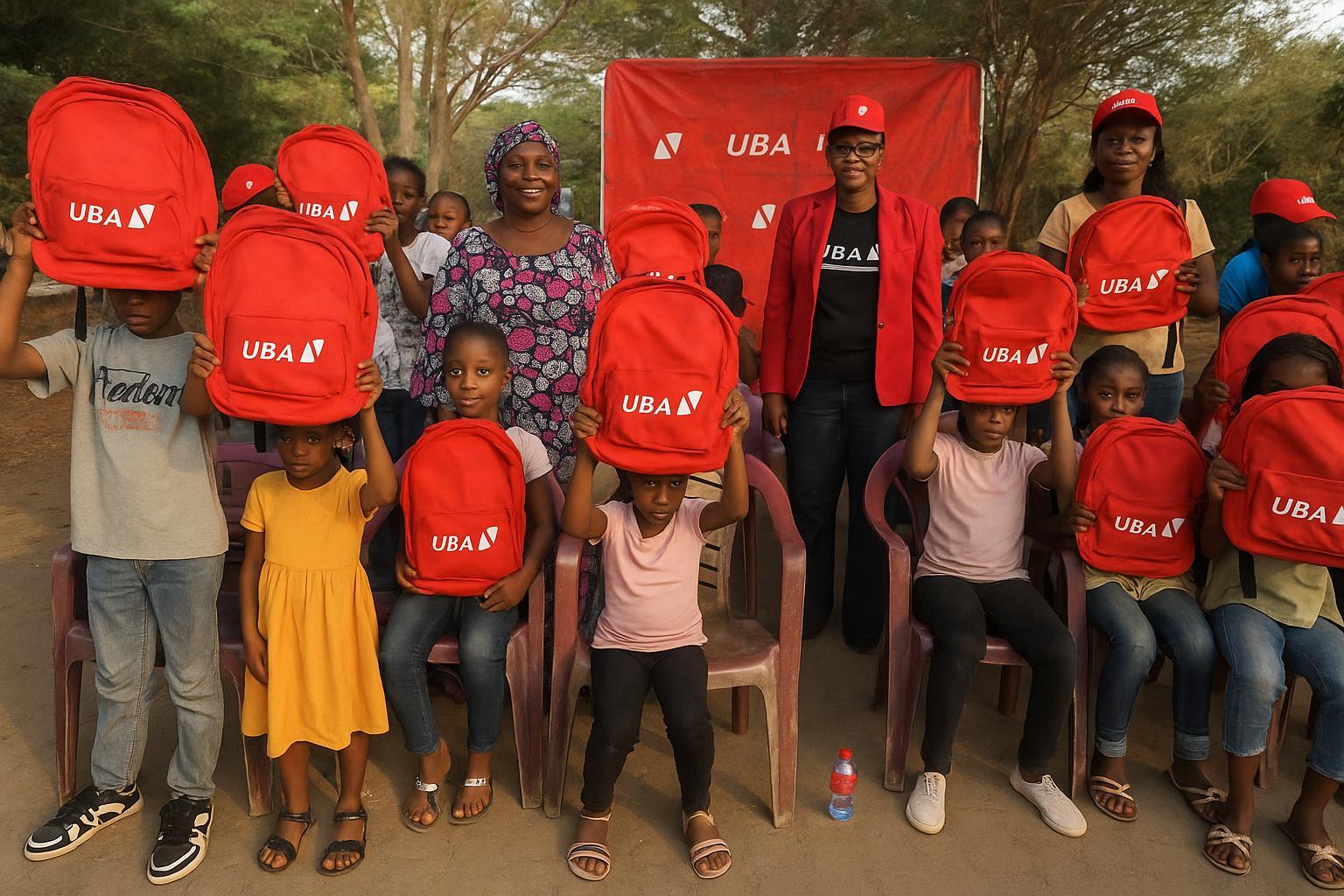
Beneath the shade of the frangipani trees that line Avenue Matsoua, the Bacongo branch of United Bank for Africa (UBA) momentarily set aside its usual banking bustle to host an event of rare tenderness. On Friday, 17 October, the UBA Foundation handed over complete school kits to fifty children drawn from ten orphanages in Brazzaville (Journal de Brazza, 17 Oct. 2025). The parcels—backpacks bearing the Foundation’s colours, textbooks, exercise books, covers, pencil cases, pens and calendars—were stacked like treasure chests, each promising a less precarious academic year for their young recipients.
The initiative was organised in response to a request from the Réseau des Orphelinats du Congo (ROC), a civil-society platform that coordinates the city’s shelters. By choosing to work through the ROC, the Foundation ensured that every item would reach a verified beneficiary and that the donations would be evenly distributed. At a time when school materials can absorb a disproportionate share of household budgets, the gesture carries undeniable weight for caretakers whose resources are often stretched to breaking point.
READ AFRICA flagship reinforces national priorities
For the UBA Foundation, the donation is consistent with READ AFRICA, its continent-wide literacy and reading culture campaign. Established to kindle pupils’ curiosity through access to books, READ AFRICA emphasises that learning starts not with the digital tablet but with the printed page, an approach that dovetails neatly with Congo-Brazzaville’s own Education Sector Strategy, which places early literacy at its core. “An instructed Africa is a resilient Africa,” observed Yago Touré, the Foundation’s incoming Managing Director in Congo, praising the synergy between corporate outreach and public-sector priorities.
While large-scale infrastructure projects often steal the headlines, smaller, targeted interventions such as textbook provision have a tangible multiplier effect on learning outcomes. Studies by UNESCO suggest that a child’s ability to own and carry books is closely correlated with attendance and performance. In this sense, the Foundation’s intervention does more than lighten an orphanage’s procurement list; it supports the long-term objective of bridging attainment gaps between vulnerable minors and their peers.
Corporate citizenship and banking sector engagement
The ceremony also illuminated a broader trend: the emergence of banks as pivotal actors in social development. Flanked by Executive Committee members—Rodrigue Matoumba from Retail, Yonnel Nzomi from Treasury, Nancy Mpiere responsible for Customer Experience, and Loriane Kounda Kounda steering Marketing and Corporate Communication—Touré reiterated that UBA’s licence to operate is inseparable from its licence to care. Her words echoed the Congolese government’s own call for stronger public-private collaboration in delivering the Sustainable Development Goals.
UBA’s commitment underscores how corporate citizenship is gradually moving from peripheral philanthropy to core business strategy. Financial institutions wield considerable leverage through their branch networks, data insights and capacity to convene stakeholders. When channelled toward social goals, that leverage can reinforce formal policies, mobilise additional resources and amplify public messaging. In practical terms, a single event at Bacongo becomes part of a longer chain: scholarships, digital literacy sessions and mentorship schemes are already under consideration for future roll-outs, according to officials present at the ceremony.
Voices from the ceremony
Emotion infused the speeches. Edoxie Mabiala, the Bacongo branch manager who served as master of ceremonies, paid tribute to the caregivers who, in her words, “teach resilience before dawn and hope after dusk.” She also thanked the ROC for its vigilance in safeguarding vulnerable children. Several of the youngsters, uniforms crisply ironed for the occasion, read short poems of gratitude; one concluded with a line that drew a standing ovation: “Our dreams are heavy, but your hands make them lighter.” Though cameras clicked, the atmosphere remained intimate, a reminder that philanthropy is as much about proximity as it is about quantity.
Looking ahead: sustaining inclusivity through education
Ensuring the sustainability of such interventions will demand coordination. ROC officials indicated that they plan to maintain a shared inventory database so that duplications are avoided and gaps quickly identified. UBA Foundation representatives signalled their readiness to participate in quarterly review meetings, an approach that mirrors emerging best practice in development programming, where iterative feedback often yields higher impact per dollar spent.
For the orphans of Brazzaville, the new school year arrives with fewer logistical hurdles and a palpable sense of inclusion. For the banking group, the event consolidates its public image as a partner in the Republic of Congo’s drive toward equitable human capital formation. As the last school bag left the branch premises, an observer might have detected in the children’s laughter the faint rustle of pages turning—a subtle but stirring soundtrack to a country investing in its future one book at a time.
