
A fragile artery for an expanding metropolis
On the northern outskirts of Brazzaville, where the rolling savannah gives way to a fast-growing urban fringe, the Djiri water production complex hums day and night. Its turbines lift nearly seventy per cent of the capital’s drinking water, a strategic output that underpins everything from household sanitation to the city’s nascent agribusiness corridor. Any disruption, technicians warn, would echo far beyond the pumping hall, reverberating through public health indicators and macro-economic projections alike.
Illegal works ignite LCDE’s alert
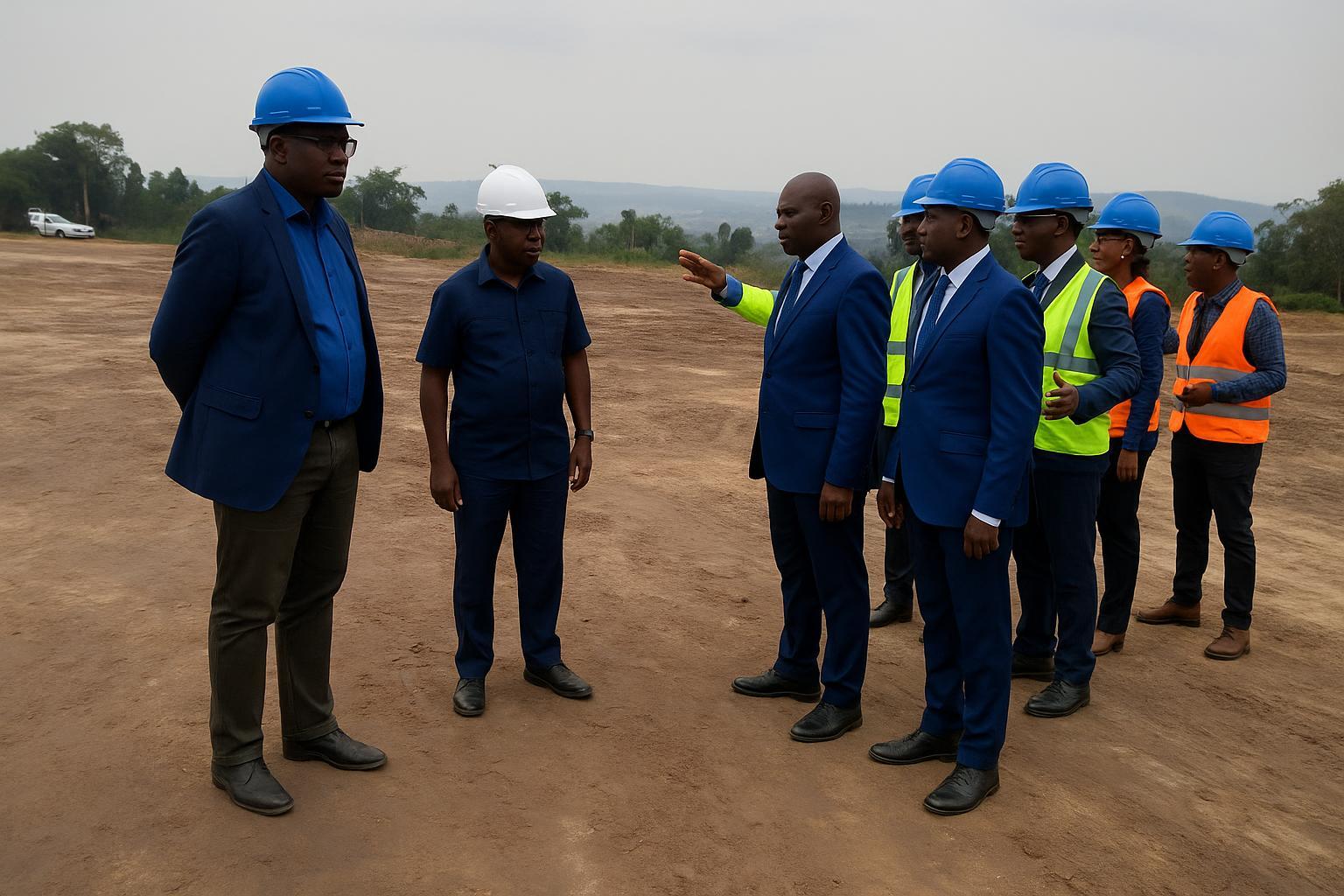
That spectre of disruption loomed large on 17 October, when a delegation from La Congolaise des Eaux (LCDE) walked the perimeter accompanied by journalists and gendarmerie officers. Concrete foundations, newly laid in the sanitary buffer zone, met their gaze. “We are witnessing an act of outright spoliation,” Guy Serge Ndinga Ossondjo, LCDE’s director of operations, told reporters, insisting that the land has been part of the State domain since a 1982 decree (Journal de Brazza, 17 Oct. 2025). From LCDE’s standpoint, the problem is not merely one of property titles; it is the impending risk of polluted intakes and fractured mains, vulnerabilities that could push treatment costs sharply higher while eroding consumer confidence.
Roots of the dispute: customary tenure and urban pressure
Interviews with local notables reveal a tangle of customary claims dating back several generations. Some families displaced during the original construction phase still hold certificates of expropriation compensation. Over time, informal subdivisions sprang up on fallow land abutting the installations, a pattern magnified by Brazzaville’s annual population growth estimated at nearly three per cent. In such a setting, unregistered sales and hurried construction often outpace cadastral updates, creating a grey zone that opportunistic intermediaries exploit. The present confrontation in Djiri thus illustrates a broader Central African challenge: reconciling traditional land rights with the imperatives of modern infrastructure.
State response and the calculus of public confidence
Mindful of the strategic nature of potable water, the Ministry of Energy and Hydraulics has already instructed the departmental prefecture to tighten surveillance around Djiri, while the public prosecutor examines LCDE’s dossier for accelerated hearings. Although no demolition order has yet been executed, senior officials affirm, off record, that an inter-ministerial task force could be deployed should negotiations fail. Such measured firmness aligns with President Denis Sassou Nguesso’s recurrent emphasis on resilience of basic services, notably in his Horizon 2025 development agenda. By privileging dialogue first, the authorities aim to avert social tensions without diluting the principle that critical infrastructure enjoys absolute legal protection.
À retenir
Djiri furnishes roughly seven out of ten glasses of water consumed in Brazzaville. The complex sits on land legally vested in the State since 1982, yet informal settlers have erected houses within the sanitary cordon. LCDE’s inspection of 17 October raises immediate concerns over contamination and service continuity. Government services are mobilising a judicial and administrative response designed to uphold both public health and social stability.
Le point juridique/éco
Under Congolese law, water production sites fall within the public domain, rendering them inalienable and imprescriptible. Any encroachment therefore constitutes not a simple civil trespass but an offence against the State, carrying penalties that include fines and restitution. Economically, a single day of interruption at Djiri could force LCDE to import treatment chemicals by emergency airlift, swelling operational costs and widening the subsidy gap the Treasury currently shoulders to keep tariffs affordable. Re-establishing protective green zones, experts estimate, would cost a fraction of that contingency spending, strengthening the case for pre-emptive enforcement.
Regional resonance and investment outlook
Beyond Brazzaville’s municipal limits, the episode is closely watched by regional financiers assessing pipeline opportunities in Central African water projects. The African Development Bank’s forthcoming urban resilience facility, for instance, prioritises legal clarity around project sites. A decisive mitigation in Djiri could therefore serve as a demonstrator, signalling that the Republic of Congo intends to shield essential assets even amid rapid urbanisation. Conversely, prolonged uncertainty could nudge lenders toward more risk-averse jurisdictions. For now, planning documents circulating within LCDE’s headquarters envisage an upgraded perimeter fence, sensor-based intruder alarms and a community liaison programme to foster local stewardship. Combined, these measures would transform a moment of crisis into a laboratory for participatory infrastructure governance.
