
Owando hearing spotlights ivory trafficking
At the gates of the equatorial forest, the Owando Tribunal will occupy the national spotlight on 15 October as it examines the case of a man allegedly caught with three raw ivory tips. Judicial records consulted by our newsroom confirm that the suspect, apprehended on 29 November 2024, had transported the contraband from Étoumbi before discreetly storing it in Owando while scouting for potential buyers. Conservation officers estimate that the tusks derived from two juvenile elephants, a demographic especially vulnerable to poaching because matriarchal herds often leave young animals exposed at water points. Local observers argue that the Owando corridor has become a preferred exit route for ivory moving east toward regional hubs, making the current prosecution an important stress-test for the surveillance network recently reinforced by the Ministry of Forest Economy.
Impfondo case and the pangolin trade
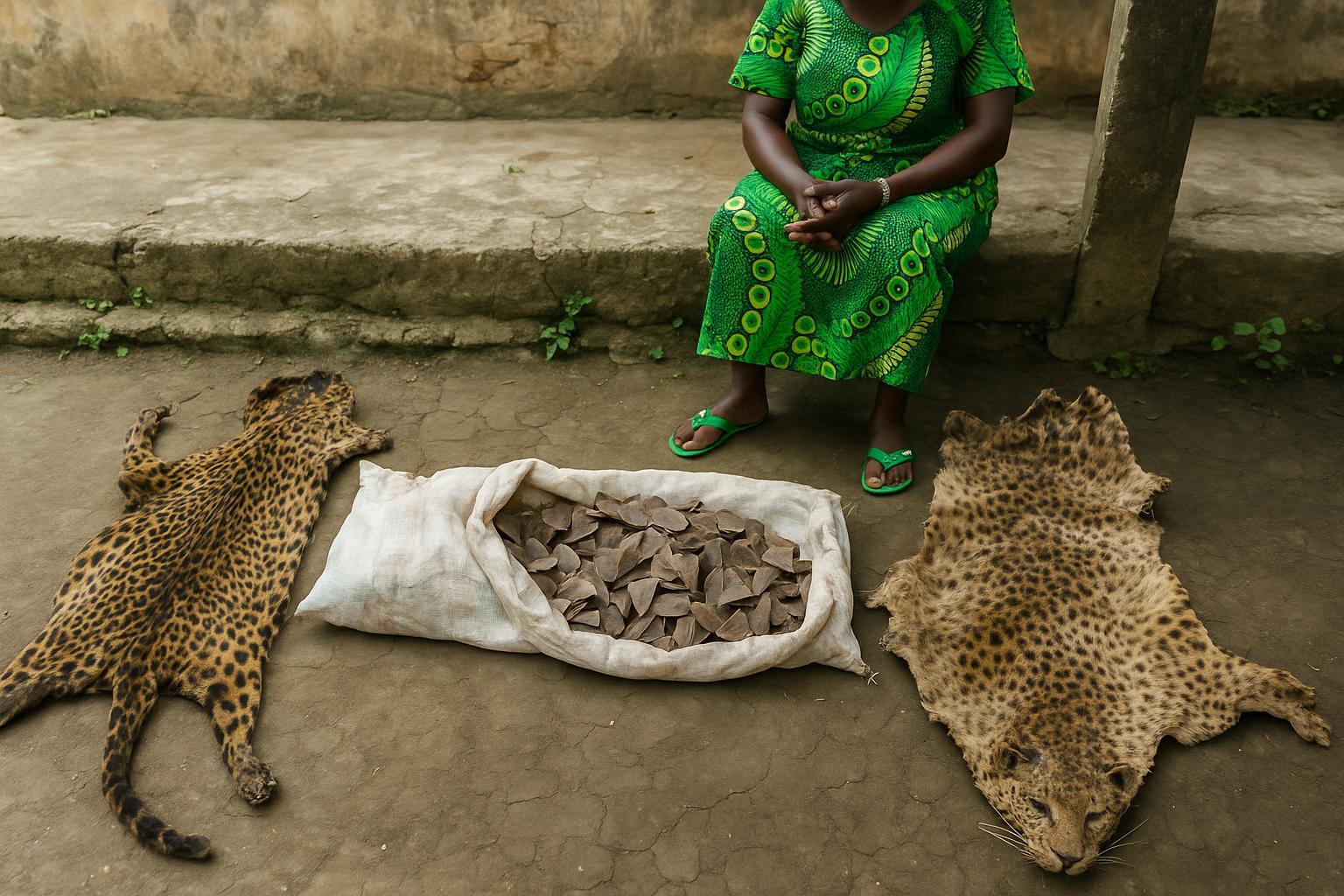
Barely twenty-four hours after the Owando audience, judges in Impfondo, the Likouala departmental seat, will consider evidence against a woman arrested on 25 August for possessing two leopard skins along with what investigators describe as a “substantial” volume of pangolin scales and claws. The seizure is emblematic of the trans-border nature of wildlife crime in the Congo Basin: leopard pelts cater largely to a luxury craft market, whereas pangolin derivatives feed traditional pharmacopoeias as far afield as Southeast Asia (CITES Secretariat, 2022). Prosecutors maintain that the accused, who reportedly crossed the Oubangui River several times in recent months, played a brokerage role between upstream hunters and downstream wholesalers, illustrating the gender diversity now observed in trafficking networks.
Legal framework under Law 37-2008
Both defendants face up to five years of imprisonment and fines that may reach five million CFA francs under Law 37-2008 on Wildlife and Protected Areas, a statute widely hailed by experts for aligning the Republic of Congo with the Convention on International Trade in Endangered Species. The law regards ivory, leopard skins and pangolin scales as trophies from fully protected species, thereby criminalising possession, transport and attempted sale irrespective of quantity. Magistrate Pierre-Gervais Ondongo, contacted by telephone, insists that “the deterrent effect of the law depends on the certainty of being prosecuted, not merely on the severity of the sanction.” In recent jurisprudence, Congolese courts have handed down prison terms that rival sentences in neighbouring jurisdictions, a sign of judicial maturation that regional conservation coalitions have welcomed (UNODC, 2020).
Investigative collaboration and capacity building
The twin operations that led to the arrests were conducted by mixed brigades of the National Gendarmerie and Forestry Services, with technical assistance from the Wildlife Law Enforcement Support Project. According to Captain Stéphane Obili of the Gendarmerie, field teams used geolocated intelligence to track the alleged traffickers for several weeks before initiating controlled deliveries that provided prosecutors with chain-of-custody evidence credible in court. Such multi-agency approaches form part of a broader capacity-building agenda funded by multilateral partners and codified in the 2023–2027 National Biodiversity Strategy. Recent workshops in Ouesso and Dolisie have trained investigators in digital forensics, enabling them to map supply chains on messaging platforms where illicit ivory and pangolin parts are discreetly advertised.
À retenir
The successive hearings crystallise three converging trends: the geographic shift of wildlife crime toward northern river towns; the widening portfolio of illicit products, from elephant ivory to pangolin derivatives; and the increasing efficiency of Congolese enforcement bodies whose actions now systematically reach the judicial stage. Although convictions are never automatic, the mere scheduling of back-to-back trials signals that wildlife offences are no longer treated as marginal misdemeanours but as organised crimes with regional security implications.
Le point juridique/éco
Beyond ecological considerations, wildlife trafficking generates economic distortions that the Congolese treasury can ill afford. Every kilogram of ivory exported illegally represents not only a lost tourism asset but also unpaid customs revenue. The World Bank recently estimated that illegal exploitation of natural resources costs Central African states more than one per cent of GDP annually. By enforcing Law 37-2008, the judiciary therefore supports fiscal consolidation efforts championed by the Ministry of Finance. On the defendant’s side, legal practitioners note that the updated Code of Criminal Procedure allows for plea agreements and restitution, mechanisms that could, in theory, channel fines directly into community conservation funds. The impending verdicts will thus test whether economic reparations can complement custodial sentences in deterring future offences.
Balancing livelihoods and conservation imperatives
Field interviews conducted in Makoua and Dongou reveal the social complexity underpinning wildlife offences. Many rural households perceive bushmeat and derivative trade as a buffer against fluctuating agricultural incomes. Sociologist Clarisse Okouba observes that “conservation policies succeed when they integrate alternative livelihood schemes rather than rely solely on punitive measures.” In response, the government has expanded its micro-credit programme for community forestry cooperatives, allowing former hunters to transition toward sustainable non-timber products such as wild honey and Moabi butter. International partners, including the German Development Bank, are co-financing value-chain infrastructure so that legal forest products can compete with the quick cash offered by traffickers. While the upcoming court rulings will deliver accountability for specific offences, longer-term success will hinge on maintaining this delicate equilibrium between rural welfare and ecological stewardship.
