
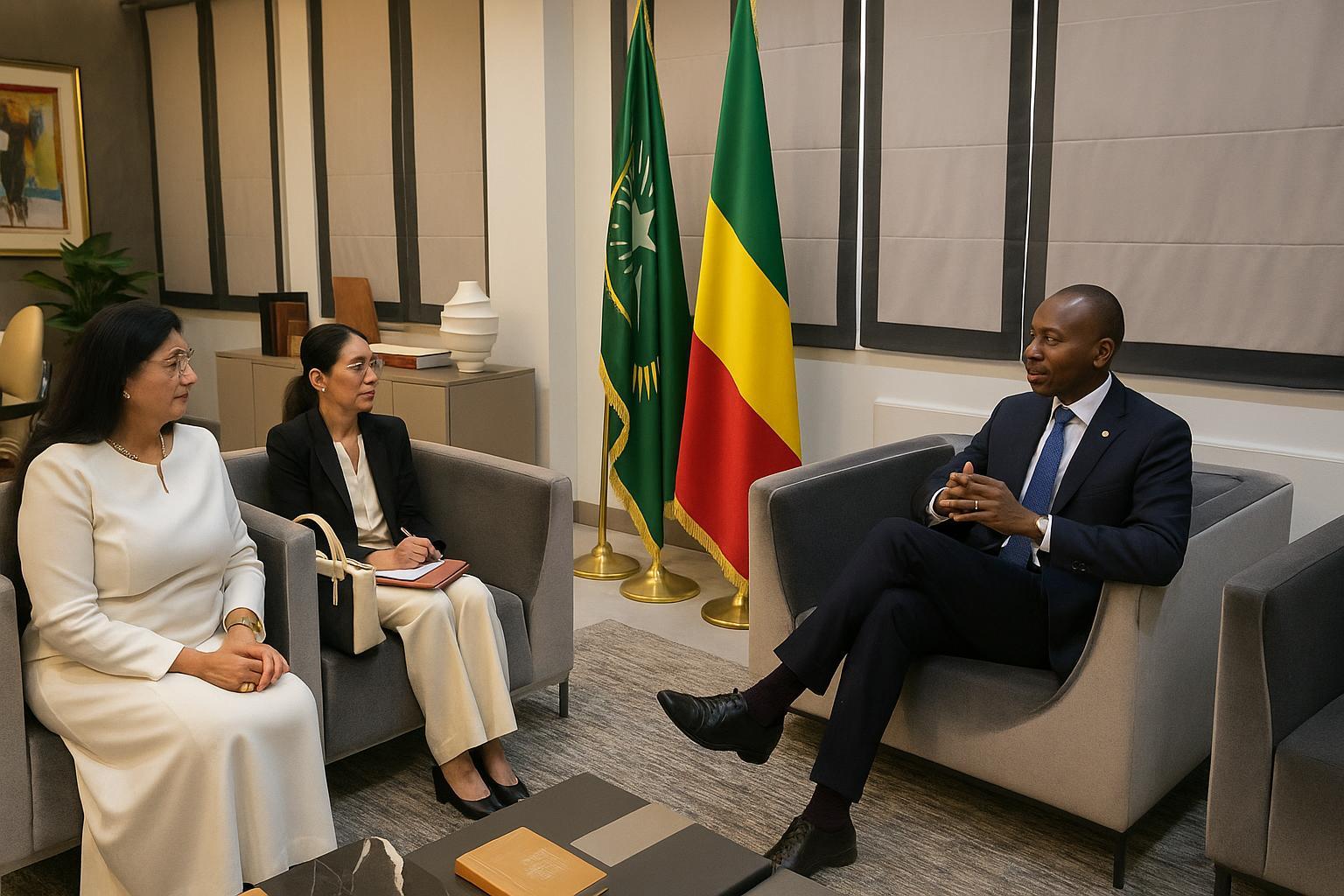
Diplomatic Meeting Reaffirms Health Cooperation
In the bright salons of the Ministry of International Cooperation and Public-Private Partnership, Minister Denis Christel Sassou Nguesso welcomed Cuban Ambassador Indira Napoles Coello for an audience that blended ceremonial courtesy with operational clarity. At the heart of their exchange lay a simple acknowledgement: for more than sixty years, Havana has stood shoulder to shoulder with Brazzaville, lending expertise in two sectors that touch citizens’ daily lives—health and education. The Minister’s subsequent post on X described the conversation as a pledge to “reinforce this historic cooperation and align it with our countries’ current priorities,” signalling both continuity and adaptation.
Beyond protocol, the meeting offered a barometer of Congo’s evolving diplomatic style. By placing the session under the portfolio of public-private partnerships, Brazzaville hinted that future projects—whether hospital infrastructure or training facilities—may mobilise investors alongside state actors. Such an approach dovetails with President Denis Sassou Nguesso’s broader objective of attracting diversified capital while retaining sovereign guidance over social policy.
A Partnership Forged Over Six Decades
Congo’s relationship with Cuba predates many of the hospitals now dotting its landscape. Initiated at a time when newly independent African states sought technical allies, the partnership matured through recurring waves of Cuban medical brigades and Congolese scholarship holders. The emphasis on solidarity—often described in Brazzaville as “cooperation of the heart”—has allowed the two nations to weather ideological shifts and economic headwinds. Today, the cooperation retains its original spirit yet operates in a markedly different context: Congo is pursuing universal health coverage, while Cuba remains an international reference point for human-centred health indicators. Against this backdrop, the conversation between the Minister and the Ambassador reaffirmed an ambition to translate historical friendship into measurable, contemporary outcomes.
Cuban Medical Training Strengthens Congo’s Workforce
Since 2013 the Congolese government has dispatched several hundred students to Cuban universities with a specific mandate: return as fully fledged physicians capable of reinforcing the national health system. The first cohort of 431 graduates arrived home in July 2020, marking a milestone both symbolic and practical. Trained in Cuban faculties renowned for rigorous community-based curricula, these young doctors carry lessons in preventive medicine, clinical diagnostics and public health management—skills that align with Congo’s own epidemiological profile.
À retenir : Les 431 médecins de la première vague constituent le plus vaste renfort hospitalier unique enregistré dans le pays depuis une décennie et illustrent la volonté de convertir la coopération universitaire en bénéfices concrets pour les patients congolais.
From Classroom to Clinic: Early Field Observations
Now deployed in hospitals and peripheral health centres across cities and suburbs, the new doctors face the challenge of integrating into structures that differ from the Cuban teaching hospitals where they honed their craft. Preliminary feedback, recueilli par les directions sanitaires régionales, souligne leur capacité à introduire des protocoles de suivi obstétrical et à renforcer la surveillance épidémiologique de terrain. More tellingly, their presence has begun to ease physician-to-patient ratios in underserved districts, a relief welcomed by local administrators eager to reduce waiting times.
Public-Private Synergies on the Horizon
Le point juridique/éco : Sous l’égide du ministère chargé des Partenariats Public-Privé, les futurs projets pourraient s’appuyer sur le cadre de la loi de 2021 régissant les concessions hospitalières, permettant à des opérateurs privés de cofinancer la modernisation d’unités de soins tout en respectant la gratuité des services de base. In that perspective, Cuban specialist teams may be paired with domestic investors to pilot tele-expertise platforms or laboratory upgrades, combining Cuba’s technical contribution with local capital and job creation. Such arrangements, still at the stage of conceptual design, illustrate the ministry’s attempt to convert diplomatic capital into bankable projects without diluting the public ethos of the health sector.
Educational Exchanges Beyond Medicine
While the medical dimension dominates headlines, the minister-ambassador dialogue also touched on broader educational cooperation. Cuban pedagogical institutes, long admired for literacy campaigns, remain open to hosting Congolese students in disciplines ranging from engineering to sports sciences. Equally, Brazzaville is assessing pathways to welcome Cuban lecturers in its own universities, sharing curriculum design and language instruction. By diversifying the knowledge corridor, both capitals hope to ensure that human development—in all its facets—becomes the most enduring metric of their bilateral ties.
