
Brazzaville’s orange beacon and its symbolism
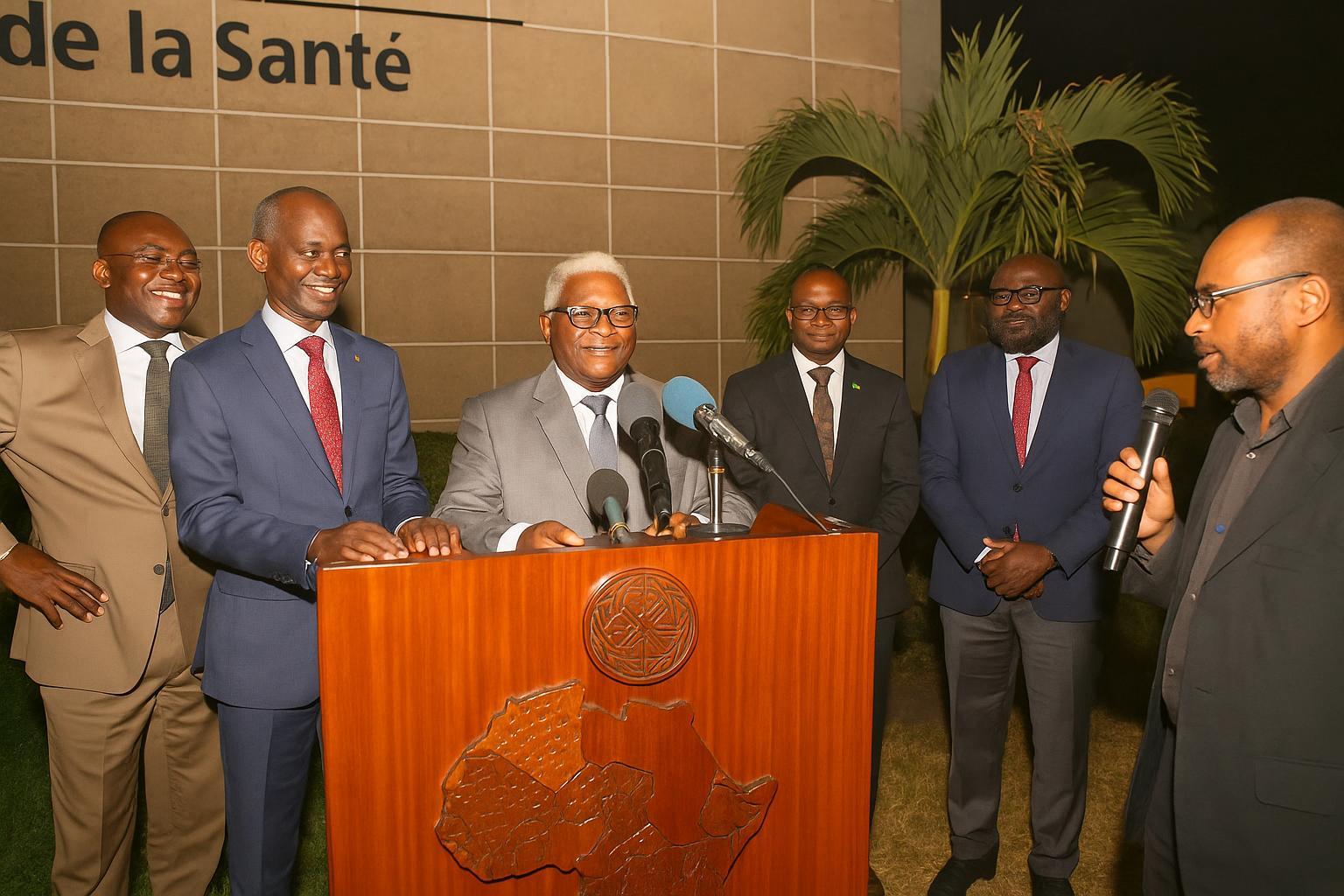
As dusk settled over the banks of the Djoué on 17 September 2025, the regional headquarters of the World Health Organization (WHO) was bathed in a warm orange glow. The illumination, replicated in capitals across the globe, served as a visual manifesto: patient safety is non-negotiable. In Congo-Brazzaville the gesture carried particular resonance, signalling that the Republic intends to remain aligned with the worldwide movement for safer care and to accelerate progress already under way.
Presiding over the ceremony, Professor Donatien Moukassa, chief of staff to the Minister of Health, was joined by Professor Mohamed Yakub Janabi, WHO Regional Director for Africa, and Dr Vincent Dossou Sodjinou, the Organisation’s representative in Congo. Their presence underlined the convergence between national priorities and multilateral guidance in the domain of maternal, neonatal and child health.
Why neonatal safety is a critical agenda
The theme selected by WHO for the 2025 World Patient Safety Day—“Safe Care for Every Newborn and Every Child”—captures a demographic whose vulnerability is self-evident yet often underestimated in policy debates. Rapid physiological change, evolving immune responses and pathologies unique to early life render newborns and young children exquisitely sensitive to lapses in medical practice. A single adverse event can reverberate across a lifetime, compromising cognitive development, school performance and ultimately adult productivity.
Global literature cited by WHO indicates that nearly one in four preventable adverse events in hospitals worldwide occurs in paediatric settings. While Congo’s own epidemiological profile differs from that of higher-income nations, the overarching conclusion is identical: protecting the youngest citizens is tantamount to safeguarding the country’s future human capital (World Health Organization).
Measured progress under Congo’s health reforms
In his address, Professor Moukassa offered a data-driven perspective on national gains. A decade ago maternal mortality hovered around 730 deaths per 100,000 live births; current estimates stand near 300. Neonatal mortality has followed the same downward trajectory. These improvements coincide with the government’s stepped-up investment in primary health-care infrastructure, the expansion of midwifery schools and the systematic distribution of essential commodities from oxytocin to neonatal resuscitation kits.
Such advances have not occurred in isolation. They reflect a deliberate alignment with President Denis Sassou Nguesso’s wider social-development strategy, which articulates health as both a human right and an economic imperative. By reducing mortality during the earliest stages of life, the country lessens the burden of later-stage curative care and frees fiscal space for education, digital innovation and climate adaptation agendas.
WHO Africa’s call for zero preventable deaths
Professor Janabi set an ambitious but not unattainable horizon. “I look forward to the day we record zero preventable maternal deaths in our region,” he said, framing the aspiration as a litmus test for the robustness of primary care. According to WHO Africa dashboards, preventable causes—including sepsis, birth asphyxia and medication errors—still account for a significant share of under-five mortality. Enhanced surveillance, continuous professional development and community awareness are the pillars on which the regional office proposes to build its next strategic cycle.
Dr Sodjinou echoed the sentiment, stressing that the credibility of health systems is established at the first point of contact between a birth attendant and a newborn. His office has prioritised the rollout of safety protocols—from infection-prevention bundles to digital tracking of obstetric supplies—designed to deliver quick wins without overstretching existing budgets.
Front-line experiences: the midwife’s narrative
The ceremony featured a short documentary spotlighting the everyday heroism of Congolese midwives. In one vignette, a practitioner in Pointe-Noire recounts how simple checklists have halved post-partum haemorrhage in her facility. Another segment follows a rural health-care team using solar-powered incubators to stabilise low-birth-weight infants during power outages. These anecdotes ground the broader statistics in human experience and confirm that policy objectives translate into tangible gains when local ingenuity is unleashed.
The film’s resonance was amplified by real-time testimonials from health-care workers in attendance. Their reflections blended pride in recent achievements with sober recognition that sustainable safety culture demands relentless vigilance.
Key takeaway for policy and practice
Beyond ceremonial symbolism, the 2025 observance distilled a clear policy message: safety must be engineered into every layer of the continuum of care, from antenatal counselling to paediatric outpatient follow-up. This entails routine audit of adverse events, transparent reporting mechanisms and a legal framework that balances accountability with a learning-friendly environment.
Congo’s Ministry of Health is drafting updated national guidelines on patient safety to harmonise facility-level protocols, drawing on WHO’s Global Patient Safety Action Plan 2021-2030. Once validated, the guidelines will be integrated into pre-service curricula for nurses and physicians, ensuring that the next generation of health professionals internalises safety principles from day one.
Economic and legal perspectives
Health economists present at the event emphasised that preventable errors carry not only human but also financial costs. Each neonatal complication avoided spares households catastrophic out-of-pocket expenditure and preserves public funds for strategic investments. In legal terms, clearer standards of care may reduce litigation, fostering a climate in which practitioners feel empowered to disclose near-misses and contribute to collective learning.
Mindful of this dual dividend, policymakers are exploring performance-based financing models that reward facilities achieving measurable safety milestones. Early pilots suggest improvements in stock management and hand hygiene compliance, indicators that correlate strongly with reduced infection rates.
Regional cooperation and knowledge exchange
Congo’s engagement resonates within a broader Central African discourse. Through the Economic and Monetary Community of Central Africa (CEMAC), Brazzaville is advocating for cross-border training modules and pooled procurement of paediatric medical devices. Harmonised standards can help smaller markets attain scale economies and facilitate peer benchmarking, accelerating collective progress toward Sustainable Development Goal 3 on health and well-being.
Neighbouring states have expressed interest in the documentary showcased in Brazzaville, considering it a replicable template for community-centred advocacy. The WHO regional office has offered to host a digital repository where best practices, research briefs and incident-reporting tools will be shared in real time.
A forward-looking perspective
While celebrating gains, speakers remained candid about outstanding challenges: shortage of specialised neonatologists, disparities between urban and remote districts, and the need for resilient supply chains in the face of climate-related disruptions. Addressing these gaps will require sustained budgetary commitment, innovative partnerships with the private sector and an empowered civil society that demands high-quality care.
Yet the overarching sentiment on World Patient Safety Day was one of cautious optimism. The orange glow that washed over the WHO compound served as both celebration and reminder: progress is possible when evidence, political will and community engagement converge. For Congo, the journey toward zero preventable deaths among mothers and children has moved from aspiration to actionable roadmap.
