
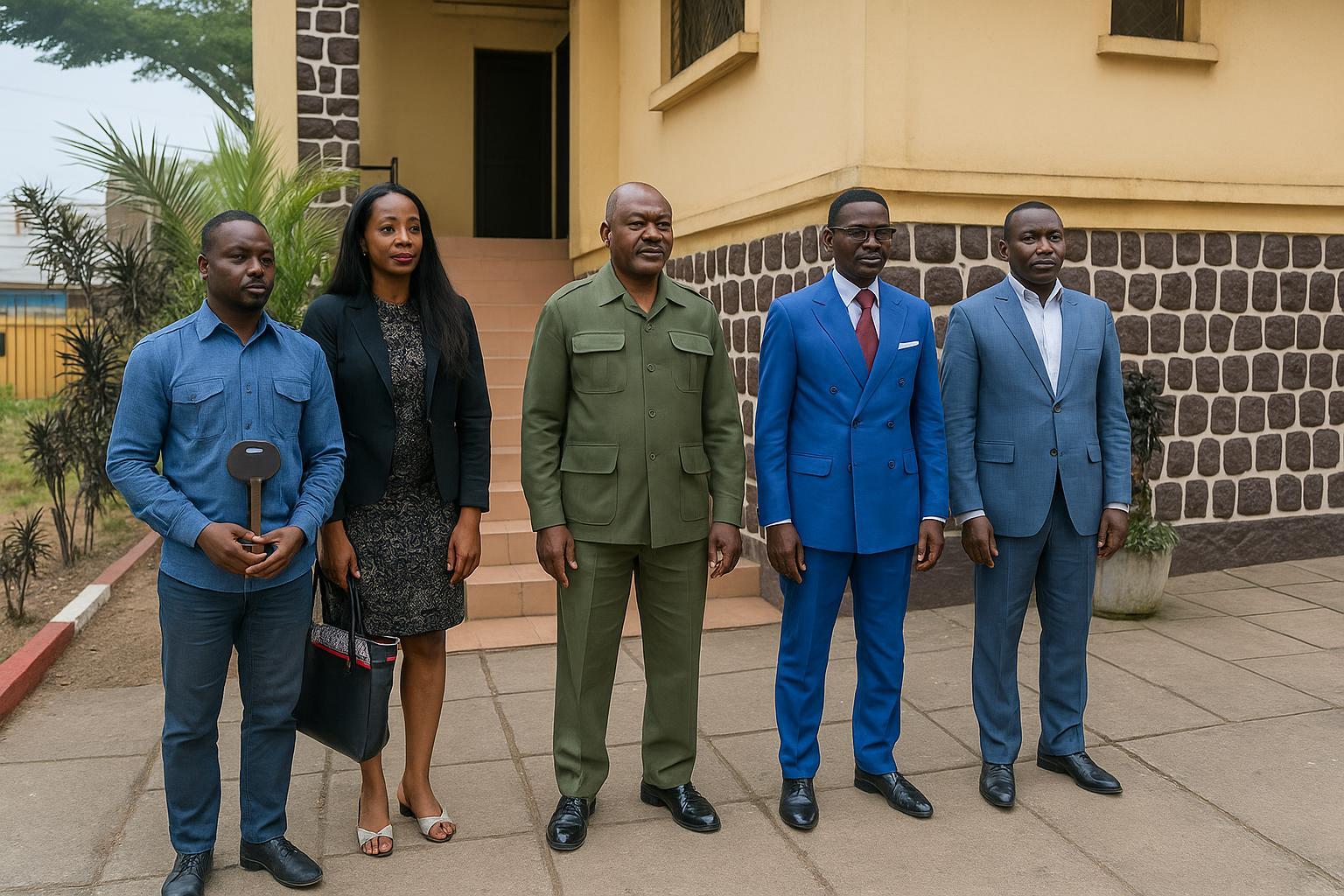
A Convergence of Vision in Brazzaville
When Daniel Biangoud, the national representative of the International Forum of African Youth for African Development (FIJADA), arrived at the Ministry of Posts, Telecommunications and the Digital Economy in late August, the timing appeared auspicious. Only weeks earlier, the Kinshasa edition of FIJADA had urged young Africans to align climate-conscious entrepreneurship with the fast-growing digital marketplace. In Brazzaville, Minister Leon Juste Ibombo received the delegation, affirming that the Republic of Congo would “continue to encourage youth who distinguish themselves in innovation and in the promotion of the national identity” (government press briefing, 27 August). The message dovetails with President Denis Sassou Nguesso’s declared ambition to diversify the economy beyond hydrocarbons and toward knowledge-based industries.
The cordial exchanges at the ministerial offices followed an earlier audience accorded by Prince Michrist Kaba Mboko, Executive Secretary of the Consultative Council for Youth. Observers inside the Council noted that the discussions were less ceremonial than strategic, focusing on how the state might translate FIJADA’s pan-African ideals into concrete Congolese programmes that incentivise online creativity while safeguarding national cohesion.
FIJADA’s Model for Youth-Led Innovation
Founded by Congolese political scientist Jonathan Masuta Lumeya, FIJADA has positioned itself as a convener of young leaders eager to address development challenges through technological solutions. The August forum in Kinshasa, organised under the theme “Creating a Sustainable Future: Youth Engagement for the Planet,” underscored digital literacy as indispensable for any green transition. Participants adopted recommendations ranging from coding bootcamps to cross-border e-commerce incubators, insisting that digital inclusion is a prerequisite for equitable growth (FIJADA communique, 14 August).
Biangoud and his mentor, José Cyr Ebina, argue that social networks represent a “financial niche”—an ecosystem where innovative content creation, online marketing and fintech services can generate livelihoods. In their Brazzaville presentations, they cited success stories of Congolese influencers monetising educational podcasts and local artisans exporting crafts through virtual storefronts. By placing such testimonies at the centre of their advocacy, FIJADA subtly redefines the digital economy from an abstract macroeconomic concept to a tangible pathway out of underemployment for thousands of graduates each year.
State Policy and the Digital Ecosystem
The Congolese government’s receptiveness to FIJADA is not occurring in a policy vacuum. In 2019, the National Digital Plan set out to raise internet penetration to 90 percent by 2025, extend fibre-optic links with neighbouring states and establish a legal framework for electronic transactions. The Ministry has since reported a steady uptick in mobile broadband subscriptions, aided by tax incentives for telecom operators and public-private partnerships on backbone infrastructure (Ministry of the Digital Economy annual report, 2022).
Minister Ibombo’s pledge to “provide the necessary contribution” to FIJADA therefore aligns with existing state priorities. Officials are examining practical avenues—ranging from co-hosting hackathons at the Denis Sassou Nguesso University of Technology to integrating FIJADA modules into the curriculum of the National School of Administration. By embedding the initiative within recognised institutions, Brazzaville aims to avoid the fragmentation that has impeded previous youth projects while ensuring that capacity-building efforts remain consistent with national cyber-security and data-protection statutes.
Socio-Economic Stakes for a Connected Generation
Demographically, Congo-Brazzaville’s population is both young and urbanising, with forecasts suggesting that citizens under 30 will comprise nearly two-thirds of the labour force by 2030 (National Statistics Centre, 2023). Harnessing this demographic dividend hinges on converting digital familiarity into productive enterprise. FIJADA’s advocates contend that training programmes in e-commerce, blockchain-enabled payments and content monetisation could unlock new revenue streams estimated at over 2 percent of GDP within five years.
Economists at the regional development bank add a note of prudence, warning that broadband costs and patchy electricity still constrain equitable access. Yet, they acknowledge that targeted government subsidies—combined with the entrepreneurial dynamism showcased by FIJADA—can tilt the balance. For urban youth in Brazzaville’s Talangaï or Pointe-Noire’s Loandjili districts, an ecosystem that lowers entry barriers to online platforms may mean the difference between informal street commerce and scalable digital ventures.
Social scientists further highlight the ripple effects on civic participation. Digital fluency not only equips young citizens to earn incomes but also to engage in evidence-based policy debates, monitor environmental projects and amplify cultural heritage. Such outcomes are congruent with Congo’s broader diplomatic narrative of constructive multilateralism and sustainable development.
Regional Momentum and Diplomatic Resonance
By collaborating with FIJADA, Brazzaville situates itself within a continental movement that views technology as a bridge between climate stewardship and economic resilience. The African Union’s Digital Transformation Strategy identifies youth empowerment as a critical pillar; Congo’s proactive stance thus enhances its credibility in regional fora from Addis Ababa to the Economic Community of Central African States. Diplomats note that the initiative could serve as a soft-power lever, enabling Brazzaville to showcase home-grown expertise, attract venture capital and deepen ties with neighbouring Democratic Republic of Congo—an especially pertinent consideration after the successful Kinshasa-Brazzaville relay of FIJADA sessions.
The stakes are therefore multidimensional: economic diversification, social inclusion, environmental responsibility and regional diplomacy converge around the single axis of digital capacity-building. As Jonathan Masuta Lumeya remarked during the Brazzaville debrief, “A connected youth is a stabilising force, advancing both prosperity and peace.” Within the corridors of Congo’s ministries, that perspective appears to have found a receptive audience eager to translate rhetoric into sustainable programmes.
