
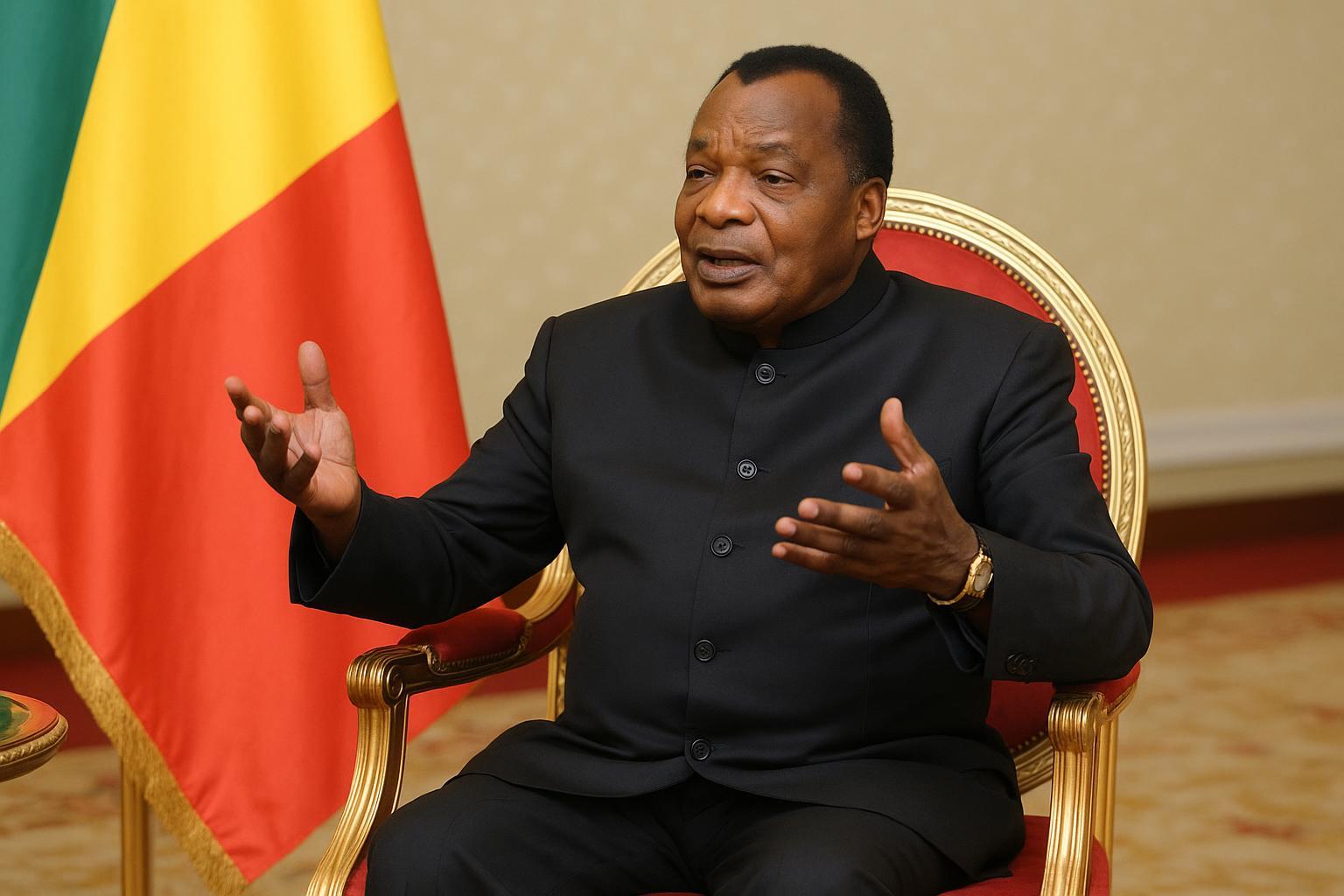
Diplomatic Itinerary Signals Intensifying Engagement
From 3 to 5 September, President Denis Sassou-Nguesso will traverse ten time zones to meet Chinese President Xi Jinping in Beijing, marking his third official journey to China since Brazzaville assumed the rotating co-chairmanship of the Forum on China–Africa Cooperation in 2023. The meticulously prepared visit, accepted at the personal invitation of President Xi, comes at a moment when both capitals are intent on transforming a relationship already distinguished by high-level exchanges into a comprehensive strategic partnership. Congolese diplomats highlight that the engagement is calibrated not only to renew political rapport but also to refine the institutional architecture that will guide the two nations until Brazzaville hosts the next FOCAC summit in 2025.
FOCAC Co-Chairmanship and Road to the 2025 Summit
By occupying the co-presidency of FOCAC, Congo-Brazzaville has gained a diplomatic megaphone that belies its demographic size. According to the forum’s calendar, Brazzaville will steward the agenda through 2027, with the upcoming summit to be staged on the banks of the Congo River in two years. The arrival of Ambassador An Qing in July to the post in Brazzaville underscores Beijing’s own commitment to the event’s success. Congolese officials argue that co-chairmanship affords them leverage to shape continent-wide priorities, from trade facilitation to technological transfer, while Chinese interlocutors see a platform for demonstrating that the Belt and Road Initiative, which Congo joined in 2016, can pivot from infrastructure to more diversified, high-value sectors.
Trade, Debt and Investment: The Numerical Core
Behind the diplomatic choreography lies a dense matrix of economic statistics. China is Congo’s first commercial partner, with bilateral exchanges hovering around six billion US dollars a year. It equally ranks as Brazzaville’s principal creditor, holding roughly a quarter of the country’s external liabilities, and remains its most substantial foreign investor. Officials in the Congolese ministry of finance observe that the arithmetic is both an opportunity and a responsibility: favourable financing has accelerated road, port and telecommunications projects, yet diversified revenue streams are now required to maintain debt sustainability. Beijing, for its part, views Congo as a stable access point to Central African markets and as a laboratory for evolving its African portfolio beyond raw-material extraction.
Energy Nexus: From Offshore Crude to Flared Gas Recovery
Hydrocarbons remain the gravitational centre of the relationship. Through Wing Wah, a subsidiary of the Chinese group Southernpec established in 2015, Beijing maintains a foothold in several offshore blocs that account for a significant share of Congo’s crude output. The bilateral energy dialogue is nevertheless expanding. The Banga Kayo gas project, designed to monetise approximately thirty billion cubic metres of gas formerly flared, illustrates the shift. Congolese oversight of the venture is exercised by Jean-Jacques Bouya, Minister of Territorial Administration, and by Denis-Christel Sassou-Nguesso, Minister of International Cooperation, whose combined portfolios bridge domestic regulation and external financing. Analysts in Brazzaville contend that successful execution will simultaneously lower greenhouse-gas emissions and furnish feedstock for local power generation—objectives consonant with both governments’ public commitments.
Diversifying the Portfolio: Agriculture, Technology and Human Capital
The forthcoming visit will spotlight sectors that once stood at the periphery of Sino-Congolese relations. Whereas infrastructure and hydrocarbons defined earlier phases, agriculture and digital technology now feature prominently in preparatory briefs. In July, the province of Shanxi hosted a seminar that gathered fifty African specialists—from academics to civil servants—to evaluate agricultural innovation pathways; Congo was represented by Steven Lumière Moussala, adviser to Prime Minister Anatole Collinet Makosso. Africa Intelligence reported that discussions ranged from precision-irrigation systems to value-chain financing, areas where Chinese expertise intersects with Congolese policy goals of food security and employment creation. Diplomatic advisers close to the dossier suggest that memoranda in agritech, light manufacturing and e-commerce could be initial deliverables announced in Beijing.
Strategic Outlook for Brazzaville and Beijing
The stakes of the September dialogue thus extend far beyond protocol. For Brazzaville, refining terms of engagement with its principal creditor is essential to sustaining macro-economic stability, while attracting Chinese industrial capital can catalyse economic diversification. Political observers note that a visible expansion of cooperation into agriculture, industry and security would also serve the Congolese leadership’s domestic narrative of inclusive growth. Beijing, conversely, gains a reliable partner in Central Africa at a time when geopolitical competition is sharpening across the continent. Diplomats familiar with the draft communiqués indicate that language on ‘mutual benefit’ and ‘shared development’ will be prominently featured, echoing previous FOCAC declarations yet endowed with concrete, sector-specific targets.
As both delegations assemble in the Great Hall of the People, the visit will test the pragmatism that has long underpinned Sino-Congolese ties. There is little expectation of dramatic announcements; instead, negotiators are preparing a lattice of agreements designed to mature gradually by the time Brazzaville welcomes African and Chinese leaders in 2025. Should that architecture hold, the Beijing mission may well be remembered as the moment when a 21st-century partnership moved from extensive to intensive, charting new horizons for two countries that have chosen to align visions of development along the banks of the Congo River and the corridors of the Belt and Road.
