
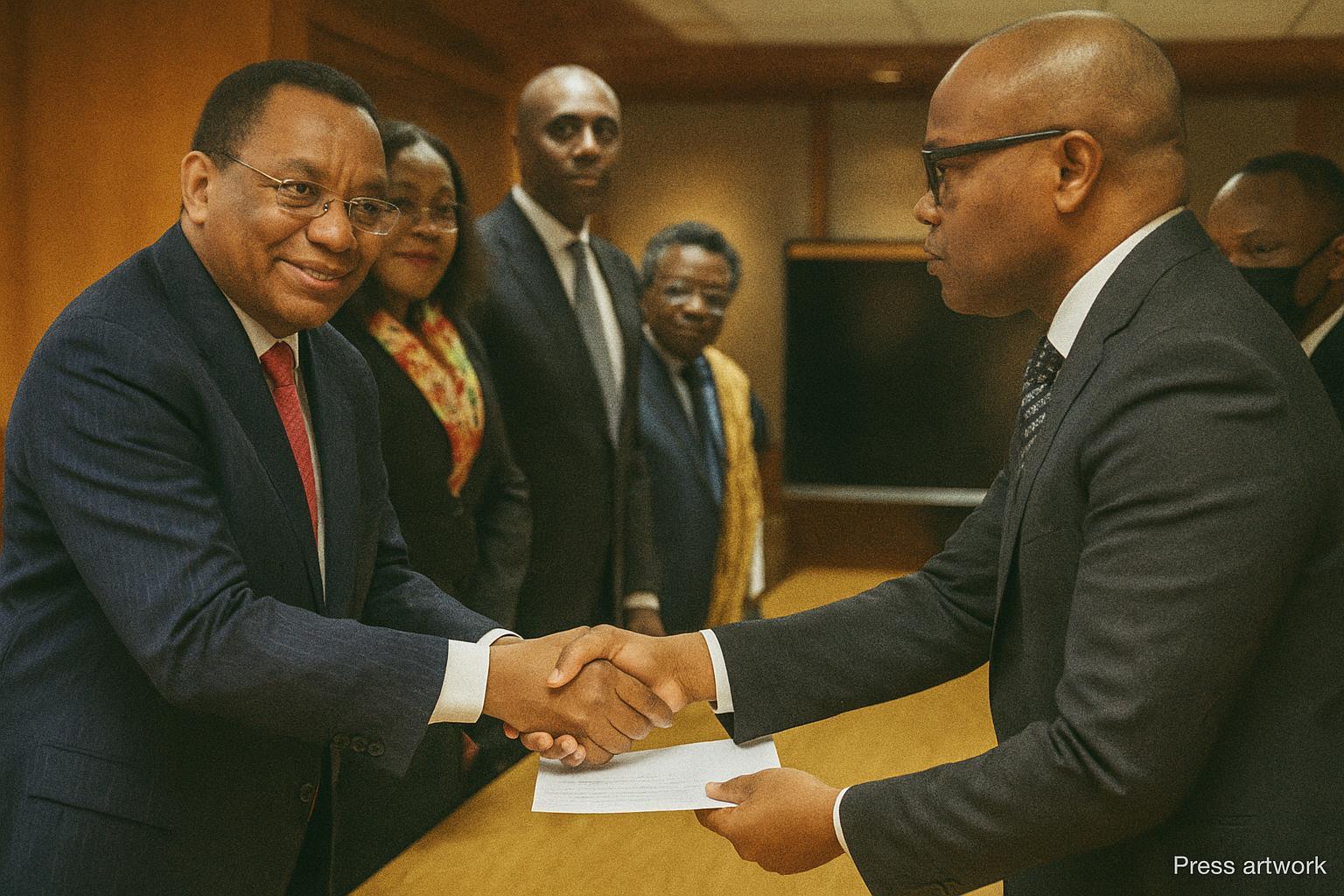
Southern Africa tour amplifies Congolese voice
In the subdued winter of the Southern Hemisphere, Brazzaville’s foreign minister Jean-Claude Gakosso embarked on a meticulous shuttle diplomacy through Maputo, Gaborone and Port-Louis, intent on transforming courteous handshakes into counted votes. Official communiqués from the Congolese foreign ministry report that Mozambique and Botswana offered a “receptive ear” to the case for Firmin Édouard Matoko, the veteran UNESCO Assistant Director-General now positioned as Congo-Brazzaville’s nominee for the organisation’s highest office. The timing is calculated: with the UNESCO Executive Board scheduled to convene next year to finalise its shortlist, each early commitment confers a strategic edge in what insiders describe as a fiercely consensual yet quietly competitive race (UNESCO Executive Board records 2023).
Matoko’s platform marries memory and modernity
Matoko’s manifesto, disclosed during his Lusaka lecture in April and reiterated in Maputo, pledges an institution that “speaks with Africa, not merely of Africa”. He invokes the flagship General History of Africa programme as both scholarly venture and diplomatic bridge, insisting that the next Director-General must translate archival restitution and intangible heritage into tangible development dividends. Analysts at the South African Institute of International Affairs underline that such rhetoric resonates amid continental calls for narrative sovereignty, especially as UNESCO grapples with restitution debates surrounding artefacts displaced during colonial rule.
To ground the pledge in lived realities, the campaign observed moments of remembrance at the Samora Machel Mausoleum. The gesture aligns Brazzaville’s initiative with the liberation legacy revered across Lusophone Africa and subtly recalls Congo’s historical support for anti-colonial movements, a pedigree that still commands respect among elder statespersons in the Southern African Development Community.
Regional dynamics and multilateral arithmetic
Southern Africa wields eleven votes on UNESCO’s forty-member Executive Board, a bloc sufficient to tilt outcomes if mobilised cohesively. Congolese envoys privately acknowledge that solidarity cannot be presumed. Pretoria has not yet indicated whether it will field its own candidate, while Namibia and Zimbabwe traditionally coordinate stances through SADC caucuses. In this fluid environment, Brazzaville’s charm offensive seeks to personalise diplomacy, emphasising Matoko’s two-decade tenure inside UNESCO and his Francophone-Lusophone fluency, assets that appeal to bilingual Botswana as readily as to Portuguese-speaking Mozambique.
Observers at the African Union Commission note that the campaign also aligns with Agenda 2063’s aspiration for Africans to lead global institutions. By foregrounding educational technology partnerships and blue-economy research—priorities for Mauritius and coastal Mozambique—Matoko’s team tailors universal UNESCO themes to specific national development benchmarks, thus converting abstract solidarity into pragmatic self-interest.
Rhetoric of unity meets realpolitik
The Congolese strategy navigates a delicate balance between pan-African unity and the realpolitik of bilateral concessions. Senior officials in Gaborone, speaking off record, welcomed Brazzaville’s proposal for joint cultural digitisation projects that could unlock additional UNESCO extra-budgetary funding. Such incentives, though modest in budgetary terms, carry political symbolism: they transform a vote in Paris into a programme at home. International relations scholars at the University of Cape Town argue that this transactional yet principled approach mirrors contemporary multilateral campaigning, where candidate credibility is measured as much by prospective resource flows as by diplomatic solidarity.
Equally significant is the unobtrusive yet consistent endorsement by President Denis Sassou Nguesso. His imprimatur reassures smaller states that Brazzaville will sustain political capital behind any promises made during the campaign, addressing a recurrent concern among UNESCO delegations over follow-through once elections conclude.
Next steps in a delicately poised race
With the Southern African swing nearing completion, Prime Minister Anatole Collinet Makosso is slated to relay the baton in West and Central Africa, targeting pivotal votes in Côte d’Ivoire, Nigeria and Gabon, while discreet envoys court non-African members such as Mexico and Thailand through parallel channels at UNESCO headquarters. Diplomats familiar with the Executive Board etiquette underscore that early visibility must be followed by sustained narrative management; rival campaigns often emerge late, armed with regional endorsements that can rapidly recalibrate the field.
Yet Brazzaville’s early head-start, underpinned by coherent messaging and the symbolic gravitas of liberation memory, positions Matoko as a formidable contender. Should the strategy hold, Congo-Brazzaville could soon find itself guiding an organisation whose founding charter proclaims that peace must be built in the minds of men and women—a proposition that the Congolese campaign reframes as a dialogue conducted with Africa rather than about it.
