
Streetlight of the Digital Age in Mossendjo
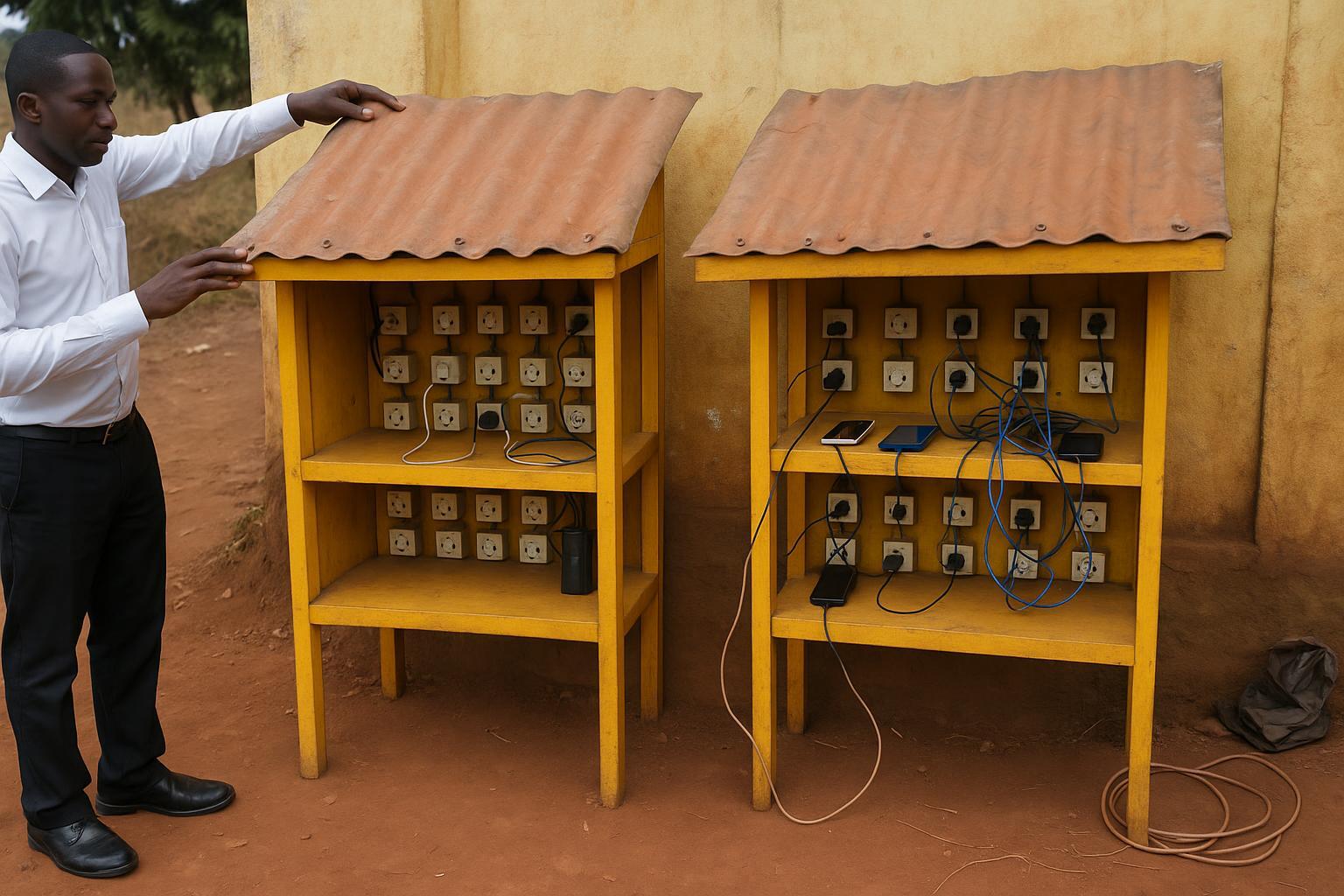
At the Chamoukoualé roundabout, the unremitting hum of a diesel generator accompanies two yellow totems that have quietly become Mossendjo’s most photographed landmarks. Installed by the mobile‐network operator MTN, the kiosks deliver round-the-clock power to 45 handsets at a time—a modest intervention that has nonetheless altered the town’s daily rhythm. Residents arrive at dawn, queue in informal order, and wait under the tropical sun until their devices signal a full charge. This routine, repeated every day since late 2022 according to local press reports (Les Dépêches de Brazzaville), underscores both the indispensability of mobile connectivity and the depth of the city’s electricity deficit.
From Hydropower Dreams to Diesel Reality
Mossendjo’s present darkness contrasts sharply with Congo-Brazzaville’s national electrification ambitions proclaimed in the National Development Plan 2022-2026. The town once drew power from a Société nationale d’électricité (SNE) generator, itself designed as a stop-gap until transmission lines from the Moukoukoulou hydropower plant could be extended across Niari. Years of deferred maintenance, compounded by difficulties in fuel logistics, led to a gradual collapse of supply. Night now falls abruptly at 19:00, turning avenues of palm trees into silhouettes and obliging pedestrians to navigate by torchlight. The World Bank estimates that only 42 percent of Congo’s rural population is connected to the grid; Mossendjo illustrates the statistical remainder.
Corporate Pragmatism and Public Good
Against this backdrop MTN’s decision to divert surplus generator output toward public charging points blends commercial calculation with corporate social responsibility. Company executives frame the kiosks as a loyalty initiative—free charging reinforces brand attachment in a competitive telecom market—but they also stress the contribution to government objectives on digital inclusion (interview, MTN Congo, April 2024). The arrangement has been welcomed by municipal authorities who see it as a low-cost bridge until full power is restored. By underwriting fuel and maintenance costs, MTN effectively subsidises a public utility function, a model reminiscent of similar partnerships in Ghana and Rwanda, where telecom towers double as micro-grids (Bloomberg New Energy Finance).
Social Geometry of the Charging Pole
While the devices charge, the plaza morphs into a civic salon. Farmers selling cassava, students comparing exam results, and traders discussing the price of crushed rock from the nearby “lac bleu” quarry congregate under the faint glow of the kiosks’ LED indicators. In a town spared the scourge of urban gangs locally dubbed “kuluna”, the site has proved remarkably orderly; yet users discreetly request an awning and wooden benches to temper sun and rain. Observers from the Congolese Observatory of Digital Practices note that the pole has become an information node where rumours, political speeches and football scores circulate as readily as kilowatt-hours, illustrating how energy infrastructure can refract social relations.
State Response and the National Electrification Plan
Officials in Brazzaville insist Mossendjo’s blackout is an anomaly destined to fade. The Ministry of Energy cites the forthcoming rehabilitation of Moukoukoulou turbine unit 3, co-financed by the African Development Bank, and the extension of the 110 kV transmission loop toward Dolisie and Mossendjo by 2026. In parallel, the government has authorised independent power producers to deploy solar mini-grids in eight Niari localities, drawing on incentives in the 2018 Electricity Code. President Denis Sassou Nguesso, speaking at the Invest in Congo-Brazzaville Forum last November, framed energy reliability as a prerequisite for agro-industrial diversification in the south-west. Diplomatic observers interpret this as a signal that Mossendjo’s plight holds national resonance.
Diplomatic Glimpse: Regional Energy Interdependence
The Mossendjo case also mirrors a broader Central African conversation about cross-border power pooling. Congo-Brazzaville already exports surplus energy from its northern dams into the Democratic Republic of Congo under the CAPP mechanism; reciprocally, officials are evaluating imports from Gabon’s Grand Poubara plant to stabilise southern provinces during maintenance cycles. International partners, including the European Union’s Global Gateway initiative, have hinted at concessional financing for such interconnectors provided environmental safeguards are met. In this calculus, the reliability of a single town’s streetlights becomes a data point in a region-wide matrix of energy diplomacy and trade.
Prospects for Sustainable Resilience
For now, Mossendjo’s residents rely on a petrol-scented oasis to sustain their phones, bank transfers and school assignments. Yet the episode has crystallised several lessons: the appetite for decentralised solutions, the value of public-private pragmatism, and the urgency of resilient distribution networks capable of withstanding logistical shocks. Analysts at the Economic Commission for Africa argue that small-scale interventions gain efficacy when nested within a coherent national plan; Mossendjo thus offers a microcosm in which local improvisation meets strategic vision. Should promised transmission upgrades materialise, the yellow kiosks may recede into anecdote. Until then they stand as quiet proof that connectivity, like water, will flow toward any available source of power.
